
DCS vs PLC: Differences, Strengths and How to Choose
On this page
Distributed Control Systems (DCS) and Programmable Logic Controllers (PLCs) both control industrial processes, and modern versions overlap more than ever. Yet they grew from different needs and still have different strengths. Choosing the right one for a project affects engineering effort, operator experience, reliability and lifetime cost.
Where each came from
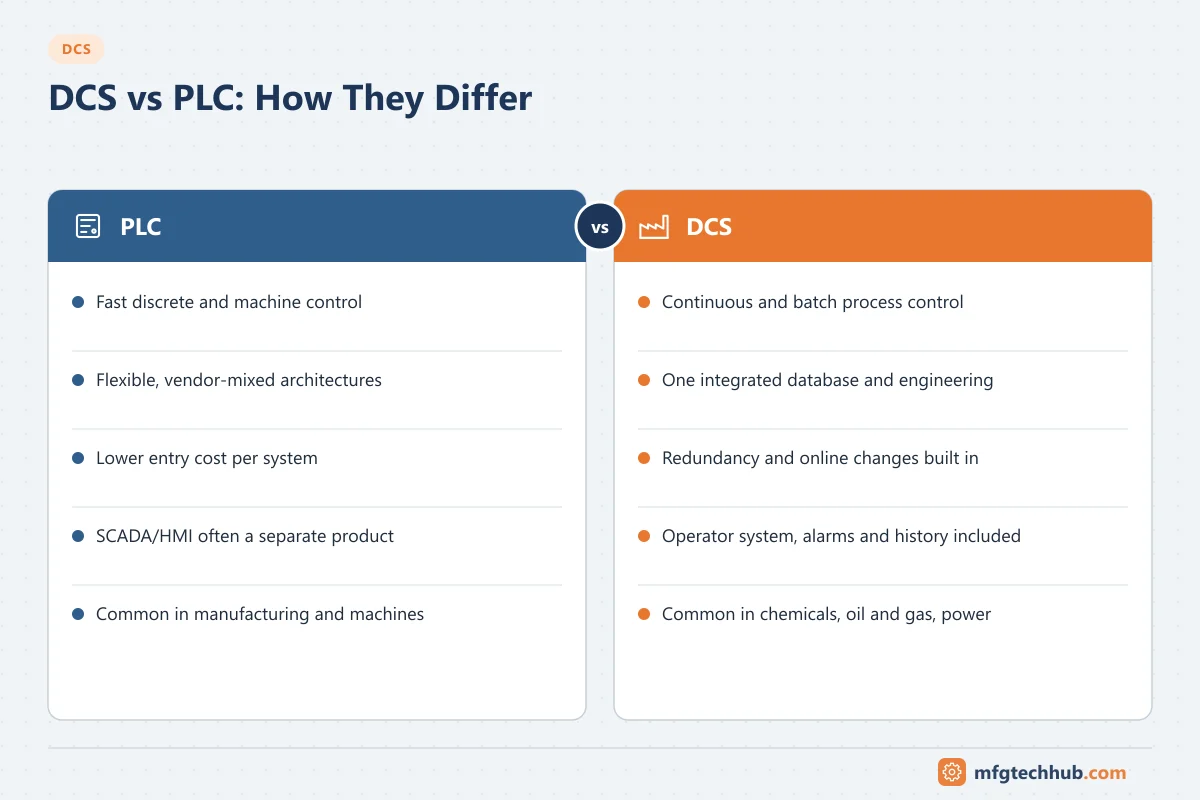
- PLCs were developed in the late 1960s to replace relay logic in automotive manufacturing. They excel at fast discrete logic, sequencing and machine control.
- DCS emerged in the 1970s to replace panels of single-loop analog controllers in continuous process plants such as refineries and chemical plants. They were designed around process control, operator interfaces and plant-wide integration from the start.
Architecture compared
| Aspect | PLC-based system | DCS |
|---|---|---|
| Core focus | Discrete logic, sequences, machine control | Continuous and batch process control |
| Scan / execution | Very fast cycle times for logic and motion | Deterministic execution optimized for regulatory control |
| System database | Often separate for PLC, HMI and historian, linked by tags | One integrated database shared by controllers, displays, alarms and history |
| Engineering | Programming in IEC 61131-3 languages, often per controller | Configuration using function block libraries and templates across the whole plant |
| HMI | Separate SCADA/HMI software from the same or another vendor | Integrated operator stations, faceplates and alarm management |
| Redundancy | Available, often as an option | Standard for controllers, networks, power and I/O |
| Scale | Single machines up to large systems | Typically medium to very large plants, thousands of I/O |
| Online changes | Supported, varies by platform | Designed for online configuration and upgrades without plant shutdown |
| Cost | Lower entry cost | Higher entry cost; lower engineering cost per loop on large projects |
Strengths of PLCs
- Speed: fast scan times suit high-speed machines, packaging, motion and interlocks.
- Flexibility and cost: lower entry cost and a wide choice of hardware sizes.
- Discrete and motion control: strong support for sequences, drives, servo and robotics.
- Skills availability: many technicians and integrators know PLC programming.
Strengths of DCS
- Integrated environment: one database for control, displays, alarms and history, reducing engineering inconsistency.
- Process control libraries: proven PID, cascade, ratio, advanced control and batch functions.
- High availability: redundancy and online change are standard.
- Alarm management and operator tools: built around ISA-18.2 practices and plant-wide operation.
- Lifecycle support: vendors provide long-term migration paths for large plants.
The overlap: PACs and hybrid systems
Modern PLCs, sometimes called programmable automation controllers (PACs), handle PID control, redundancy and large I/O counts. Many DCS vendors offer smaller systems and strong discrete control. As a result:
- Large process plants often use a DCS for the process and PLCs for packaged equipment (compressors, water treatment, packaging lines), integrated via industrial networks.
- Mid-sized plants may use PLCs with SCADA for the whole process.
- Hybrid systems combine a PLC-style controller with DCS-style integrated engineering.
How to choose
Ask these questions:
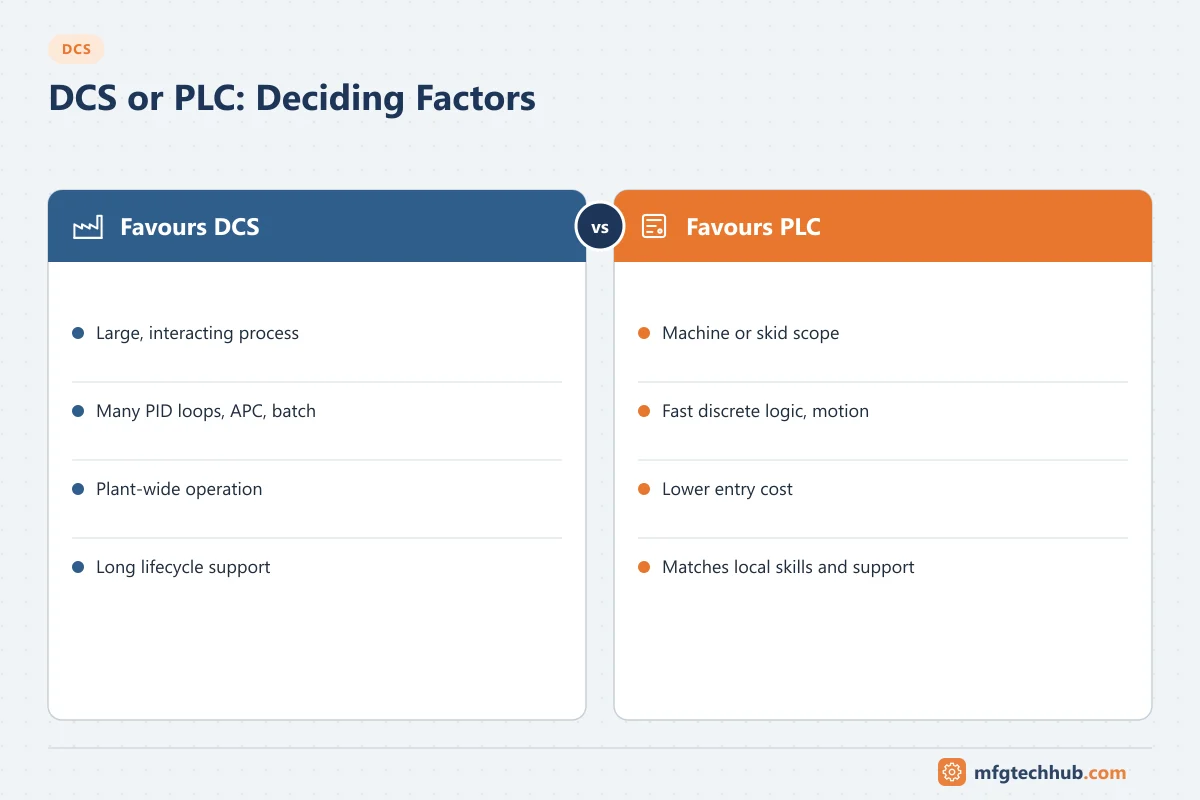
- What kind of process? Continuous or batch process with many analog loops favors a DCS; discrete manufacturing and machines favor PLCs.
- How large is it, and how will it grow? Hundreds of loops and plant-wide operation favor a DCS.
- What availability is required? If shutdowns are extremely costly or hazardous, standard redundancy and online change are valuable.
- Who will maintain it? Match the platform to local skills and vendor support.
- What is the lifetime cost? Include engineering, licensing, spares, training and future migration, not only hardware.
- How will packaged equipment integrate? Plan communication between the main system and vendor PLCs.
Example scenarios
| Scenario | Typical choice |
|---|---|
| Bottling and packaging line | PLCs with HMI |
| Refinery or petrochemical complex | DCS, with PLCs in vendor packages and a separate safety system |
| Water treatment plant | PLCs with SCADA, or a small DCS for large plants |
| Pharmaceutical batch plant | DCS with batch management, or PLC/SCADA with batch software |
| Power plant | DCS for boiler and turbine control |
Key takeaways
- PLCs grew from discrete logic; DCS grew from continuous process control.
- DCS provide an integrated database, standard redundancy and plant-wide operator tools.
- PLCs provide speed, flexibility and lower entry cost.
- Many plants use both, and the right choice depends on process type, scale, availability needs and skills.
Related tutorials
Before you apply this in a plant: this article is for education. Always check the current edition of the relevant standards, the manufacturer's documentation for your exact product and version, and your site's procedures. Safety-related work needs qualified personnel. See our editorial policy.