
History of Distributed Control Systems: From Pneumatic Panels to Open, Virtualised DCS
On this page
The distributed control system appeared in the mid-1970s as the answer to a specific problem: central computers could control a whole plant, but when the computer failed, the whole plant lost control. Distributing control over many microprocessor-based controllers, while keeping operation central, solved that problem. Each later generation added openness, networking and integration, but the core idea has not changed.
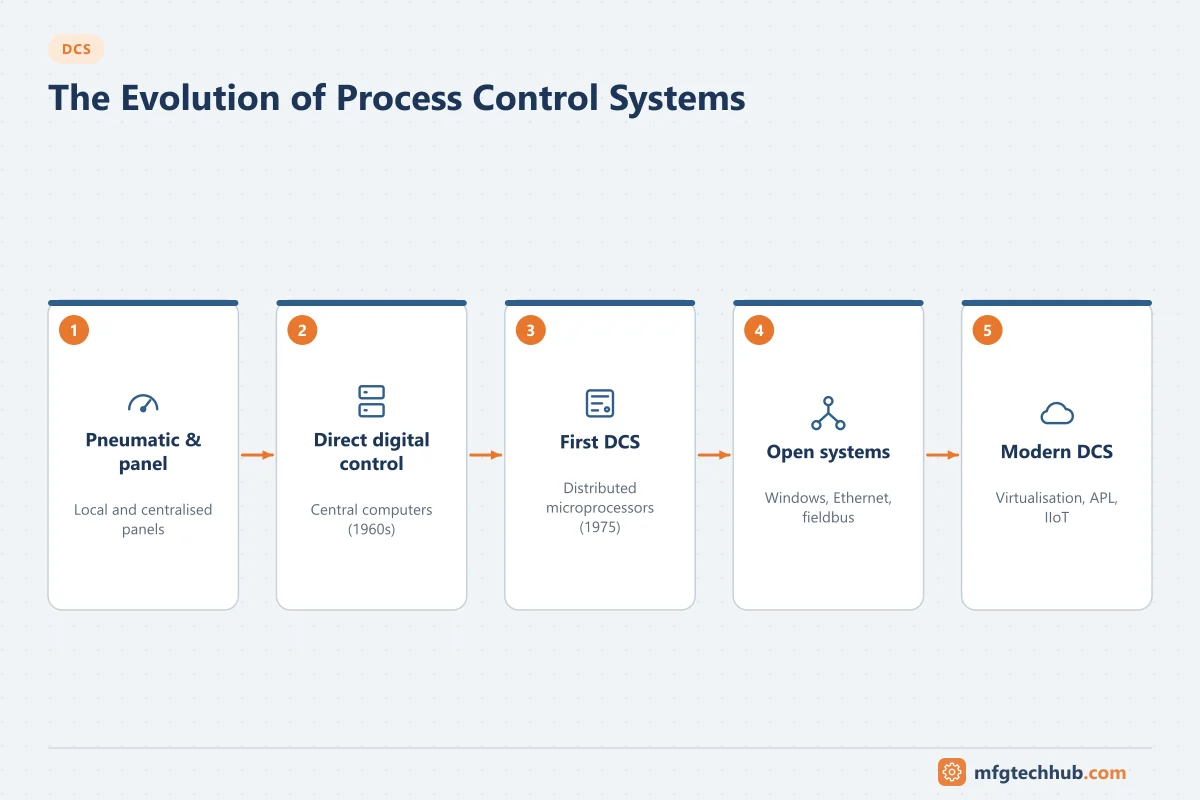
Knowing this history is practical: many plants still run systems from the 1990s and 2000s alongside current ones, and the migration decisions they face follow from how those systems were built.
Before DCS: pneumatic and panel control
Until the 1960s, process plants were controlled by individual controllers, one per loop, first mounted locally and later grouped on panels in a central control room. Most were pneumatic, using the 3–15 psi air signal, and later electronic analog controllers. The 4–20 mA signal became the common electronic standard in the 1970s.
Panel control was robust and each loop was independent, but it had clear limits: large panels, no history apart from chart recorders, little coordination between loops, and every change meant rewiring or re-piping.
Computers enter the plant (late 1950s–1970s)
- Supervisory computer control. Computers calculated optimal setpoints and sent them to analog controllers. A Texaco refinery installation at Port Arthur in 1959 is commonly cited as one of the first.
- Direct digital control (DDC). From the early 1960s, some plants let a central computer execute the control loops directly. An ICI plant at Fleetwood in the UK, using a Ferranti Argus computer from 1962, is a frequently cited early example.
- PLCs. In the late 1960s the programmable logic controller (Modicon 084) replaced relay logic in discrete manufacturing. See PLC Introduction.
Central DDC showed what digital control could do, but it concentrated risk: one computer failure affected every loop, and analog backup controllers were often installed “just in case”.
The first DCS (1975 onwards)
In 1975 both Honeywell (TDC 2000) and Yokogawa (CENTUM) introduced systems that distributed control over multiple microprocessor-based controllers linked by a digital data highway, with operators using CRT-based consoles. Other suppliers followed in the late 1970s and 1980s. Key ideas introduced by this generation remain in every DCS today:
- Control split across multiple controllers, each for part of the plant, with redundancy.
- Function blocks configured rather than programmed.
- Central operator consoles with displays, alarms and trends instead of panel instruments.
- A proprietary network connecting everything, designed and supported by one vendor.
Open systems (1990s–2000s)
The next generation replaced proprietary hardware at the top of the system with standard IT technology:
- Windows PCs for operator and engineering stations, replacing proprietary consoles.
- Ethernet replacing proprietary data highways, usually with redundant networks.
- OPC (from 1996) for data exchange with other systems.
- Fieldbus (FOUNDATION Fieldbus, PROFIBUS PA) and HART for digital field communication.
- New platforms such as Emerson DeltaV (mid-1990s), Foxboro I/A Series (introduced 1987, an early open design), Siemens PCS 7, Honeywell Experion PKS and ABB 800xA.
- Standards for batch control (ISA-88, 1995) and enterprise integration (ISA-95, 2000).
Openness brought integration and lower hardware cost, but also Windows lifecycles, patching and cybersecurity. The 2010 Stuxnet attack on centrifuge control systems made industrial cybersecurity a board-level topic, and the IEC 62443 series became the reference. See ISA/IEC 62443.
Modern DCS (2010s onwards)
- Virtualisation of servers and stations; thin clients in control rooms.
- Configurable I/O and electronic marshalling, reducing cabinets and late-change rework.
- Better operator interfaces and alarms, guided by ISA-18.2 (2009) and ISA-101 (2015).
- Ethernet-APL (early 2020s) bringing Ethernet to field instruments, including hazardous areas.
- OPC UA as the standard interface to MES, historians and analytics.
- Modular plants using NAMUR MTP (Module Type Package) to integrate package units.
- Open process automation: the Open Process Automation Forum (The Open Group), started in 2016, is developing the O-PAS standard for interoperable, multi-vendor control systems.
- New-generation platforms alongside the established ones, for example Siemens PCS neo.
See Traditional vs Modern DCS Architectures and DCS Technology: Future Trends.
Timeline
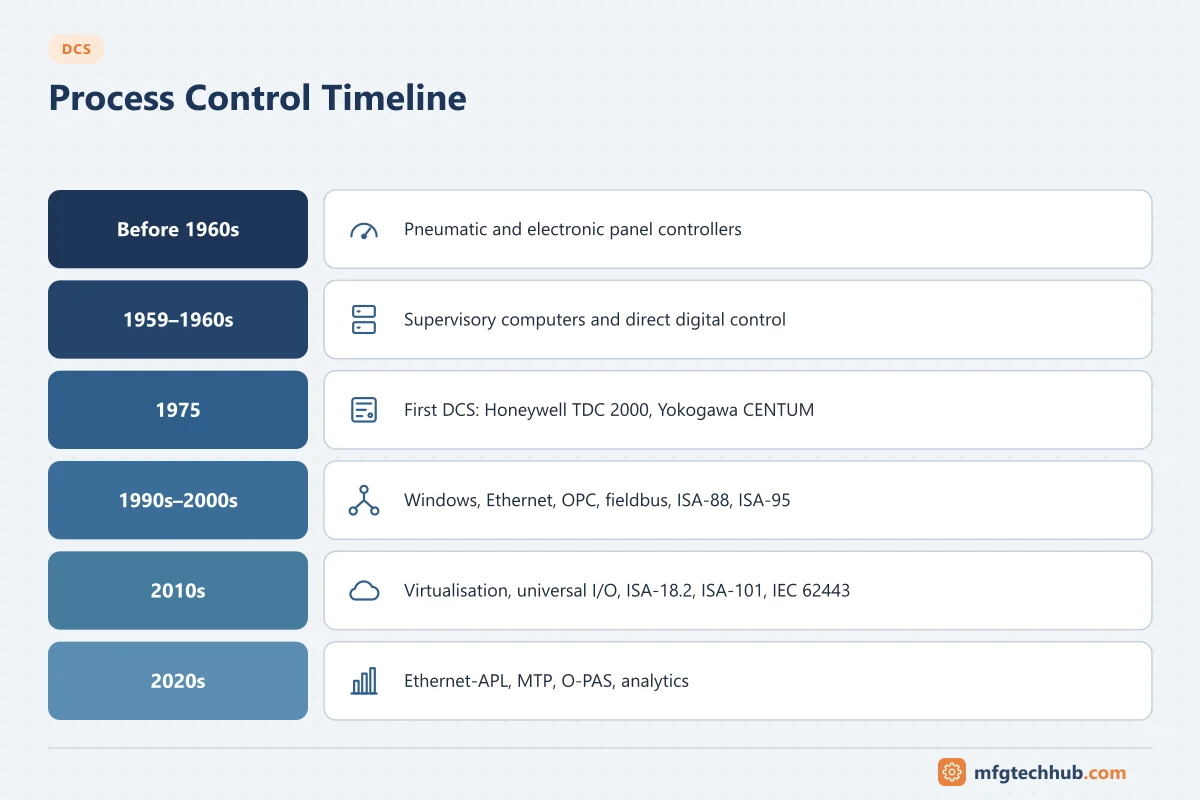
| Period | Development | What it changed |
|---|---|---|
| Before 1960s | Pneumatic and electronic panel controllers | One controller per loop; central panels |
| 1959–1960s | Supervisory computers, direct digital control | Digital control, but centralised risk |
| Late 1960s | PLC | Programmable logic for discrete control |
| 1970s | 4–20 mA becomes the common analog standard | Standard electronic field signal |
| 1975 | First DCS (Honeywell TDC 2000, Yokogawa CENTUM) | Distributed control, central operation |
| 1980s | HART; larger, more integrated DCS | Digital data over analog loops |
| 1990s | Windows stations, Ethernet, OPC, fieldbus, ISA-88 | Open systems and integration |
| 2000s | ISA-95, IEC 61511, integrated safety systems | Enterprise integration, functional safety |
| 2010s | Virtualisation, universal I/O, ISA-18.2, ISA-101, IEC 62443 | Lower hardware footprint, better operation, security |
| 2020s | Ethernet-APL, MTP, O-PAS, analytics | Ethernet to the field, modular and open automation |
What this means for plants today
Many plants run a mix of generations. Typical consequences:
- Obsolescence. Controllers and I/O from the 1990s may run reliably, but spare parts, support and skilled people become scarce.
- Windows lifecycle. Stations from the open-systems generation need regular OS upgrades that older DCS versions cannot follow.
- Migration options. Vendors offer phased migrations that keep field wiring and sometimes I/O while replacing controllers and stations. Planning starts with an installed-base audit. See DCS Implementation Challenges.
- Security. Systems designed before IEC 62443 need compensating controls (segmentation, remote access control, backups).
Frequently asked questions
When was the first DCS introduced?
In 1975. Honeywell introduced the TDC 2000 and Yokogawa introduced CENTUM that year; both are commonly cited as the first distributed control systems.
What came before the DCS?
Individual pneumatic and electronic analog controllers on panels, and in some plants central computers performing supervisory or direct digital control.
Why did DCS replace central computer control?
A central computer was a single point of failure for all loops. A DCS spreads control over many redundant controllers, so a failure affects only part of the plant.
Key takeaways
- The DCS was created in 1975 to distribute control and remove the single point of failure of central computers.
- The 1990s brought open technologies (Windows, Ethernet, OPC, fieldbus) and with them integration and cybersecurity challenges.
- Modern systems add virtualisation, configurable I/O, Ethernet-APL, OPC UA and modular automation.
- Plants often run several generations at once, which drives migration and security planning.
Related tutorials
Before you apply this in a plant: this article is for education. Always check the current edition of the relevant standards, the manufacturer's documentation for your exact product and version, and your site's procedures. Safety-related work needs qualified personnel. See our editorial policy.