
ISA-95 Explained: Levels, Architecture, MES Integration and Industry 4.0 Guide
On this page
Modern manufacturing plants use many different systems to manage production, quality, equipment, materials, inventory, and business operations. These systems often include PLCs, SCADA, DCS, MES, ERP, historians, quality systems, and analytics platforms.
Without a standard integration model, data can become fragmented across the organization. Operators may see one version of production data, quality teams may use another, and business teams may depend on delayed manual reports.
ISA-95 solves this problem by providing a structured framework for connecting enterprise systems with manufacturing operations.
What is ISA-95?
ISA-95, also known as ANSI/ISA-95, is an international standard developed by the International Society of Automation for enterprise-control system integration.
It defines how business systems such as ERP should communicate with manufacturing systems such as MES, SCADA, DCS, PLCs, historians, and quality systems.
In simple terms, ISA-95 acts as a bridge between:
- Business planning
- Manufacturing execution
- Supervisory control
- Machine control
- Physical production processes
This makes ISA-95 an important foundation for MES implementation, IT-OT integration, Smart Manufacturing, and Industry 4.0.
Quick Summary
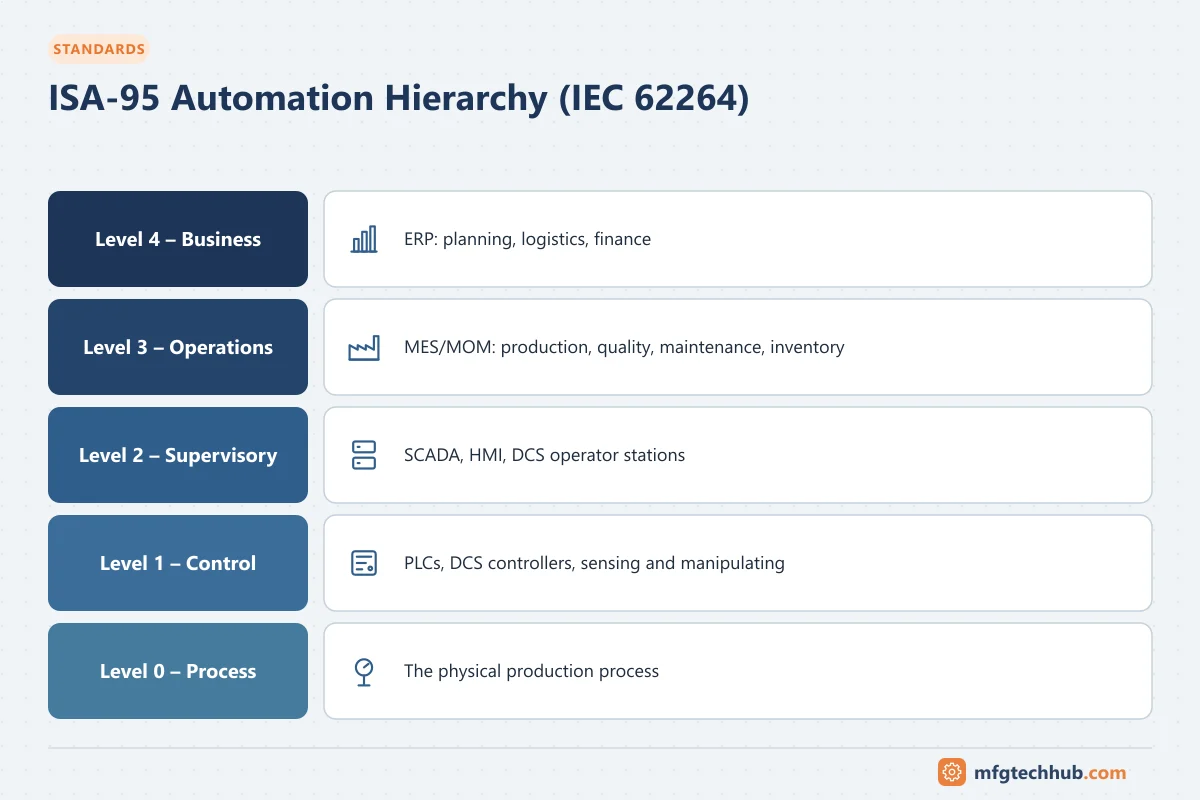
ISA-95 organizes manufacturing systems into five levels:
| Level | Name | Main Purpose |
|---|---|---|
| Level 0 | Physical Process | Actual production process |
| Level 1 | Sensing and Control | Sensors, actuators, PLC control |
| Level 2 | Supervisory Control | SCADA, DCS, HMI, alarms, historian |
| Level 3 | Manufacturing Operations Management | MES, MOM, quality, production tracking |
| Level 4 | Business Planning and Logistics | ERP, supply chain, inventory, finance |
The goal is to create clear responsibility between systems and improve the flow of information from the shop floor to business systems.
Why ISA-95 Matters
Manufacturing operations generate large volumes of data every day from sensors, machines, controllers, SCADA systems, MES applications, quality systems, and ERP platforms.
Without ISA-95 or a similar structure, organizations often face problems such as:
- Duplicate manual data entry
- Poor visibility into production status
- Inconsistent data between ERP and MES
- Delayed reporting
- Difficult IT and OT coordination
- Higher integration cost
- Limited scalability for Industry 4.0 projects
ISA-95 provides a common language for automation, manufacturing, IT, quality, and business teams.
It helps define which system owns which data, how information should flow, and how manufacturing operations should connect with enterprise planning.
ISA-95 Automation Hierarchy
The ISA-95 automation hierarchy explains how manufacturing systems are organized from the physical process level up to enterprise planning.
This model helps manufacturers design scalable and maintainable architectures for automation and digital transformation.
Level 0: Physical Process
Level 0 represents the actual manufacturing process. This is where raw materials are transformed into finished or semi-finished products.
Examples include:
- Mixing
- Filling
- Welding
- Assembly
- Packaging
- Machining
- Heating
- Cooling
- Chemical processing
Typical Level 0 components include:
- Sensors
- Actuators
- Motors
- Valves
- Pumps
- Robots
- CNC machines
- Field instruments
Common signals and protocols include:
- 4-20 mA
- HART
- Modbus RTU
- Fieldbus protocols
- Discrete input/output signals
Level 0 is the foundation of the automation hierarchy. Accurate measurement and reliable field devices are essential because higher-level systems depend on this data.
Level 1: Sensing and Control
Level 1 performs direct control of machines and equipment. It receives input from sensors, executes control logic, and sends output commands to actuators or machines.
Typical Level 1 systems include:
- PLCs
- RTUs
- Machine controllers
- Drives
- Basic HMIs
- Safety controllers
Common communication methods include:
- Modbus TCP/IP
- EtherNet/IP
- Profinet
- OPC UA
- Industrial Ethernet
Example:
In a conveyor system, sensors detect product position, and a PLC controls motor start/stop logic based on production conditions.
Level 1 is critical for safe, reliable, and real-time equipment operation.
Level 2: Supervisory Control
Level 2 provides supervisory monitoring and control across production areas, lines, machines, or plant systems.
Typical Level 2 systems include:
- SCADA
- DCS
- HMI
- Alarm management systems
- Process historians
- Batch control systems
Operators use Level 2 systems to:
- Monitor process values
- View alarms and events
- Control equipment
- Analyze trends
- Track downtime
- Review process history
Common protocols include:
- OPC UA
- MQTT
- Modbus TCP
- Profinet
- Industrial Ethernet
Level 2 provides real-time visibility and control for operators and control room teams.
Level 3: Manufacturing Operations Management
Level 3 is where manufacturing execution and operations management take place.
This level coordinates production activities and connects plant-floor operations with business planning.
Typical Level 3 systems include:
- MES
- MOM
- QMS
- LIMS
- OEE systems
- Production scheduling tools
- Electronic batch record systems
- Maintenance execution systems
MES at Level 3 commonly manages:
- Production orders
- Work instructions
- Work-in-progress tracking
- Quality checks
- Equipment status
- Downtime
- Genealogy and traceability
- Batch records
- Performance and OEE
- Operator activities
- Compliance data
Common communication methods include:
- OPC UA
- REST APIs
- Web APIs
- XML
- B2MML
- Database integration
- Middleware platforms
Level 3 is one of the most important parts of ISA-95 because it acts as the operational bridge between ERP and the shop floor.
Level 4: Business Planning and Logistics
Level 4 represents enterprise-level business planning and logistics.
Typical Level 4 systems include:
- ERP
- SCM
- CRM
- Finance systems
- Inventory management systems
- Procurement systems
- Business intelligence platforms
Level 4 manages:
- Customer orders
- Production planning
- Procurement
- Inventory
- Supply chain
- Costing
- Financial reporting
- Demand planning
Common integration methods include:
- REST APIs
- SOAP services
- B2MML
- Kafka
- AMQP
- Enterprise integration platforms
Level 4 focuses on business decisions, while Level 3 focuses on manufacturing execution.
ISA-95 Data Flow Between Levels
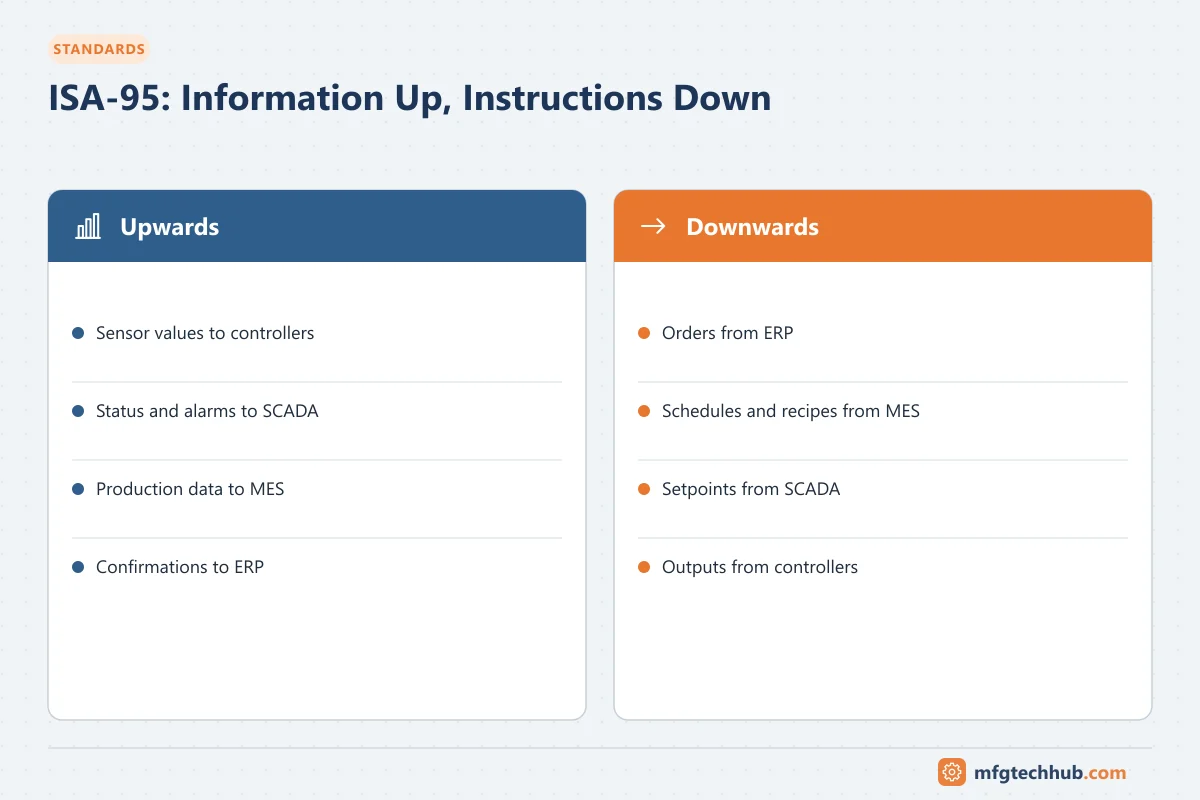
Effective communication between ISA-95 levels is essential for successful integration.
| From Level | To Level | Typical Data | Common Protocols |
|---|---|---|---|
| Level 0 | Level 1 | Sensor signals, actuator feedback | 4-20 mA, HART, Modbus RTU |
| Level 1 | Level 2 | Equipment status, control values, alarms | Modbus TCP, EtherNet/IP, Profinet, OPC UA |
| Level 2 | Level 3 | Process data, alarms, events, production status | OPC UA, MQTT, Web APIs |
| Level 3 | Level 4 | Production results, quality reports, order updates | REST APIs, B2MML, Kafka, AMQP |
A well-designed ISA-95 architecture improves data consistency and reduces point-to-point integration complexity.
Real-World Example: Automotive Manufacturing
In an automotive manufacturing plant, ISA-95 may be applied like this:
- Level 0: Sensors, torque tools, robots, conveyors, and vision inspection systems operate on the production line.
- Level 1: PLCs control robotic welding cells, conveyors, assembly stations, and safety interlocks.
- Level 2: SCADA monitors alarms, equipment status, production counts, and downtime.
- Level 3: MES manages work orders, quality checks, genealogy, rework, and production tracking.
- Level 4: ERP manages demand planning, inventory, procurement, customer orders, and delivery schedules.
This structure helps the plant connect shop-floor execution with business planning.
Common ISA-95 Implementation Challenges
Legacy System Integration
Older machines and controllers may not support modern communication methods such as OPC UA, MQTT, or REST APIs.
Poor Master Data Quality
Incorrect material codes, equipment names, routing data, or production definitions can create integration problems.
Lack of IT-OT Alignment
ISA-95 projects require collaboration between automation, operations, IT, quality, and business teams.
High Customization
Manufacturing processes differ across industries, so MES and ERP integration often requires careful design.
Compliance Requirements
Pharmaceuticals, food, and other regulated industries may require audit trails, validation, electronic records, and strict change control.
Benefits of ISA-95
ISA-95 provides several practical benefits for manufacturing organizations.
Improved Data Accuracy
Automated data exchange reduces manual entry and improves consistency between ERP, MES, and plant systems.
Better Production Visibility
Production status, quality data, downtime, and performance information become available across the organization.
Faster Decision-Making
Business and operations teams can act faster using reliable manufacturing data.
Stronger IT-OT Integration
ISA-95 creates a shared framework for IT and OT teams to design integration responsibly.
Improved MES Implementation
ISA-95 helps define MES boundaries, functions, data ownership, and interfaces with ERP and automation systems.
Industry 4.0 Readiness
ISA-95 supports smart factories, IIoT, analytics, digital twins, AI, and cloud-based manufacturing platforms.
ISA-95 and MES Integration
MES is commonly positioned at Level 3 in the ISA-95 hierarchy.
Its role is to translate business plans from ERP into executable manufacturing activities and send production results back to enterprise systems.
Typical ERP-to-MES data includes:
- Production orders
- Material master data
- BOM information
- Routing details
- Inventory requirements
- Delivery schedules
Typical MES-to-ERP data includes:
- Production confirmations
- Material consumption
- Quality results
- Batch genealogy
- Downtime information
- Finished goods quantity
- Scrap and rework data
A well-designed ISA-95-based MES integration reduces manual reporting and improves production control.
ISA-95 and Industry 4.0
ISA-95 remains highly relevant in Industry 4.0 because it provides structure for connected manufacturing.
It supports:
- IT-OT convergence
- IIoT data collection
- Smart factory architecture
- MES and ERP connectivity
- Predictive maintenance
- Digital twins
- Manufacturing analytics
- AI-driven production optimization
- Real-time production intelligence
Industry 4.0 projects are more successful when they are built on a clear integration architecture rather than disconnected point solutions.
Best Practices for ISA-95 Implementation
- Define clear system ownership for ERP, MES, SCADA, DCS, PLC, and historian data.
- Use standard naming conventions for equipment, materials, tags, and production areas.
- Avoid unnecessary point-to-point integrations.
- Start with critical production and quality use cases.
- Use middleware or integration platforms where appropriate.
- Validate master data before MES or ERP integration.
- Involve IT, OT, operations, quality, and business stakeholders early.
- Design for scalability, cybersecurity, and maintainability.
Key Takeaways
- ISA-95 is a global standard for enterprise-control system integration.
- It defines five levels from physical process control to business planning.
- MES operates mainly at Level 3 and connects ERP with plant-floor operations.
- ISA-95 improves IT-OT integration, data quality, production visibility, and decision-making.
- It is a strong foundation for Smart Manufacturing and Industry 4.0.
Conclusion
ISA-95 provides a practical and structured approach for connecting business systems with manufacturing operations.
By defining clear responsibilities across Levels 0 to 4, it helps manufacturers improve production visibility, reduce manual data entry, strengthen IT-OT collaboration, and create a scalable foundation for digital transformation.
Whether an organization is implementing MES, modernizing legacy systems, integrating ERP with plant operations, or planning an Industry 4.0 roadmap, ISA-95 remains one of the most important standards for industrial automation and smart manufacturing.