
Why Process Plants Use a DCS: Functions, Advantages and Limitations
On this page
Large process plants such as refineries, chemical plants, power stations and pharmaceutical facilities typically run on a distributed control system (DCS). A DCS is not simply “a bigger PLC”. Its value comes from treating the whole plant as one integrated system: one engineering database, one operator environment, plant-wide redundancy and built-in functions for continuous and batch process control.
This article explains what a DCS does in process control, why plants choose it, and where its limitations are. For the basics, see DCS Introduction; for the comparison with PLCs, see DCS vs PLC.
What makes process control different
| Characteristic of process plants | What the control system must provide |
|---|---|
| Hundreds to thousands of interacting control loops | Efficient loop configuration, cascade, ratio, feedforward and override control |
| Continuous operation for years between shutdowns | Redundancy and online changes without stopping the process |
| Hazardous materials and high energy | Alarm management, operator guidance, integration with safety systems |
| Slow, interacting dynamics | Tuning tools, advanced process control, simulation |
| Many operators across shifts and units | Consistent displays, alarm philosophy, operator training |
| Regulated records (for example GMP, environmental) | Audit trails, historian, batch records |
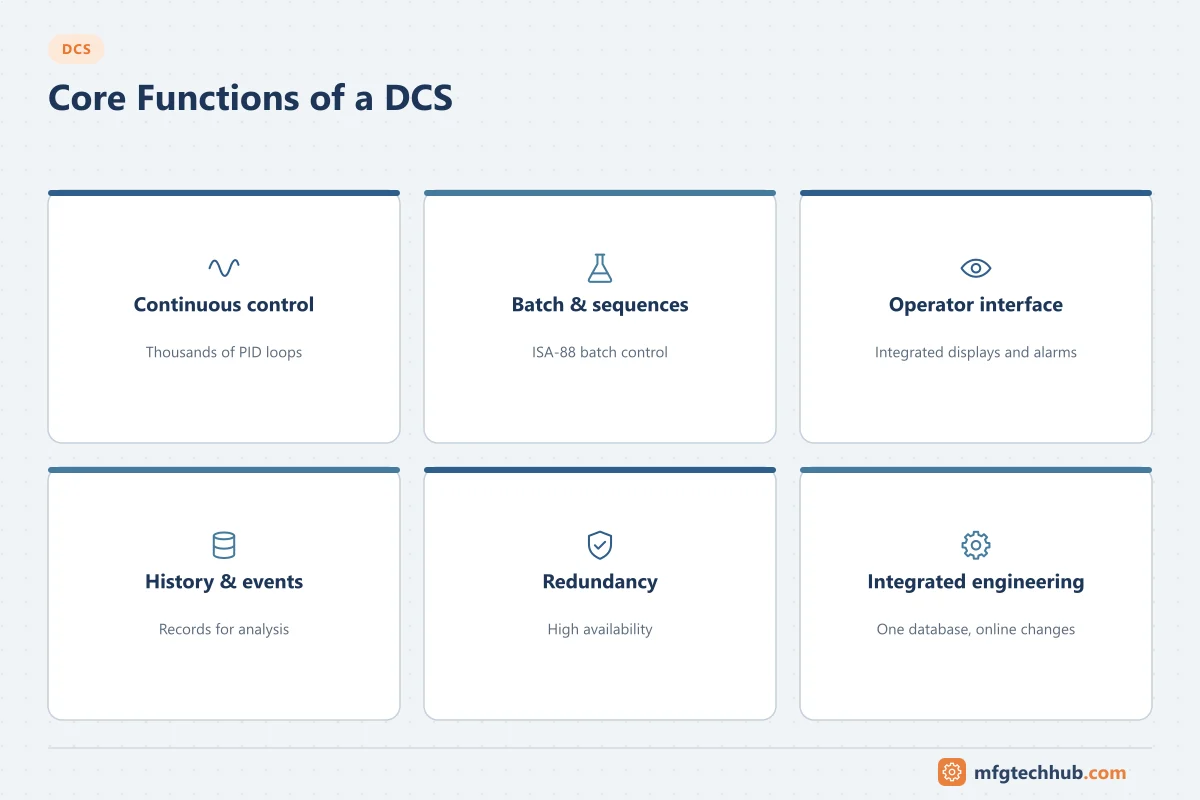
Core functions of a DCS
- Regulatory control: PID and advanced loop structures (cascade, ratio, split-range, feedforward, override). See Control Strategies in DCS.
- Logic and sequencing: interlocks, motor and valve control, start-up and shutdown sequences.
- Batch control: recipes and phases structured per ISA-88.
- Operator interface: displays, faceplates, trends and alarms with consistent behaviour across the plant. See DCS HMI.
- Alarm and event management: prioritisation, suppression, shelving and sequence-of-events records. See Alarm and Event Management.
- History: integrated or connected historian for trends and reports.
- Asset management: HART and fieldbus diagnostics for instruments and valves.
- Integration: interfaces to safety systems, historians, MES and advanced process control.
Advantages of a DCS
| Advantage | Why it matters in a process plant |
|---|---|
| Single engineering database | A tag is defined once and used in control, displays, alarms and history; fewer mapping errors |
| Plant-wide redundancy | Redundant controllers, networks, power and servers with bumpless failover |
| Online changes and upgrades | Configuration changes and some upgrades without stopping production |
| Standard function libraries | Proven, consistent blocks for loops, motors and valves across the plant |
| Consistent operator environment | Operators move between units with the same display and alarm behaviour |
| Built-in diagnostics | System and field device diagnostics in one place |
| Scalability | Add controllers, I/O and stations as the plant expands |
| Lifecycle support | Vendors provide migration paths, long-term support and system-level responsibility |
Limitations and costs
- Higher initial cost than a PLC/SCADA solution for small applications.
- Vendor-specific engineering environment, hardware and skills.
- Complex lifecycle management: servers, operating systems and security patches, as with any IT-based system.
- Less suited to very fast discrete control, high-speed motion or small standalone machines, which are often integrated as PLC-controlled packages.
- Migration of large systems takes years of planning.
When a DCS is the right choice
A DCS is usually justified when several of these apply:
- Large continuous or batch process with many interacting loops
- High cost of downtime, needing plant-wide redundancy
- Many operators and units needing a consistent operating environment
- Need for integrated batch control, alarm management and asset management
- Long plant life with a preference for single-vendor system responsibility
Smaller plants, skids and hybrid manufacturing often use PLC-based process control systems or PLC + SCADA combinations instead. See DCS Vendors and Platforms.
DCS and safety systems
Protective functions are implemented in a separate safety instrumented system (SIS) designed to IEC 61511, even when the SIS is integrated with the DCS for engineering and operation. The DCS keeps the process in its normal range; the SIS takes it to a safe state if protection is needed. See Functional Safety Explained.
Frequently asked questions
Why do refineries use a DCS instead of PLCs?
Because a refinery has thousands of interacting loops, runs continuously for years, and needs plant-wide redundancy, a consistent operator environment and integrated alarm and asset management. A DCS provides these as one integrated system.
Is a DCS more reliable than a PLC?
Both can be highly reliable. A DCS is designed with redundancy and online maintenance as standard features across the whole system, while PLC systems achieve similar availability through specific redundant configurations.
What industries use DCS?
Oil and gas, refining, petrochemicals, chemicals, power generation, pulp and paper, pharmaceuticals, mining and minerals, water treatment and food processing. See DCS Applications Across Industries.
Key takeaways
- Process plants choose a DCS for its integrated database, redundancy, online changes, consistent operator environment and built-in process control functions.
- DCS costs more initially and is vendor-specific; it is best suited to large, continuous or batch processes.
- Safety functions remain in a separate SIS.
Related tutorials
Before you apply this in a plant: this article is for education. Always check the current edition of the relevant standards, the manufacturer's documentation for your exact product and version, and your site's procedures. Safety-related work needs qualified personnel. See our editorial policy.