
DCS Control Strategies: Cascade, Feedforward, Ratio, Split Range, Override, Valve Position and MPC
On this page
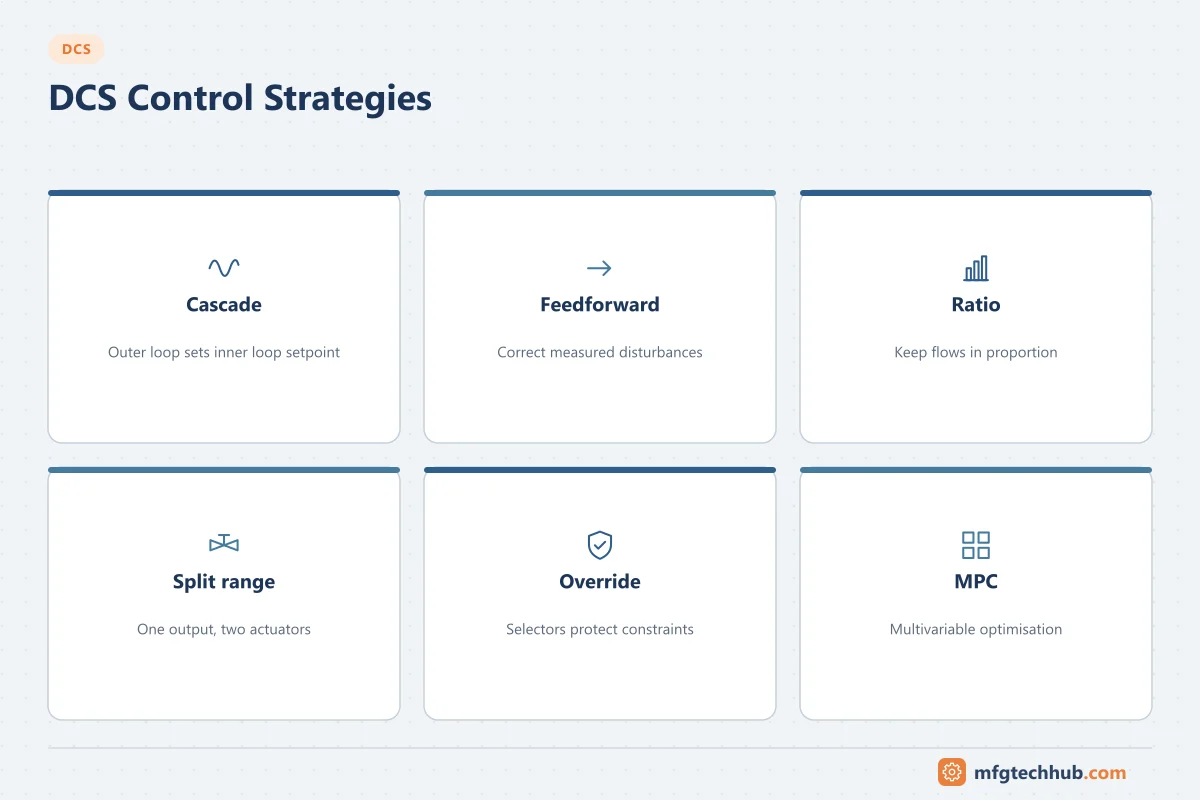
A single PID loop handles most process control. Some problems need more: disturbances that upset the loop before feedback can react, two flows that must stay in proportion, one controller driving two valves, or constraints that must not be exceeded. Control strategies combine PID blocks, calculations and selectors to solve these problems. In a DCS they are built from standard function blocks, and getting the connections right (initialisation, back-calculation and mode handling) matters as much as choosing the strategy.
This guide assumes you know basic PID; if not, start with PID Control Explained.
Choosing a strategy
| Problem | Strategy |
|---|---|
| A fast inner disturbance (supply pressure, fuel quality) upsets a slow loop | Cascade |
| A measurable disturbance (feed rate, load) affects the process before feedback sees it | Feedforward (combined with feedback) |
| Two or more streams must stay in proportion | Ratio control |
| One controller must drive two actuators, such as heating and cooling | Split range |
| Normal control must yield when a constraint (pressure, temperature, motor load) is approached | Override / selector control |
| A fast, cheap actuator must be kept in a good operating range by a slower one | Valve position (mid-ranging) control |
| Many interacting variables and constraints must be optimised together | Model predictive control (MPC) |
Cascade control
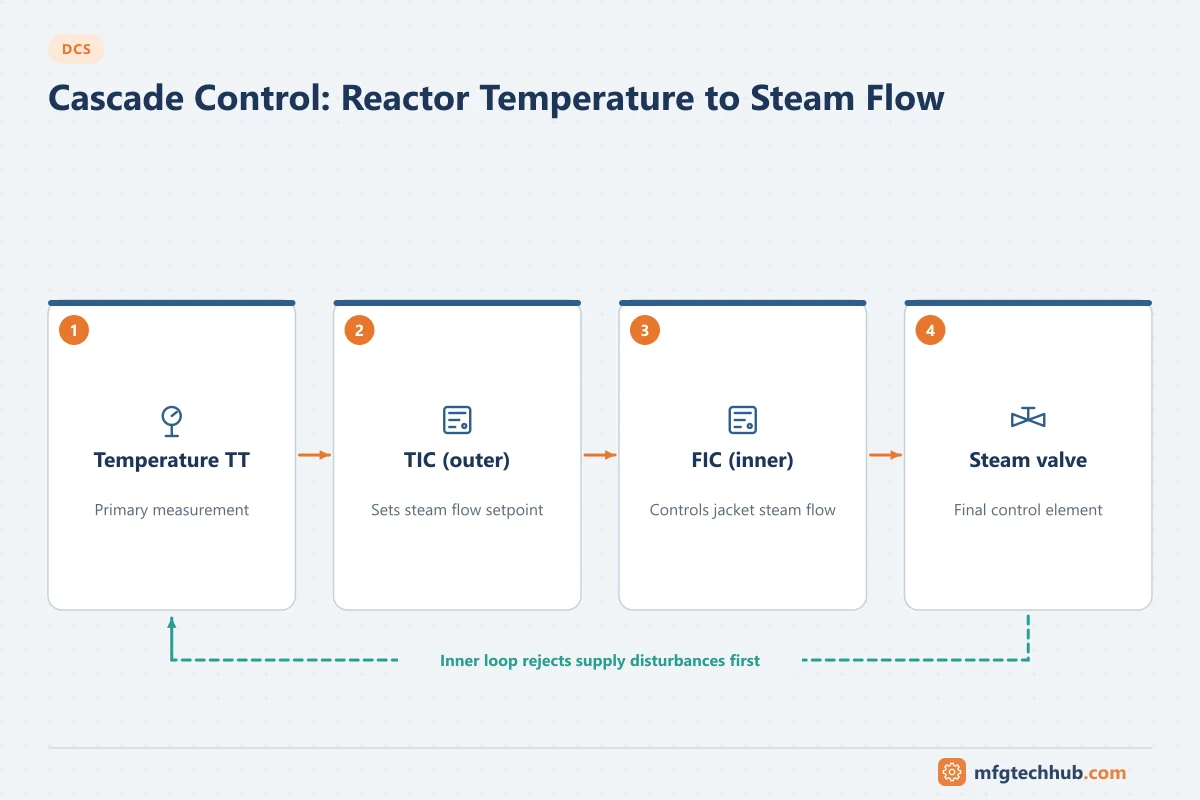
An outer (primary) controller controls the main variable and writes the setpoint of an inner (secondary) controller, which controls a faster variable that affects it.
Example: reactor temperature (outer) → jacket or steam flow (inner). A change in steam supply pressure is corrected by the flow loop before it affects the temperature.
Design rules:
- The inner loop must be significantly faster than the outer loop, commonly several times faster, or the loops will interact.
- Tune the inner loop first, with the outer loop in manual, then tune the outer loop with the inner loop in cascade.
- Configure initialisation and back-calculation so that when the inner loop is not in cascade mode, the outer loop tracks the inner setpoint and does not wind up.
- Define mode shedding: what happens to the outer loop if the inner loop’s measurement goes bad.
Feedforward control
Feedforward measures a disturbance and adjusts the output before the disturbance affects the controlled variable. It is almost always combined with feedback, because no model is perfect.
- Static feedforward: output change proportional to the disturbance (a gain).
- Dynamic feedforward: adds lead-lag compensation when the disturbance and the manipulated variable affect the process with different speeds.
- Combine by summing the feedforward signal with the PID output, or by multiplying (for example the flow required is proportional to feed rate, and the PID trims the ratio).
Example: in three-element boiler drum level control, steam flow is a feedforward to the feedwater flow setpoint.
Ratio control
Ratio control keeps a controlled flow in proportion to a wild (uncontrolled) flow: controlled flow setpoint = ratio × wild flow.
- Operators or a higher-level controller adjust the ratio; a feedback controller (for example on a composition analyser) can trim it.
- Use consistent units and compensation (mass flow, or temperature/pressure-compensated volumetric flow).
- Cross-limiting in combustion control: on load increase, air leads and fuel follows; on load decrease, fuel leads and air follows. High and low selectors enforce this so the burner never runs fuel-rich during transients. Burner management and combustion safeguards are handled separately under safety requirements; see Functional Safety.
Split-range control
One controller output drives two or more actuators across different parts of its range.
Example: a reactor temperature controller output 0–50% opens the cooling valve (from fully open to closed), and 50–100% opens the heating valve.
- Decide whether there should be a small gap (dead zone, to avoid both valves open) or overlap.
- Actuators often have different gains (a large steam valve versus a small cooling valve), which changes loop behaviour depending on the range. Characterise or compensate, or consider separate controllers with a selector.
- Document the ranges clearly on the HMI so operators understand what each output value means.
Override (selector) control
Two or more controllers compete for one actuator, and a low or high selector chooses which output is used.
Example: a compressor normally runs on discharge pressure control, but a motor current controller takes over through a low selector if the motor approaches its current limit.
- Anti-windup is essential: the controllers that are not selected must not wind up. Use external reset feedback (the selected output fed back to all controllers) so each can take over smoothly.
- Show on the HMI which controller is in control.
- Override control protects operating limits; it does not replace safety instrumented functions.
Valve position (mid-ranging) control
A fast actuator does the control; a second, slower controller adjusts another variable to keep the fast actuator near the middle of its range.
Example: a small fine-trim valve controls flow precisely, while a valve position controller slowly moves a large valve to keep the small valve around 50% open.
Model predictive control (MPC) and advanced process control
Model predictive control uses dynamic models (usually identified from plant step tests) to predict how many controlled variables will respond to changes in several manipulated variables, and chooses moves that keep all variables within constraints while optimising an objective such as throughput or energy.
- MPC normally runs above the regulatory PID layer and writes setpoints to PID controllers, which stay in place.
- It suits interacting, constrained, multivariable units such as distillation columns, crude units and reactors; see Oil Refinery Automation.
- Success depends on good regulatory control first, maintained models and operator acceptance. An MPC on top of poorly tuned PID loops performs poorly.
- “Advanced process control” (APC) usually refers to MPC plus other model-based and advanced regulatory techniques; it is not synonymous with machine learning, although data-driven models are increasingly used alongside.
Configuring strategies in a DCS
- Build from standard function blocks (PID, ratio, lead-lag, selector, splitter, calculation) rather than custom code.
- Connect back-calculation / initialisation paths so every upstream block knows what its downstream block is actually doing.
- Define modes (manual, auto, cascade, remote cascade) and mode shedding on bad inputs.
- Use bumpless transfer on every mode change.
- Handle bad quality inputs explicitly (hold, shed to manual, use a substitute value).
- Document the strategy with a control narrative and a function block diagram, and show its state clearly on faceplates.
- Test in simulation before commissioning, including failure cases.
Troubleshooting
| Symptom | Likely cause | Check |
|---|---|---|
| Cascade oscillates | Inner loop too slow or poorly tuned; loops interacting | Tune inner loop first; compare loop speeds |
| Bump when switching to cascade | Initialisation or back-calculation not connected | Block connections and tracking configuration |
| Override controller takes over late or with a bump | Non-selected controllers wound up | External reset feedback configuration |
| Ratio drifts | Flow measurement not compensated; meter error | Units, compensation, meter calibration |
| Split-range loop behaves differently in each range | Different valve gains | Characterisation or separate tuning |
| Feedforward makes things worse | Wrong gain or dynamics; feedforward acting on noisy signal | Step tests; lead-lag settings; filtering |
Frequently asked questions
When should I use cascade control?
When a faster secondary variable (often a flow) is affected by disturbances that would otherwise upset the slower primary variable, and the secondary loop is significantly faster than the primary.
What is the difference between feedforward and feedback control?
Feedback reacts to an error that has already appeared in the controlled variable. Feedforward measures a disturbance and acts before it affects the controlled variable. They are normally combined.
Is MPC a replacement for PID?
No. MPC normally sits above the PID layer and writes setpoints to PID controllers. Good PID tuning is a prerequisite for successful MPC.
Key takeaways
- Choose strategies by the problem: cascade for fast inner disturbances, feedforward for measured disturbances, ratio for proportions, split range for multiple actuators, override for constraints.
- Tune inner loops first, and configure initialisation, back-calculation and anti-windup correctly.
- MPC optimises multivariable, constrained units on top of well-tuned regulatory control.
Related tutorials
Before you apply this in a plant: this article is for education. Always check the current edition of the relevant standards, the manufacturer's documentation for your exact product and version, and your site's procedures. Safety-related work needs qualified personnel. See our editorial policy.