
DCS Applications by Industry: Typical Control Tasks and Industry-Specific Requirements
On this page
Every DCS provides the same building blocks: controllers, I/O, operator stations, history and engineering tools. What differs between industries is what they are used for and which additional requirements apply, such as burner management in power plants, batch control and validation in pharmaceuticals, or advanced process control in refineries. This page summarises those differences and links to the industry guides.
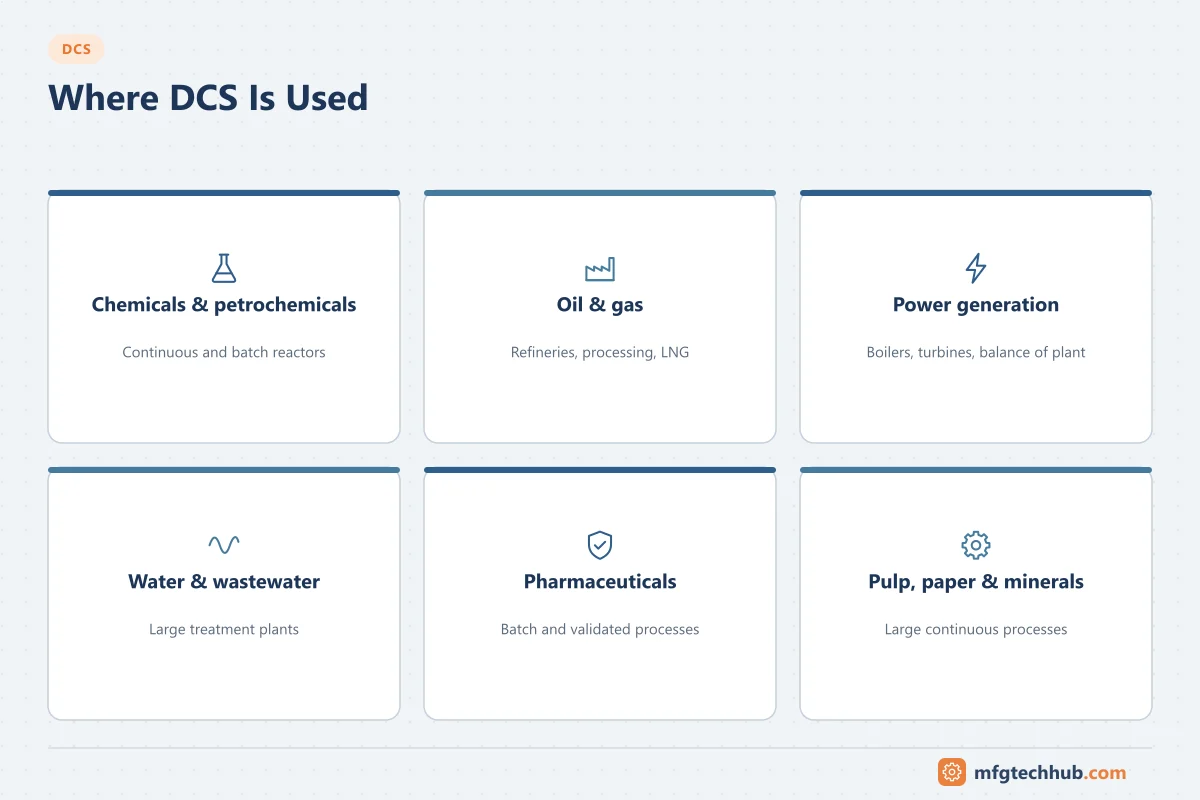
Industry overview
| Industry | Typical DCS tasks | Industry-specific requirements |
|---|---|---|
| Refining | Distillation, cracking, reforming, blending, utilities, tank farm | APC on major units, integration with SIS and fire and gas systems, API RP 554 practice |
| Oil and gas production and LNG | Separation, compression, dehydration, liquefaction | Integrated control and safety systems, compressor control packages, remote operations |
| Chemicals and petrochemicals | Reactors, distillation, continuous and batch units | Batch control (ISA-88) for specialty products, reactor safety interlocks, SIS |
| Power generation | Boiler, turbine auxiliaries, feedwater, combustion, emissions | Burner management systems, coordinated boiler-turbine control, turbine control integration |
| Pharmaceuticals and biotech | API synthesis, fermentation, bioreactors, purification, utilities | ISA-88 batch, validation (GAMP 5), electronic records (21 CFR Part 11, EU Annex 11) |
| Water and wastewater | Large treatment plants: dosing, aeration, filtration, sludge | Often DCS for the plant and SCADA for the network; regulatory reporting |
| Pulp and paper | Digesters, bleaching, recovery boiler, paper machine | Quality control systems (basis weight, moisture), recovery boiler safety |
| Mining, minerals and metals | Grinding, flotation, kilns, smelting | Large drive systems, expert or APC control of mills and kilns, harsh environments |
| Food and beverage (large continuous) | Sugar, dairy processing, brewing | Hygienic design, recipe and batch management, traceability |
Industry notes
Refining and petrochemicals
Refineries are large, continuous, highly interactive processes with many units that feed each other. The DCS runs thousands of loops, and advanced process control (model predictive control) on units such as crude distillation and fluid catalytic cracking pushes operation towards constraints. Separate safety instrumented systems and fire and gas systems are integrated for operator view. See Oil Refinery Automation and DCS Control Strategies.
Power generation
In thermal plants the DCS controls the boiler and balance of plant, often with the turbine controlled by a dedicated turbine control system integrated into the DCS. Typical applications are three-element drum level control, combustion (air/fuel ratio with cross-limiting), steam temperature control and coordinated unit load control. Burner management is a safety function implemented in a separate, suitably certified system. See Power Plant Automation and Boiler Drum Level Control.
Pharmaceuticals and biotech
Pharmaceutical plants rely on batch control (ISA-88 recipes, phases and batch records), clean utilities and environmental monitoring. The DCS is a validated computerised system: changes follow change control, user access and audit trails are enforced, and electronic batch records must meet data integrity requirements. See Pharmaceutical Manufacturing Automation, ISA-88 and Computerised System Validation.
Water and wastewater
Large treatment works often use a DCS or a process-oriented SCADA platform for the plant, and SCADA with telemetry for the distribution or collection network. Key applications are chemical dosing, aeration control based on dissolved oxygen, filter backwash sequences and regulatory reporting. See Water and Wastewater Automation.
Food and beverage
Most food and beverage lines use PLCs, but large continuous or batch processes (dairy, sugar, brewing) sometimes use a DCS for recipe management, cleaning-in-place sequences and traceability. See Food and Beverage Automation.
Common application patterns
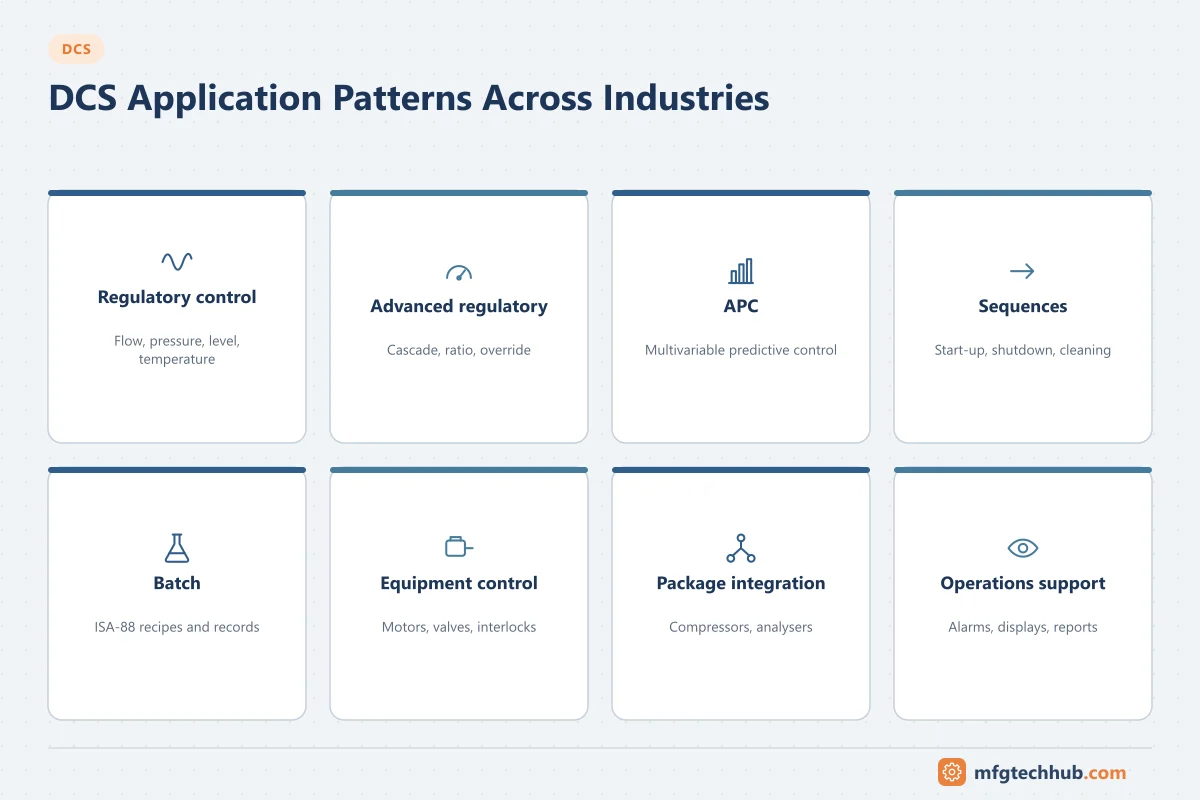
Across industries, the same patterns recur:
| Pattern | Examples | Detail |
|---|---|---|
| Regulatory control | Flow, pressure, level and temperature loops | Setting Up Control Loops |
| Advanced regulatory control | Cascade, ratio, feedforward, override, split range | DCS Control Strategies |
| Advanced process control | Multivariable predictive control on major units | Control Strategies |
| Sequences | Start-up and shutdown, filter backwash, cleaning | Step logic in controllers |
| Batch | Recipes, phases, batch records | ISA-88 |
| Equipment control | Motors, valves, interlocks, permissives | Device templates in libraries |
| Package integration | Compressors, analysers, boilers with their own PLCs | System Integration |
| Operations support | Alarms, displays, reports, shift logs | HMI Displays and Alarms |
When a DCS is not the best fit
A DCS is not automatically the right choice. Small plants, machine-centred processes, discrete manufacturing and geographically spread assets are often better served by PLCs with an HMI or by SCADA. The deciding factors are the size and interaction of the process, the need for integrated engineering and redundancy, and the plant’s lifecycle support model. See DCS vs PLC and Why Process Plants Use a DCS.
Frequently asked questions
Which industries use DCS?
Mainly process industries: refining, oil and gas, chemicals and petrochemicals, power generation, pharmaceuticals and biotech, pulp and paper, mining and metals, and large water and wastewater plants.
Why do pharmaceutical plants use a DCS?
Because they need batch control with recipes and electronic batch records, integrated operation of many units and utilities, and a validated system with audit trails and controlled changes.
Is a DCS used in power plants?
Yes. Thermal power plants typically use a DCS for the boiler and balance of plant, with the turbine controller and burner management system integrated for operation.
Key takeaways
- The DCS building blocks are the same everywhere; the applications and requirements differ by industry.
- Refining emphasises APC and integration with safety systems; power emphasises boiler control and burner management; pharmaceuticals emphasise batch, validation and data integrity.
- Common patterns (regulatory control, sequences, batch, equipment control) recur across all industries.
- A DCS is not always the right choice; compare with PLC and SCADA for the specific plant.
Related tutorials
Before you apply this in a plant: this article is for education. Always check the current edition of the relevant standards, the manufacturer's documentation for your exact product and version, and your site's procedures. Safety-related work needs qualified personnel. See our editorial policy.