
Cement, Steel and Mining Automation: Kilns, Furnaces, Rolling Mills, Crushing, Grinding and Flotation
On this page
Cement plants, steelworks and mines share several characteristics: very large equipment, high energy use, harsh environments with dust, heat and vibration, and processes where raw material variability makes control difficult. They typically combine DCS or PLC-based control with specialised systems (kiln optimisers, mill models, rolling mill automation) and put strong emphasis on availability and predictive maintenance of large drives and rotating equipment.
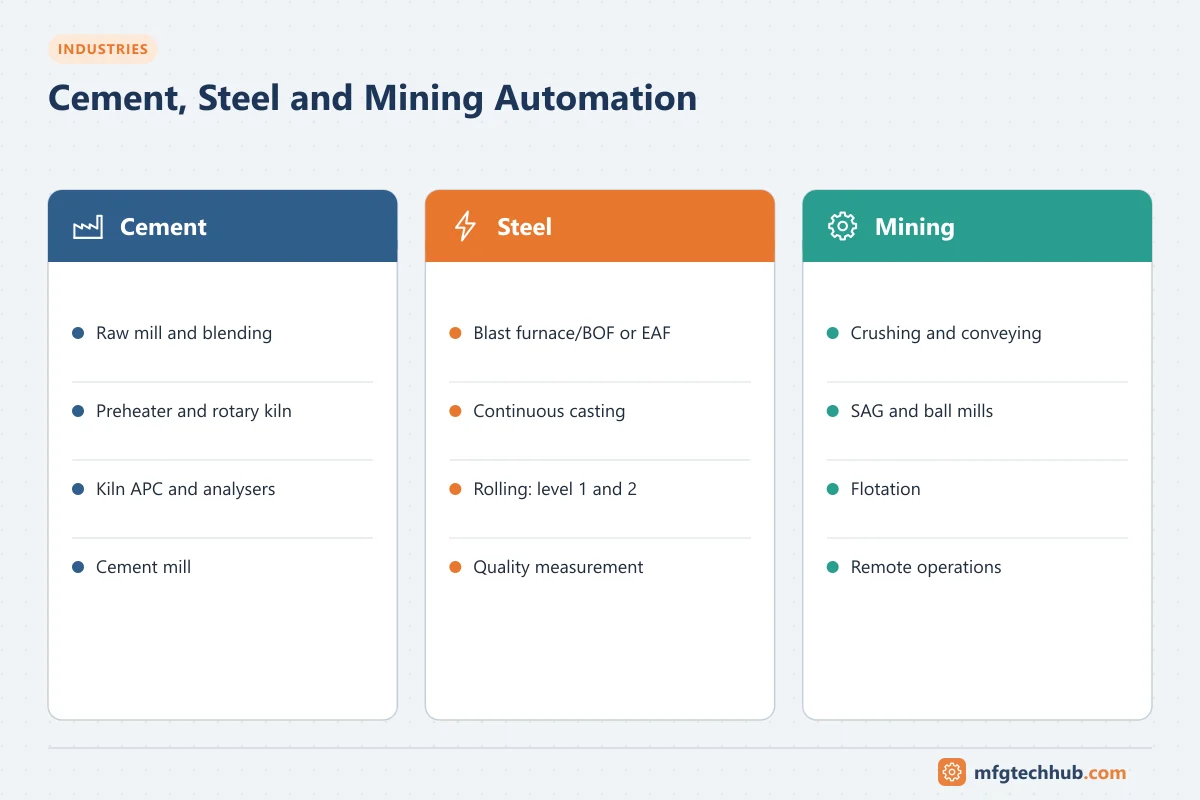
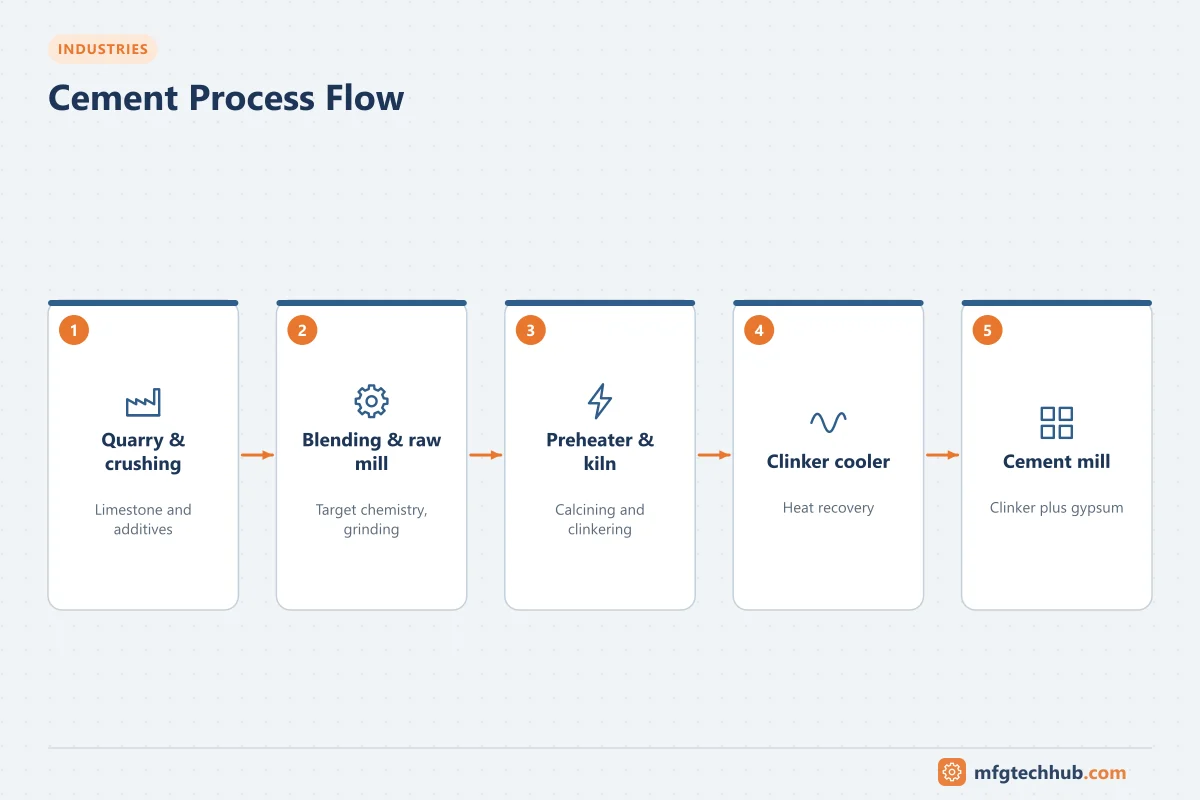
Cement
| Stage | What happens | Automation focus |
|---|---|---|
| Quarry and crushing | Limestone and other materials extracted and crushed | Crusher control, conveyors |
| Raw material blending | Stockpiles and proportioning to target chemistry | Cross-belt analysers, feeder ratio control |
| Raw mill | Grinding and drying of raw meal | Mill load, separator, gas flow control |
| Preheater and precalciner | Raw meal heated and largely calcined by hot gases | Temperatures, pressures, fuel, gas analysis |
| Rotary kiln | Clinker formation at high temperature | Kiln feed, fuel, draft, burning zone temperature, NOx and oxygen |
| Clinker cooler | Clinker cooled, heat recovered | Grate speed, air flows |
| Cement mill | Clinker ground with gypsum and additives | Mill load, fineness, separator |
Kiln control is the heart of a cement plant. Because the kiln responds slowly and raw material varies, many plants use expert systems or model predictive control on top of the DCS to stabilise the process and reduce fuel use. Online analysers (for example cross-belt analysers on raw materials and gas analysers at the kiln inlet and stack) provide the measurements. Emissions monitoring (CEMS) and alternative fuels add further control tasks. See DCS Control Strategies.
Steel
| Route | Main steps |
|---|---|
| Integrated (blast furnace) | Coke and sinter production, blast furnace (iron), basic oxygen furnace (steel), secondary metallurgy, continuous casting, rolling |
| Electric arc furnace (EAF) | Scrap or direct reduced iron melted in an EAF, secondary metallurgy (ladle furnace), casting, rolling |
Rolling mill automation is organised in levels:
| Level | Function |
|---|---|
| Level 1 | Basic automation: drives, hydraulic gap control, automatic gauge control, tension and speed control; fast PLCs or dedicated controllers |
| Level 2 | Process models: pass schedules, temperature and force models, set-up calculations for each coil or bar |
| Level 3 | Production planning, tracking and quality (MES) |
Other key systems include EAF electrode control, casting mould level control, cooling control, and extensive quality measurement (thickness, width, flatness, surface inspection). Large drives and power quality are major topics; see VFDs and Soft Starters and Power Quality.
Mining and mineral processing
| Stage | What happens | Automation focus |
|---|---|---|
| Drill, blast, load, haul | Ore extracted and transported | Fleet management, autonomous haulage in some mines, dispatch systems |
| Crushing | Primary, secondary, tertiary crushing | Crusher load and gap control, protection from tramp metal |
| Conveying | Long overland and plant conveyors | Belt protection (misalignment, rip, speed), sequencing |
| Grinding | SAG and ball mills reduce ore to fine particles | Mill load and power, water addition, cyclone control; expert control common |
| Flotation | Minerals separated with reagents and air | Level, air, reagent dosing, froth vision systems, online analysers |
| Thickening and tailings | Water recovery and tailings disposal | Density, flocculant dosing, tailings dam monitoring |
| Underground ventilation | Air supply to working areas | Ventilation-on-demand, gas monitoring |
Mines are often remote, so remote operations centres, telemetry and private wireless networks are common. See SCADA Telemetry Communications.
Common automation themes
| Theme | Why it matters | Typical approach |
|---|---|---|
| Raw material variability | Unstable processes and quality | Online analysers, feedforward, APC or expert control |
| Energy intensity | Large share of operating cost | Optimisation of kilns, mills and drives; energy monitoring |
| Large rotating equipment | Failures are costly and slow to repair | Vibration and condition monitoring; see Vibration Monitoring |
| Harsh environment | Dust, heat, vibration damage instruments | Robust instruments, enclosures, non-contact measurement (for example radar) |
| Safety | Heavy machinery, hot metal, gases, mobile equipment | Safety systems, isolation procedures, collision avoidance |
| Emissions | Regulatory limits | CEMS and emissions control; see Sustainable Energy Solutions |
Frequently asked questions
Why is kiln control difficult in cement plants?
The kiln responds slowly, raw materials and fuels vary, and many variables interact. Plants use analysers, careful DCS control and often expert or model predictive control to keep the kiln stable.
What are level 1 and level 2 in a rolling mill?
Level 1 is basic automation that controls drives, gap, gauge, speed and tension in real time. Level 2 uses process models to calculate set-ups and pass schedules for each product.
How is grinding controlled in mineral processing?
By controlling mill feed, water addition, mill load and power, and cyclone conditions, often with expert systems or advanced control, supported by particle size and slurry density measurements.
Key takeaways
- Cement, steel and mining share large equipment, energy intensity and harsh environments.
- Kiln and mill control rely on analysers and advanced or expert control on top of DCS or PLCs.
- Rolling mills separate fast level 1 control from level 2 process models.
- Condition monitoring, robust instrumentation and safety are constant priorities.
Related tutorials
Before you apply this in a plant: this article is for education. Always check the current edition of the relevant standards, the manufacturer's documentation for your exact product and version, and your site's procedures. Safety-related work needs qualified personnel. See our editorial policy.