
Automotive Manufacturing Automation: Press, Body, Paint, Final Assembly and Battery Plants
On this page
A vehicle plant is a chain of highly automated shops, each with its own technology: presses stamp panels, hundreds of robots weld them into a body, a paint shop coats it in a sequence of chemical and baking steps, and final assembly turns it into a finished vehicle in a line that builds a different variant almost every minute. Automation here is dominated by PLCs, robots and safety systems, tied together by an MES that sequences orders, tells each station what to build and records what was done.
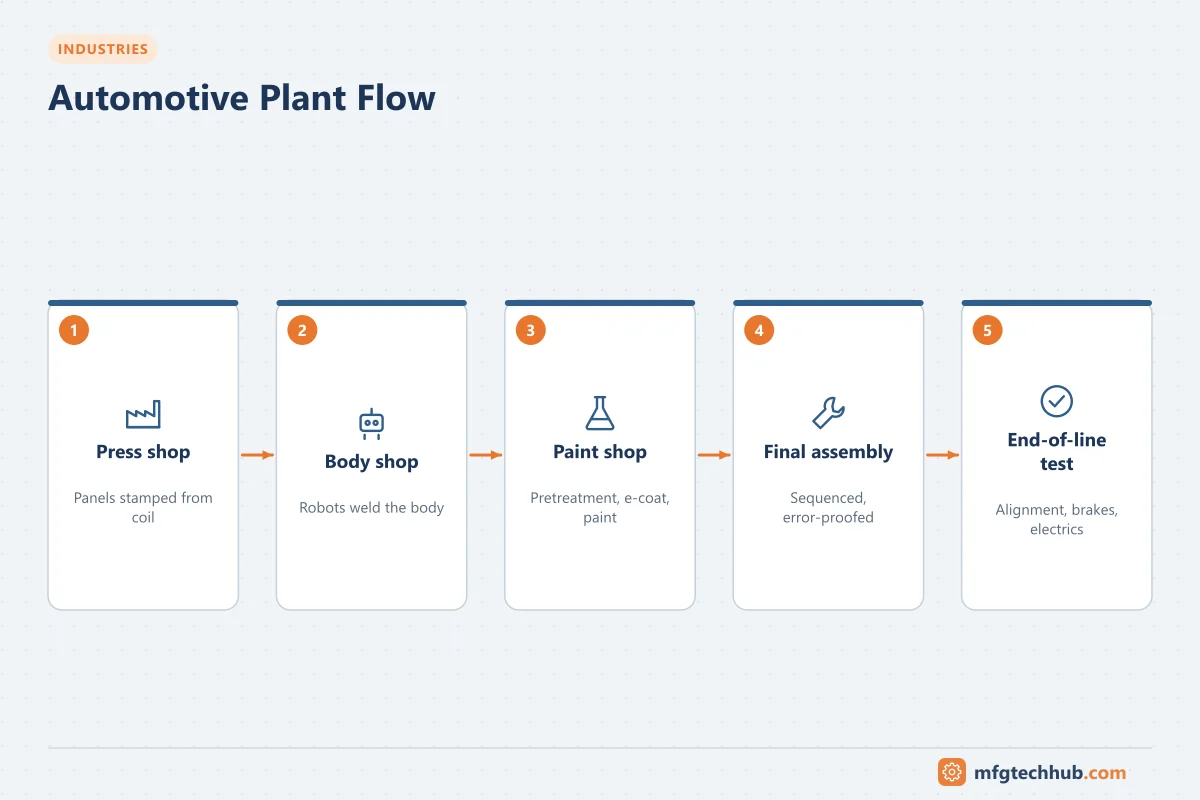
The shops of a vehicle plant
| Shop | What happens | Main automation |
|---|---|---|
| Press shop | Steel or aluminium coils are blanked and stamped into panels | Press line PLCs, transfer automation, die change systems, press safety |
| Body shop (body-in-white) | Panels are joined into the body structure | Welding robots (spot, laser, arc), sealing and adhesive robots, fixtures, framing stations, vision measurement |
| Paint shop | Body is cleaned, protected and painted | Pretreatment and e-coat process control, painting robots, ovens, air handling, emissions treatment |
| Final assembly | Trim, chassis, powertrain or battery, interior, wheels, fluids | Conveyors, torque tools, error-proofing, fluid fill, end-of-line test |
| Powertrain or battery plant | Engines, transmissions, e-motors, battery packs | Machining lines, assembly cells, test stands |
Body shop
- Hundreds of robots perform spot welding, handling, sealing and laser brazing, typically organised in cells controlled by PLCs. See Industrial Robots.
- Fixtures and clamps position parts; sensors confirm part presence and clamp states before welding.
- Weld controllers monitor current and energy per weld; results are stored for quality analysis.
- In-line measurement (vision, laser gauging) checks body geometry.
- Safety relies on guarding, light curtains, safety PLCs and safe robot functions; see Functional Safety.
Paint shop
| Stage | Purpose | Control focus |
|---|---|---|
| Pretreatment | Cleaning and phosphating or conversion coating | Bath temperature, concentration, conductivity |
| E-coat (electrocoat) | Corrosion protection by electrodeposition | Voltage profile, bath chemistry, temperature |
| Sealing | Seams and underbody protection | Robots, material flow |
| Primer, basecoat, clearcoat | Appearance and protection | Painting robots, booth air temperature and humidity |
| Ovens | Curing | Temperature profiles |
| Emissions treatment | VOC abatement (for example thermal oxidisers) | Combustion control, environmental monitoring |
The paint shop is the largest energy consumer in many plants because of air handling and ovens, making it a focus of energy management. See Industrial Energy Efficiency.
Final assembly
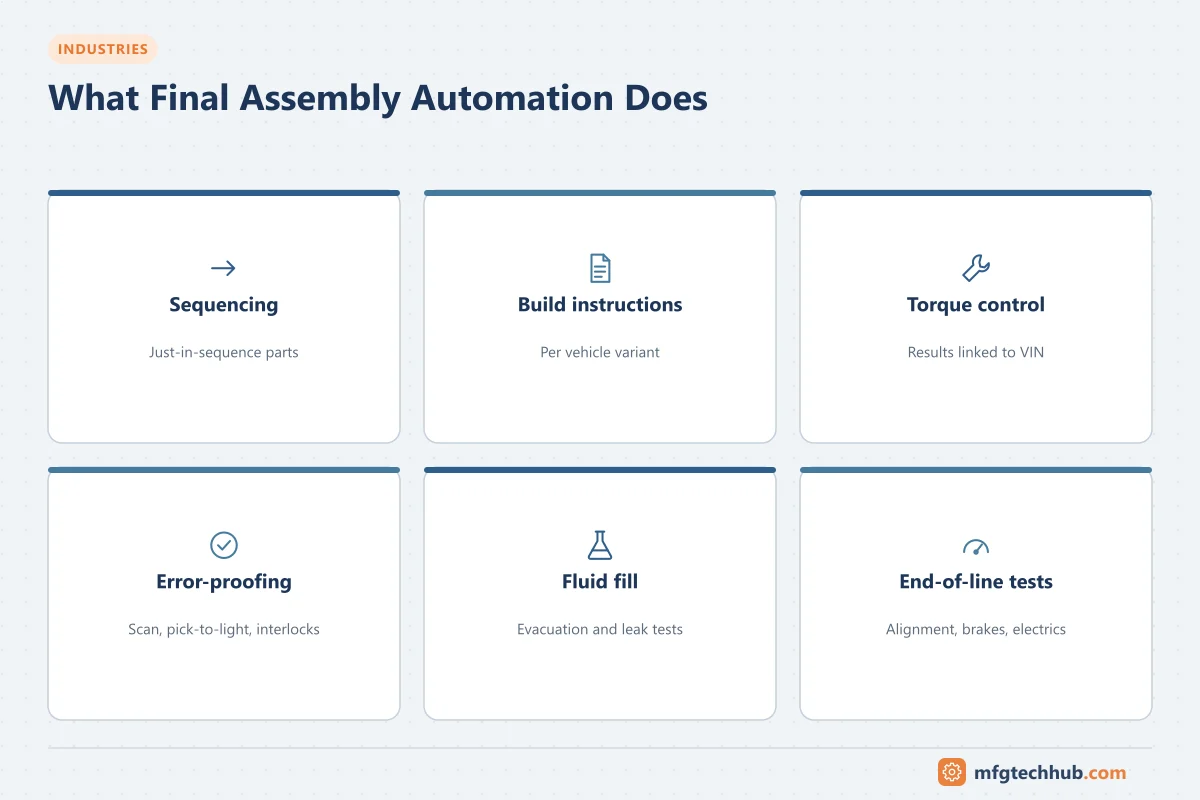
- A moving line carries each vehicle through many stations; each vehicle may be a different model, colour, engine and option set.
- Sequencing: the build sequence is fixed early and suppliers deliver parts in the same order (just-in-sequence).
- Build instructions per vehicle tell operators and machines which parts to fit.
- Torque tools tighten critical joints and report results against the vehicle identification number (VIN).
- Error-proofing (scanning parts, pick-to-light, tool interlocks) prevents wrong or missing parts.
- Fluid fill (brake fluid, coolant, refrigerant) with evacuation and leak tests.
- End-of-line tests: wheel alignment, headlamp aiming, roll and brake tests, electrical and software checks.
- Andon systems let operators signal problems and stop the line when necessary.
See MES in Automotive, Aerospace and Electronics and PLC Applications in Manufacturing.
EV battery assembly
Battery production adds its own steps: cell inspection, module and pack assembly, laser welding of cell connections, thermal interface application, insulation and leak testing, and end-of-line electrical testing. Traceability usually follows each cell into its module and pack. Cell manufacturing itself (electrode coating, cell assembly, formation and ageing) is a separate, process-like operation with strict environmental control.
Control and IT architecture
| Level | Typical systems |
|---|---|
| Field | Sensors, valves, drives, robots, weld controllers, torque tools, vision |
| Control | PLCs per cell or line, safety PLCs, robot controllers |
| Networks | PROFINET or EtherNet/IP, often per OEM standard; see Industrial Communication Protocols |
| Supervision | Line HMIs, andon boards, SCADA for utilities and paint shop |
| Operations | MES: sequencing, build data, quality, traceability, performance |
| Enterprise | ERP, supplier logistics, engineering systems (PLM) |
Vehicle manufacturers typically publish their own automation standards (preferred PLC platforms, HMI layouts, safety concepts, naming), and suppliers of equipment must follow them.
Quality and traceability
- IATF 16949 is the automotive quality management standard; it drives control plans, traceability and error-proofing. See MES Standards.
- Safety-relevant joints and parts are traced to the vehicle: torque results, part serial numbers, test results.
- Genealogy links supplier lots to vehicles for targeted recalls.
Typical challenges
| Challenge | Why it matters | Approach |
|---|---|---|
| High variant complexity | Wrong-part errors | Sequencing, per-vehicle instructions, error-proofing |
| Line stops are expensive | Every station affects the whole line | Buffers, fast diagnostics, standard fault handling |
| Frequent model changes | New tooling and programs | Simulation and virtual commissioning; see Digital Twins |
| Energy use in paint shops | Large share of plant energy | Air handling optimisation, heat recovery |
| Cybersecurity | Large, connected networks | Segmentation and standards; see ISA/IEC 62443 |
Frequently asked questions
What are the main areas of a car plant?
Press shop, body shop, paint shop and final assembly, often with separate powertrain or battery assembly.
How is a car plant automated?
Mainly with PLCs and robots in each shop, safety systems, industrial Ethernet networks, and an MES that sequences vehicles, provides build instructions, collects quality data and traces parts to each vehicle.
What is just-in-sequence delivery?
Suppliers deliver parts in the exact order in which vehicles will be built, so each part arrives at the line ready for the vehicle it belongs to.
Key takeaways
- Vehicle plants combine press, body, paint and final assembly shops with different technologies.
- Robots and PLCs dominate; safety systems protect people around them.
- MES sequencing, per-vehicle instructions and error-proofing manage variant complexity.
- Traceability of torque, parts and tests to each VIN is a core quality requirement.
Related tutorials
Before you apply this in a plant: this article is for education. Always check the current edition of the relevant standards, the manufacturer's documentation for your exact product and version, and your site's procedures. Safety-related work needs qualified personnel. See our editorial policy.