
Digital Twins and Simulation in Manufacturing
On this page
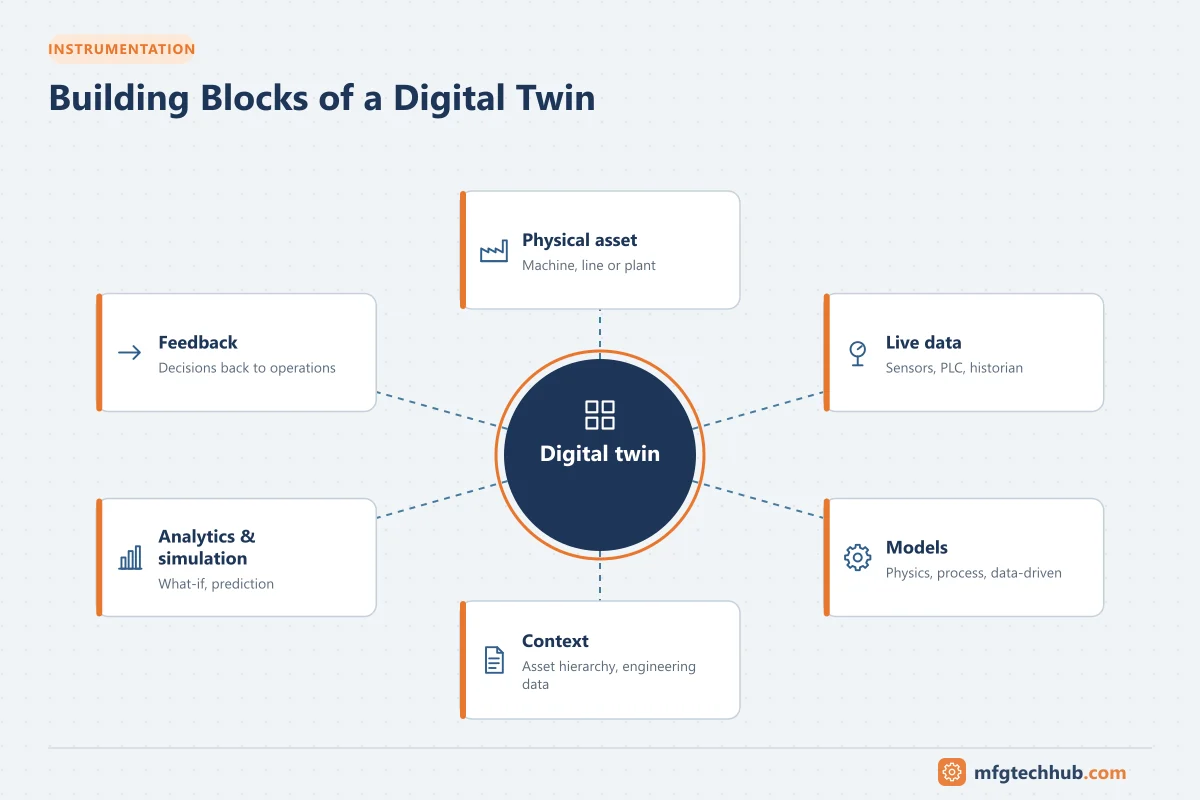
A digital twin is a virtual representation of a physical asset, process or system that is kept up to date with data from its real counterpart. It lets engineers test changes, train operators, predict behavior and optimize performance without risking the real plant. The term is widely used, and sometimes overused, so it helps to understand what a digital twin really is and where it delivers value.
Simulation vs digital twin
| Aspect | Simulation model | Digital twin |
|---|---|---|
| Connection to the real system | None, or occasional manual updates | Continuous or regular data exchange |
| Purpose | Design studies and “what if” analysis | Ongoing monitoring, prediction and optimization during operation |
| Lifetime | Often used for a project | Evolves over the asset’s life |
Many practical “digital twins” sit between these extremes. What matters is choosing the level of fidelity and connection that the use case actually needs.
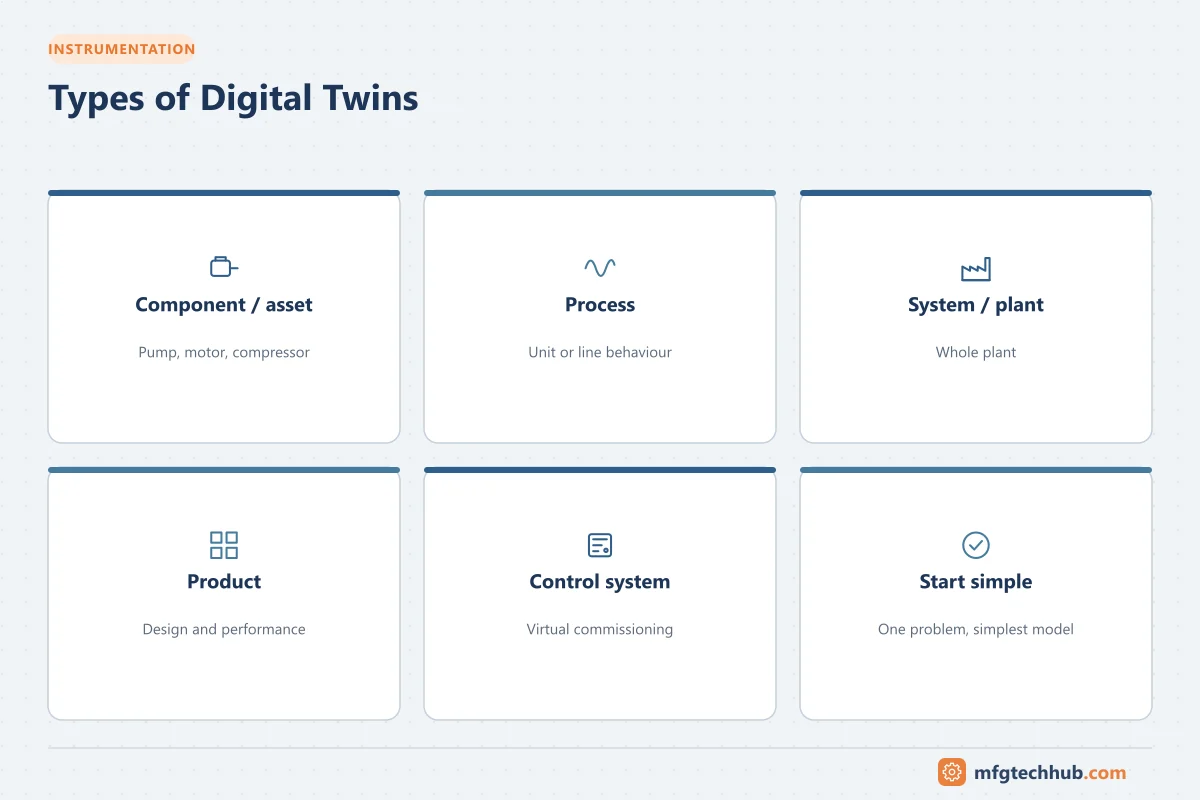
Types of digital twins
| Type | Example |
|---|---|
| Component / asset twin | A pump, motor or compressor with performance and condition models |
| Process twin | A dynamic model of a reactor, distillation column or production line |
| System / plant twin | An entire plant with control system and process models |
| Product twin | Design and performance data of a manufactured product |
| Control system twin | A virtual copy of PLC/DCS logic connected to a process simulation |
Main applications
Virtual commissioning
Control software is tested against a simulated plant before the real equipment is installed. PLC or DCS code runs (in emulation or on real hardware) connected to a process or machine model.
Benefits:
- Finds logic errors, sequence problems and interlock mistakes early
- Shortens on-site commissioning
- Reduces startup risk
Operator training simulators (OTS)
A high-fidelity process model connected to a copy of the control system lets operators practice startups, shutdowns and emergencies safely. OTS are widely used in refining, chemicals and power generation.
Process optimization
A calibrated model can test different setpoints and operating strategies to improve throughput, yield or energy efficiency, then feed recommendations to operators or advanced control systems.
Predictive maintenance
Asset twins combine physics-based models with sensor data to estimate equipment health and remaining life. For example, a pump twin can compare actual head, flow and power with the expected performance curve to detect wear. See Predictive Maintenance Implementation Example.
What-if analysis and planning
Evaluate new products, layout changes, capacity increases or bottlenecks before investing. Discrete-event simulation is common for production lines and logistics.
Soft sensors and monitoring
Process models estimate variables that cannot be measured directly and detect deviations from expected behavior. See AI and Machine Learning in Process Control.
Building blocks of a digital twin
- Models: physics-based (first principles), data-driven (machine learning) or hybrid
- Data: reliable, contextualized measurements from instruments, historians, MES and maintenance systems
- Integration: connectivity through OPC UA, historians and IIoT platforms. See Industrial IoT
- Calibration: keeping the model aligned with real plant behavior
- Visualization: dashboards, 3D views or engineering interfaces
- Governance: ownership, version control and change management
Why instrumentation quality matters
A digital twin is only as good as the data feeding it. Poorly calibrated instruments, missing measurements or incorrect timestamps lead to models that disagree with reality, and quickly lose users’ trust. Accurate, well-maintained instrumentation is the foundation. See Instrument Preventive Maintenance and Calibration Testing.
Challenges
- Cost and effort of building and maintaining high-fidelity models
- Keeping the twin current as the plant is modified
- Data quality and integration across many systems
- Skills in modeling, data and domain knowledge
- Unclear objectives leading to impressive visuals with little value
How to start
- Pick a specific problem, such as reducing commissioning time, training operators, or detecting pump degradation.
- Choose the simplest model that answers the question.
- Ensure data availability and quality for the chosen scope.
- Validate the model against real plant data.
- Measure results and expand to other assets or areas.
Key takeaways
- A digital twin is a virtual model kept current with data from its physical counterpart.
- Proven applications include virtual commissioning, operator training, optimization and predictive maintenance.
- Models can be physics-based, data-driven or hybrid; data quality is critical.
- Start with a clear, valuable use case and the simplest effective model.
Related tutorials
Before you apply this in a plant: this article is for education. Always check the current edition of the relevant standards, the manufacturer's documentation for your exact product and version, and your site's procedures. Safety-related work needs qualified personnel. See our editorial policy.