
Industrial UPS, Battery Backup Systems and Power Redundancy
On this page
Control systems, safety systems, networks and critical instruments must keep running when the mains supply fails or dips. Uninterruptible power supplies (UPS) and battery backup systems bridge interruptions, ride through voltage sags, and give processes time to shut down safely or for generators to start. In process plants, the UPS is often one of the most important safety-related utilities.
What needs backup power?
- DCS, PLC and safety instrumented system (SIS) controllers and I/O
- Operator workstations, servers and network switches
- Field instrument power supplies (24 V DC)
- Fire and gas detection systems
- Emergency lighting and communication systems
- Critical valves, analyzers and telemetry equipment
Large motors and process heaters are normally not on the UPS; they may be backed up by generators instead. See Industrial Generators and Emergency Backup.
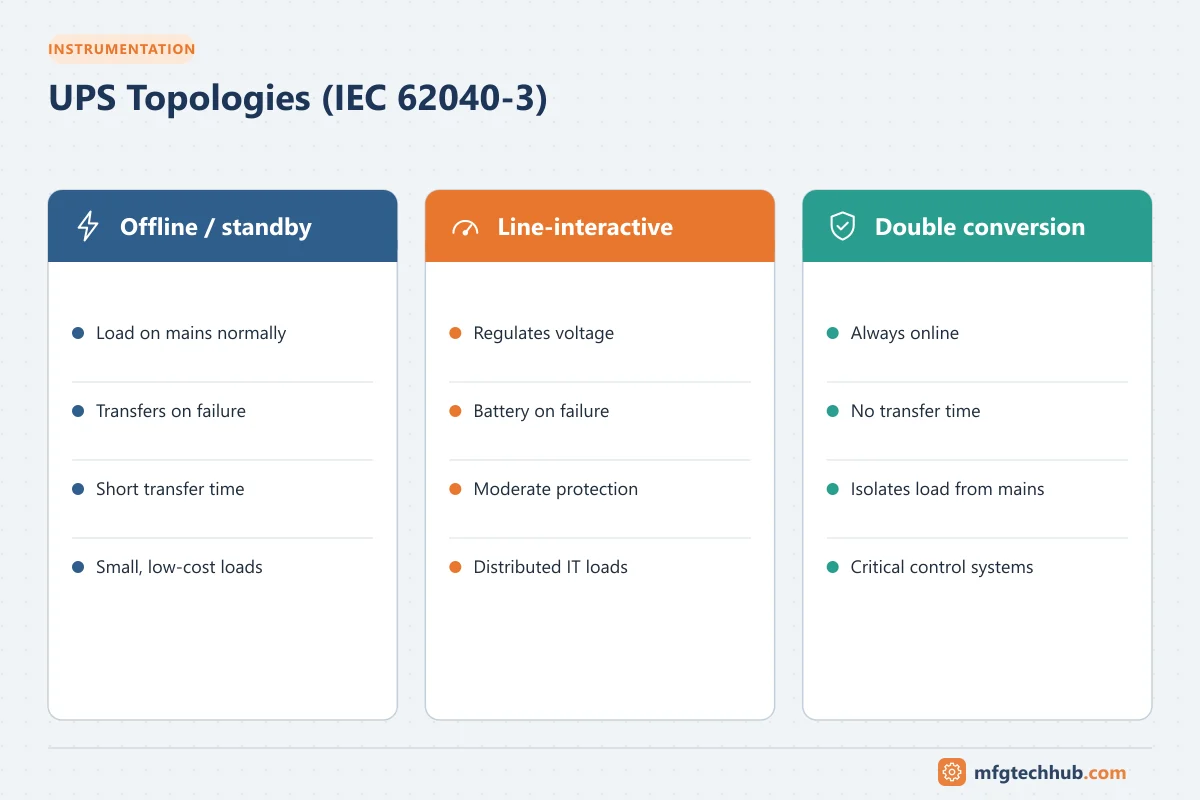
UPS topologies (IEC 62040-3)
| Topology | How it works | Protection | Typical use |
|---|---|---|---|
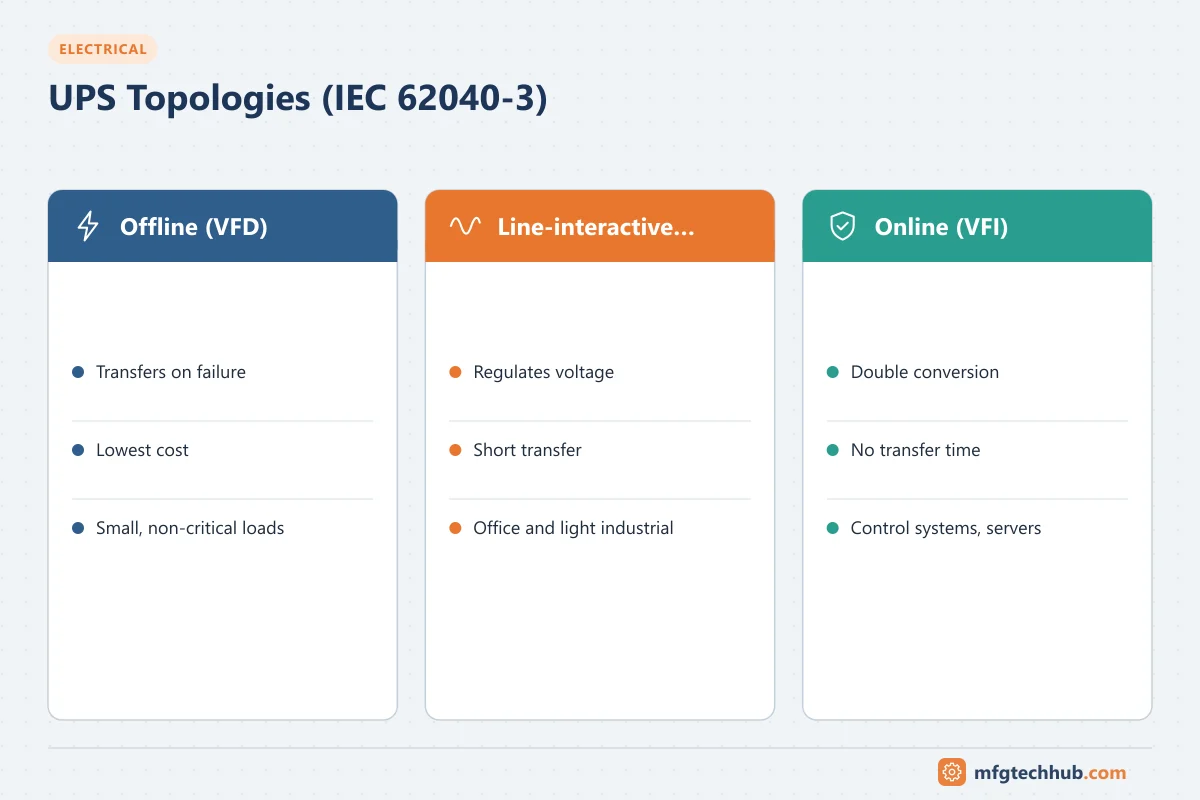
| Offline / standby (VFD) | Load runs from mains; switches to inverter on failure | Basic; short transfer time | Small desktop loads |
| Line-interactive (VI) | Adds voltage regulation (tap-changing transformer) | Handles moderate voltage variations | Small IT and control loads |
| Double conversion online (VFI) | Mains is rectified to DC and inverted back to AC continuously; battery connected to DC link | Load is isolated from mains disturbances; no transfer interruption | Industrial control systems, data centers, critical loads |
Industrial UPS systems for process plants are usually double conversion designs, often with transformer isolation and ratings suited to harsh environments.
Static bypass
Online UPS systems include a static bypass switch that transfers the load directly to an alternative supply if the inverter fails or is overloaded, and a manual maintenance bypass for servicing without shutting down the load.
AC UPS vs DC UPS
- AC UPS: supplies 230 V or 120 V AC (single-phase) or three-phase AC loads such as servers and workstations.
- DC UPS / DC power systems: supply 24 V DC (sometimes 48 V or 110 V DC) directly to controllers, I/O and field instruments. They are simpler and more efficient because they avoid conversion back to AC. Substations commonly use 110 V or 125 V DC battery systems for protection relays and breaker tripping.
Batteries
| Battery type | Characteristics |
|---|---|
| VRLA (valve-regulated lead-acid) | Common and low cost; sensitive to temperature; typical design life 5-12 years depending on type and conditions |
| Vented (flooded) lead-acid | Long life and robust; needs ventilation, water topping and more maintenance |
| Nickel-cadmium (NiCd) | Tolerates extreme temperatures and abuse; used in harsh industrial and offshore environments |
| Lithium-ion | Smaller, lighter, longer cycle life and faster charging; requires a battery management system; higher initial cost |
Temperature is critical: a common rule for lead-acid batteries is that life roughly halves for every 8-10 °C above 25 °C. Battery rooms and cabinets should be kept cool.
Sizing: how much runtime?
Required backup time (autonomy) depends on the purpose:
- Ride-through until generators start and stabilize (often 10-15 minutes minimum)
- Time for an orderly process shutdown
- Specific requirements for safety and fire systems, which may require 30 minutes, several hours or more under relevant standards
A simplified DC system estimate:
Battery capacity (Ah) ≈ Load current (A) × Runtime (h) ÷ (Depth of discharge × Temperature and ageing factors)Example: a 24 V DC control system draws 20 A and needs 2 hours of backup. Allowing for 80% usable capacity and a combined ageing and temperature factor of 0.8: 20 × 2 ÷ (0.8 × 0.8) ≈ 63 Ah, so select the next standard size above this. Real sizing uses discharge tables from the battery manufacturer, because available capacity depends on discharge rate and end voltage.
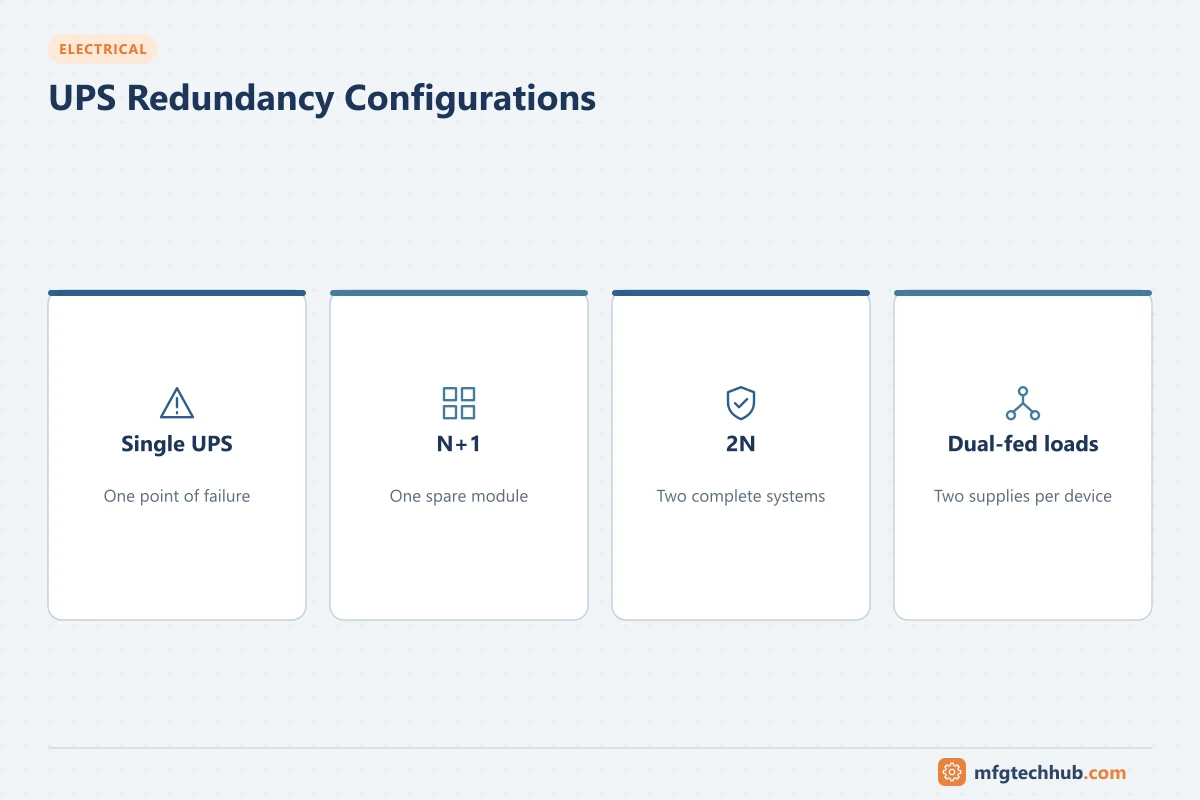
Redundancy configurations
| Configuration | Description | Availability |
|---|---|---|
| Single UPS | One UPS with static bypass | Basic |
| N+1 | Enough modules to carry the load, plus one spare | Tolerates one module failure |
| 2N | Two fully independent UPS systems, each able to carry the whole load | Tolerates failure of an entire system |
| Dual-fed loads | Critical equipment with two power supplies fed from separate UPS systems | Highest availability |
Many control systems have redundant power supply modules in each cabinet, fed from two independent sources (for example UPS A and UPS B), so no single failure removes power from the controllers.
Monitoring and maintenance
- Monitor UPS alarms and status in the DCS or SCADA (on battery, bypass, battery fault, overload).
- Perform periodic battery tests: impedance or conductance measurements and controlled discharge (capacity) tests. IEEE 1188 (VRLA) and IEEE 450 (vented lead-acid) give recommended practices.
- Check battery temperatures and terminal connections; use thermography.
- Replace batteries before end of life, based on test results.
- Test transfer to battery and bypass under controlled conditions.
- Keep UPS rooms clean, cool and ventilated.
Common problems
- Batteries that fail capacity tests long before their design life due to high temperature
- UPS overloaded by equipment added over the years without review
- Single points of failure such as one distribution board feeding both “redundant” supplies
- Maintenance bypass left closed after servicing
- Loads that do not need backup connected to the UPS, reducing runtime
Key takeaways
- Double conversion online UPS systems protect critical industrial loads from interruptions and disturbances.
- DC UPS systems efficiently supply 24 V DC controllers and instruments.
- Battery choice, temperature control and testing decide real backup performance.
- N+1, 2N and dual-fed designs remove single points of failure.
Related tutorials
Before you apply this in a plant: this article is for education. Always check the current edition of the relevant standards, the manufacturer's documentation for your exact product and version, and your site's procedures. Safety-related work needs qualified personnel. See our editorial policy.