
Bimetallic Thermometers: How They Work, Selection, Installation and Checking
On this page
A bimetallic thermometer is the familiar dial thermometer on pipes, tanks and heat exchangers. It needs no power, is cheap and robust, and gives operators a local reading they can trust when the control system is down or when they want to confirm a transmitter. It is not a precision or remote-reading instrument, and it is often neglected until someone relies on a reading that has been wrong for years.
How it works
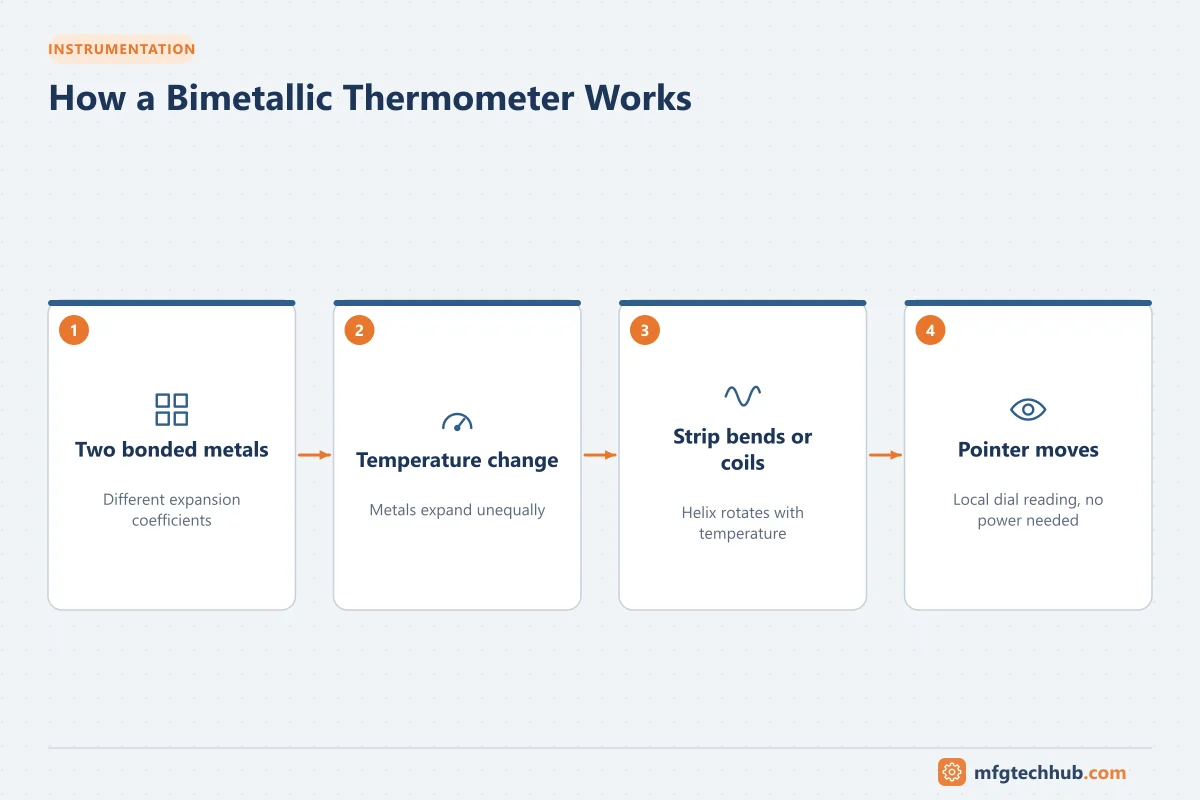
Two metal strips with different thermal expansion are bonded together. When the temperature changes, one expands more than the other and the strip bends. In industrial thermometers the bimetal is wound into a helix inside the stem; as temperature changes the helix rotates, turning a shaft connected directly to the pointer. No gears or electronics are involved.
Bimetal elements are also used in thermostats and thermal switches, where the bending strip opens or closes a contact, and in bimetallic motor overload relays. See Motor Protection Relays.
Where they are used
| Use | Why a bimetallic thermometer fits |
|---|---|
| Local indication on process lines, vessels, heat exchangers | Power-free, robust, low cost |
| Check against transmitter readings | Independent local reference for operators |
| HVAC, utilities, boilers | Simple monitoring of water and air temperatures |
| Food and beverage | Hygienic versions for local indication |
| Test points | Quick local checks during commissioning |
Where a reading must reach the control system, use an RTD or thermocouple with a transmitter. See RTDs vs Thermistors.
Selection checklist
| Parameter | Considerations |
|---|---|
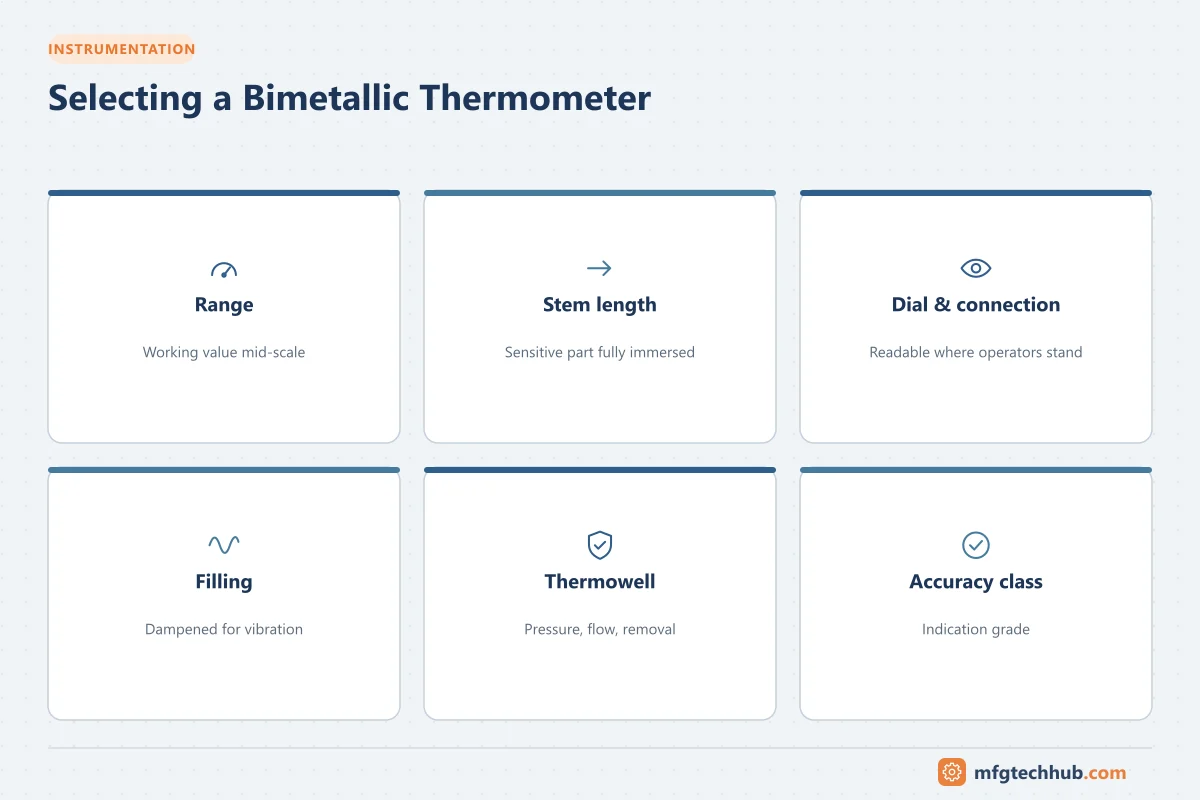
| Range | Normal operating temperature in the middle part of the scale; allow for maximum temperature |
| Stem length | Sensitive part fully immersed in the process (not only the tip) |
| Connection | Back or bottom connection, adjustable angle for readability |
| Dial size | Readable from where operators stand |
| Accuracy class | Check the manufacturer’s class; typical dial thermometers are indication-grade, not precision instruments |
| Case and filling | Stainless steel cases; liquid-filled or dampened versions resist vibration |
| Thermowell | Needed for pressure, flow velocity, corrosive media and removal without shutdown |
| Standards | EN 13190 (dial thermometers) and ASME B40.200 (thermometers) are commonly referenced |
Installation
- Use a thermowell in pressurised or flowing lines so the thermometer can be removed safely, and check the thermowell design for flow-induced vibration at high velocities.
- Ensure the sensitive length of the stem is immersed; partially immersed stems read closer to ambient.
- Fill the thermowell with heat-transfer paste where recommended to improve response.
- Mount where the process is representative (not in dead legs) and where operators can read it.
- Avoid locations with heavy vibration or use dampened versions.
Response time
Bimetallic thermometers respond more slowly than electronic sensors, especially in thermowells. They are suited to indication, not to fast control or protection.
Checking and calibration
- Compare against a reference thermometer in a stirred bath or dry block at two or three points.
- Many models allow pointer adjustment (zero reset); record as-found and as-left values.
- Replace thermometers that are damaged, fogged or outside tolerance; repair is rarely economic.
- In service, compare periodically with the transmitter on the same line: a growing difference points to a problem with one of them.
See Calibration and Traceability.
Common faults
| Symptom | Likely cause | Remedy |
|---|---|---|
| Reads low compared with transmitter | Stem not fully immersed, dry thermowell | Longer stem, heat-transfer paste |
| Pointer stuck | Mechanical damage, overheating beyond range | Replace |
| Fogged or water-filled dial | Seal failure | Replace; choose better ingress protection |
| Pointer oscillates | Vibration | Liquid-filled or dampened version, relocate |
| Permanent offset after overtemperature | Bimetal overstressed | Check against reference; replace |
Bimetallic compared with other local thermometers
| Type | Strengths | Limitations |
|---|---|---|
| Bimetallic dial | Cheap, robust, no power | Limited accuracy, slow, local only |
| Filled-system (gas or liquid) | Remote dial via capillary, good for panel mounting | Capillary damage, ambient effects |
| Glass thermometer | Simple, accurate in laboratories | Fragile; mercury types restricted |
| Digital local indicator | Better accuracy, easy to read | Needs battery or power |
Frequently asked questions
How does a bimetallic thermometer work?
Two bonded metals with different expansion rates bend when temperature changes. Wound into a helix, the bimetal rotates a shaft that moves the pointer directly.
Are bimetallic thermometers accurate?
They are indication-grade instruments, suitable for local checks. For control, records or accurate measurement, use an RTD or thermocouple with a transmitter.
Why does a bimetallic thermometer read lower than the transmitter?
Often because the sensitive part of the stem is not fully immersed in the process or the thermowell is dry, so the thermometer is influenced by ambient temperature.
Key takeaways
- Bimetallic thermometers give power-free, robust local indication.
- Select range, stem length and dial for readability and full immersion.
- Install in thermowells and away from heavy vibration.
- Check periodically against a reference and replace when out of tolerance.
Related tutorials
Before you apply this in a plant: this article is for education. Always check the current edition of the relevant standards, the manufacturer's documentation for your exact product and version, and your site's procedures. Safety-related work needs qualified personnel. See our editorial policy.