
Open-Loop vs Closed-Loop Control Systems Explained
On this page
Every automated process uses one of two basic control strategies. In open-loop control, the controller acts without checking the result. In closed-loop (feedback) control, the controller measures the result and corrects its action until the target is reached. Understanding the difference explains why a timer-based dosing pump can drift, why a temperature controller holds a steady value, and why most industrial loops are closed-loop.
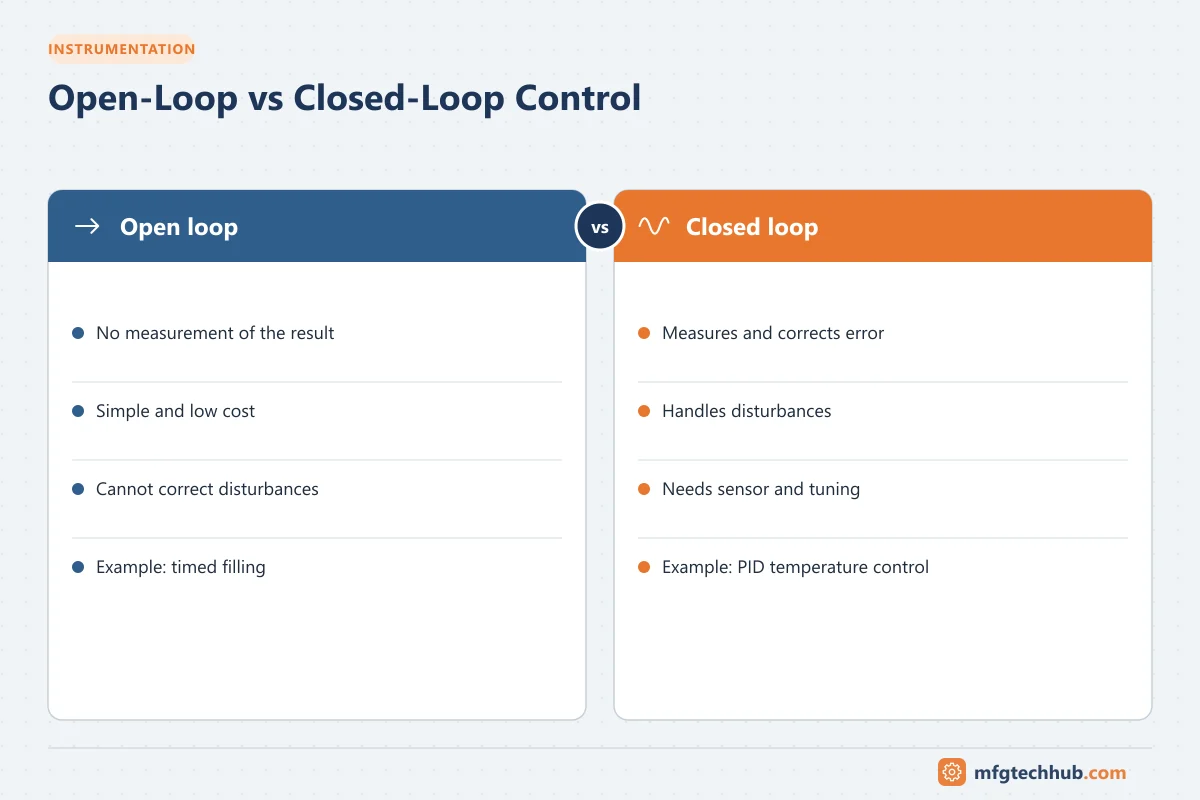
Open-loop control
An open-loop system sends a command to an actuator based only on a setting, a schedule or a timer. It does not measure the output.
Setpoint / command  ──►  Controller  ──►  Actuator  ──►  Process  ──►  Output
                                     (no measurement fed back)
Industrial examples
- A conveyor that runs at a fixed drive speed setting
- A dosing pump that injects chemical for a fixed time every hour
- A timed sequence that opens a drain valve for 30 seconds
- A stepper motor that moves a set number of steps without a position sensor
Advantages
- Simple and low cost: no sensor or tuning needed
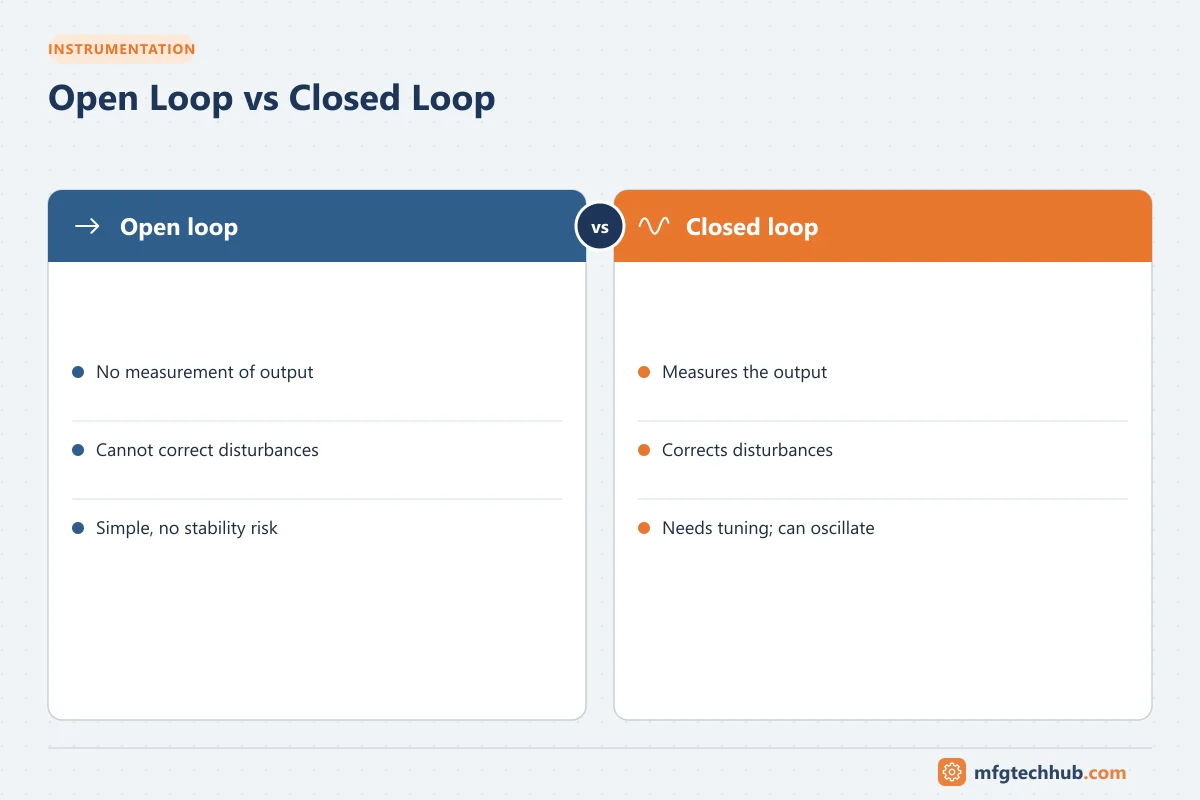
- Always stable, because there is no feedback to cause oscillation
- Fast when the process is well understood and repeatable
Limitations
- Cannot correct for disturbances such as load changes, wear, temperature or supply variations
- Accuracy depends entirely on how well the process was characterized and calibrated
- Errors go undetected: if the pump loses prime, the controller does not know
Closed-loop (feedback) control
A closed-loop system measures the controlled variable, compares it with the setpoint, and adjusts the output to reduce the difference (the error).
Setpoint ──►(+)──► Controller ──► Final element ──► Process ──┬──► Output (PV)
             ▲ (−)                                              │
             └───────────────── Measurement (transmitter) ◄────┘
Elements of a feedback loop
| Element | Example in a temperature loop |
|---|---|
| Process variable (PV) | Tank temperature |
| Sensor/transmitter | RTD with a 4-20 mA transmitter |
| Setpoint (SP) | 80 °C |
| Controller | PID block in a PLC or DCS |
| Final control element | Steam control valve |
| Disturbances | Cold feed flow, ambient temperature, steam pressure changes |
Advantages
- Corrects automatically for disturbances and changes in the process
- Maintains accuracy even when equipment ages or conditions change
- Makes it possible to detect problems, because the measured value is always available
Limitations
- Needs a reliable measurement; a faulty transmitter causes wrong control action
- Can oscillate or become unstable if poorly tuned
- Reacts only after an error appears, so slow processes may deviate before being corrected
Most closed-loop controllers use PID or ON/OFF algorithms. See Process Controllers: ON/OFF, PID and Fuzzy Logic and PID Control Explained.
Side-by-side comparison
| Feature | Open-loop | Closed-loop |
|---|---|---|
| Uses measurement of the output | No | Yes |
| Corrects disturbances | No | Yes |
| Stability risk | None | Possible if poorly tuned |
| Cost and complexity | Lower | Higher |
| Accuracy over time | Drifts | Maintained |
| Typical uses | Sequences, timers, simple drives | Temperature, pressure, flow, level, speed control |
Feedforward: correcting before the error appears
Feedforward control measures a disturbance directly and adjusts the output before the process variable is affected. It is technically open-loop with respect to the process variable, so it cannot correct for disturbances it does not measure. In practice, feedforward is almost always combined with feedback:
- Example: in a heat exchanger, a sudden increase in process flow will cool the outlet. A feedforward signal from the flow transmitter increases the steam valve immediately, while the feedback temperature controller trims any remaining error.
Boiler drum level control is a classic application; see Boiler Drum Level Control.
Choosing between open and closed loop
Use open-loop when:
- The process is highly repeatable and disturbances are small
- Moderate errors are acceptable
- No practical measurement is available, or measurement would be too costly
Use closed-loop when:
- The result must be held accurately despite disturbances
- The process changes over time
- Safety, quality or efficiency depend on the controlled value
Many real systems use both: a PLC sequence (open-loop logic) steps through a batch, while closed-loop PID controllers hold temperatures and flows within each step.
Common problems in closed-loop systems
- Measurement problems: noisy, frozen or wrongly scaled transmitters. Check scaling with the 4-20 mA calculator.
- Final element problems: sticking or oversized control valves. See Actuators and Control Valves.
- Wrong controller action: direct instead of reverse, which drives the output to one extreme.
- Poor tuning: oscillation or sluggish response. Try the PID tuning calculator.
Key takeaways
- Open-loop control acts without measuring the result; closed-loop control measures and corrects.
- Closed-loop control handles disturbances but depends on good measurement and tuning.
- Feedforward adds speed by correcting measured disturbances before they affect the process.
- Industrial systems combine open-loop sequences with closed-loop regulatory control.
Related tutorials
Before you apply this in a plant: this article is for education. Always check the current edition of the relevant standards, the manufacturer's documentation for your exact product and version, and your site's procedures. Safety-related work needs qualified personnel. See our editorial policy.