
Electromagnetic and Ultrasonic Flowmeters: Principles, Selection, Installation and Troubleshooting
On this page
Electromagnetic and ultrasonic flowmeters share a big advantage: nothing in the flow path moves or obstructs the flow, so there is little pressure loss and little wear. Magnetic meters are the default for conductive liquids such as water, wastewater, slurries and chemicals. Ultrasonic meters handle non-conductive liquids and gases, and clamp-on versions can be fitted without cutting the pipe. Both depend on correct installation.
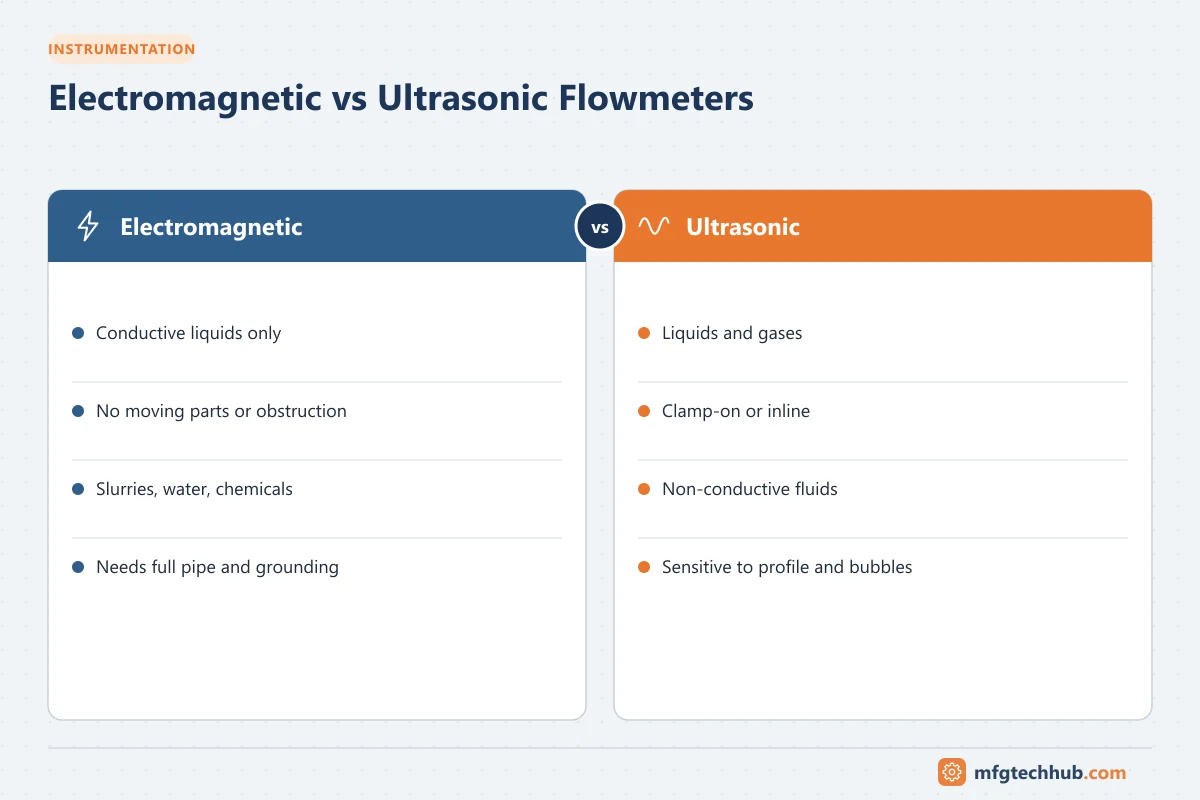
Electromagnetic (magnetic) flowmeters
Principle: a conductive liquid flowing through a magnetic field generates a voltage proportional to its velocity (Faraday’s law). Electrodes in the pipe wall measure this voltage; the meter calculates volumetric flow from velocity and pipe area.
| Aspect | Detail |
|---|---|
| Fluids | Conductive liquids only; minimum conductivity is specified by the manufacturer (often a few µS/cm) |
| Not suitable for | Hydrocarbons, oils, gases, pure water below the minimum conductivity |
| Strengths | No obstruction, no pressure loss, wide rangeability, handles slurries and solids |
| Liners | Rubber, PTFE, PFA, ceramic: chosen for chemicals, abrasion and temperature |
| Electrodes | Stainless steel, Hastelloy, titanium, platinum, depending on corrosion |
| Grounding | The liquid must be at the same potential as the meter; use grounding rings or electrodes in lined or plastic pipes |
Ultrasonic flowmeters
| Type | Principle | Suits |
|---|---|---|
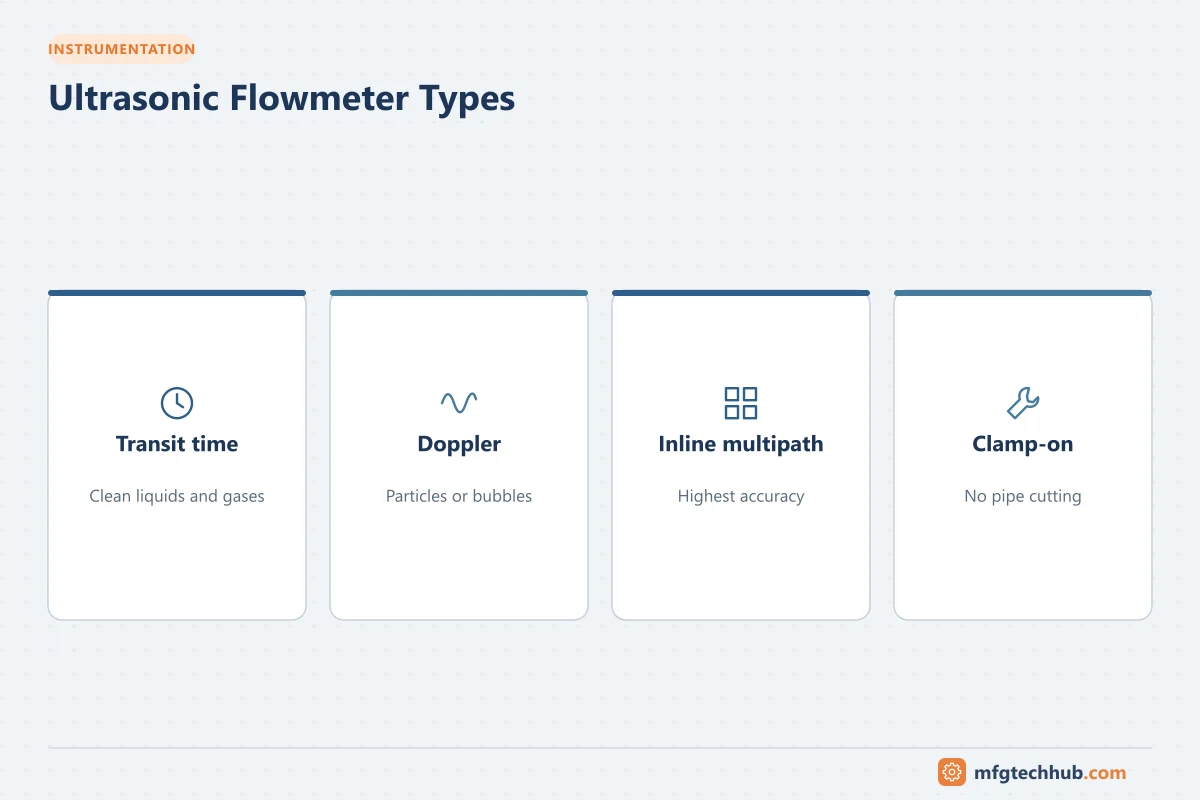
| Transit time | Measures the difference in travel time of sound pulses sent with and against the flow | Clean liquids and gases; most common type |
| Doppler | Measures the frequency shift of sound reflected from particles or bubbles | Liquids with suspended solids or bubbles; lower accuracy |
| Inline (spool) | Transducers built into a pipe section, often multipath | Accurate measurement, gas custody transfer with multipath meters |
| Clamp-on | Transducers mounted outside the pipe | Retrofits, temporary surveys, no process interruption |
Multipath meters use several acoustic paths across the pipe to average the velocity profile, improving accuracy and reducing straight-run needs.
Comparison
| Aspect | Magnetic | Ultrasonic transit time |
|---|---|---|
| Fluids | Conductive liquids | Liquids and gases (clean) |
| Solids and slurries | Very good | Poor for transit time; Doppler possible |
| Pressure loss | None | None |
| Installation | Inline; cut into the pipe | Inline or clamp-on |
| Straight run | Moderate | Moderate to long (less with multipath) |
| Sensitivity to | Conductivity, grounding, coating of electrodes | Bubbles, solids, pipe wall condition (clamp-on) |
| Typical use | Water, wastewater, chemicals, food, mining slurries | Hydrocarbons, water distribution, gas, retrofits |
Installation rules
- Full pipe: both meter types need a full pipe for accurate volumetric flow. Install in vertical lines with upward flow or in low points of horizontal lines; avoid high points where air collects.
- Straight runs: follow the manufacturer’s upstream and downstream lengths; bends, pumps and valves distort the velocity profile.
- Magnetic meter orientation: electrodes horizontal, so they are not in the air at the top or in sediment at the bottom.
- Grounding: grounding rings on lined or non-metallic pipes; keep the meter away from strong electrical noise.
- Clamp-on: correct pipe dimensions, wall thickness and material entered; clean pipe surface; acoustic couplant; transducer spacing as calculated by the meter.
Verification
Many modern meters offer in-situ verification that checks electronics, coils and sensors against factory baselines, producing a report without removing the meter. It complements, but does not always replace, flow calibration. For custody transfer and critical measurements, follow the relevant regulations and verify against a reference. See Calibration and Traceability.
Troubleshooting
| Symptom | Meter | Likely cause | First check |
|---|---|---|---|
| Noisy or unstable reading | Magnetic | Poor grounding, air bubbles, low conductivity | Grounding rings, full pipe, conductivity |
| Reading drifts or zero offset | Magnetic | Electrode coating | Clean electrodes; electrode diagnostics |
| Empty-pipe alarm while full | Magnetic | Coated electrodes, low conductivity | Diagnostics, conductivity |
| Loss of signal | Ultrasonic | Bubbles, solids, poor coupling (clamp-on) | Signal strength diagnostics; couplant, transducer mounting |
| Reading wrong since installation | Ultrasonic clamp-on | Wrong pipe data or transducer spacing | Re-enter pipe parameters; check spacing |
| Error after pipe change | Both | Straight run disturbed | Installation geometry |
Frequently asked questions
Can a magnetic flowmeter measure oil?
No. Magnetic flowmeters need a conductive liquid. Oils, hydrocarbons and gases are not conductive enough; ultrasonic, Coriolis or other technologies are used.
What is the difference between transit-time and Doppler ultrasonic meters?
Transit-time meters measure the time difference of sound pulses with and against the flow and suit clean liquids and gases. Doppler meters measure frequency shifts from particles or bubbles and suit dirty liquids, with lower accuracy.
Are clamp-on ultrasonic flowmeters accurate?
They can be accurate enough for many monitoring and survey tasks, but accuracy depends on correct pipe data, pipe condition, transducer installation and flow profile. Inline multipath meters are used where the highest accuracy is needed.
Key takeaways
- Magnetic meters: conductive liquids, slurries, no pressure loss; get grounding right.
- Ultrasonic meters: liquids and gases, inline or clamp-on; transit time for clean fluids, Doppler for dirty ones.
- Both need a full pipe and adequate straight runs.
- Use built-in diagnostics and verification to catch problems early.
Related tutorials
Before you apply this in a plant: this article is for education. Always check the current edition of the relevant standards, the manufacturer's documentation for your exact product and version, and your site's procedures. Safety-related work needs qualified personnel. See our editorial policy.