
Industrial Instrumentation and Electrical Best Practices and Guidelines
On this page
Standards specify minimum requirements, but reliable plants are built on good practice applied consistently at every stage of an asset’s life. This article collects practical guidelines for instrumentation and industrial electrical systems, from design and installation through commissioning, maintenance and modification. Use it as a checklist and adapt it to your site’s standards and regulations.
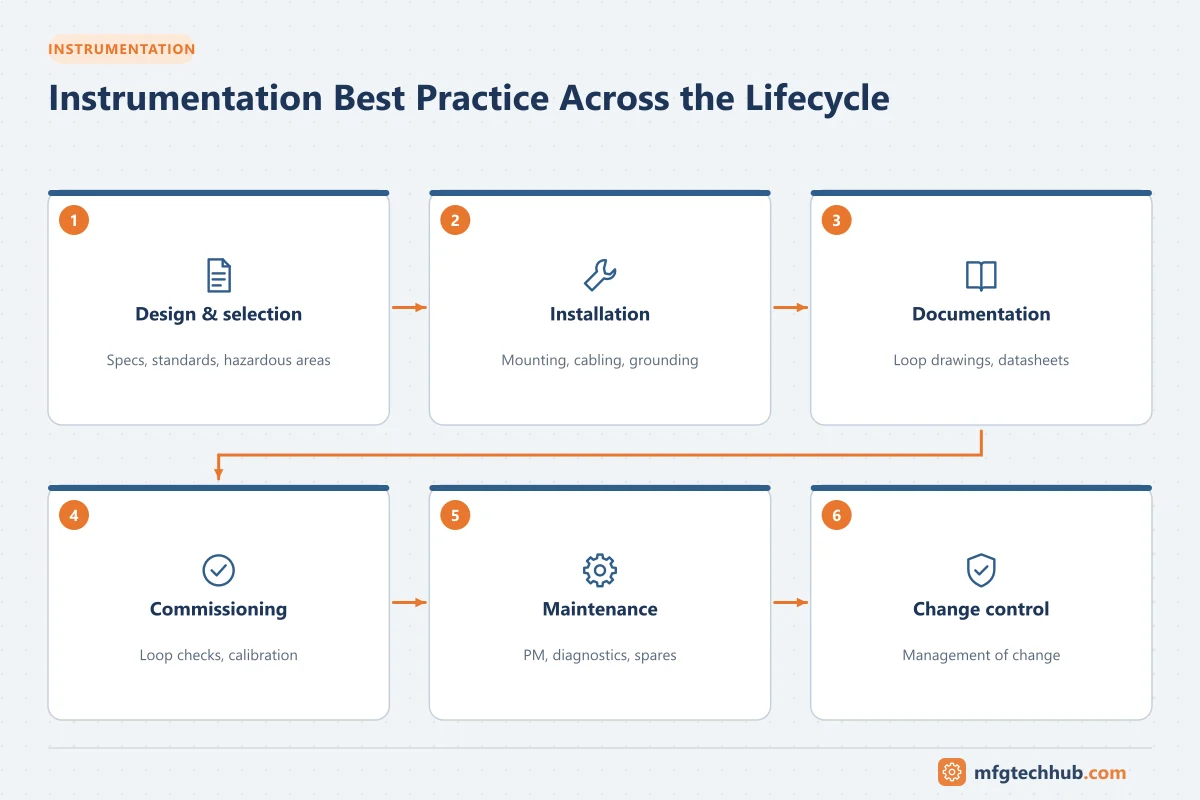
1. Design and specification
- Start from the process requirement: range, accuracy, response time, fluid properties and operating conditions (normal, minimum, maximum and upset).
- Standardize instrument types, models and manufacturers where possible, to reduce spares and training.
- Specify materials compatible with the process, including cleaning and upset conditions.
- Classify hazardous areas before selecting equipment, and select certified equipment accordingly.
- Design for maintenance: access, isolation valves, test connections and space for calibration.
- Separate safety from control: safety instrumented functions use independent sensors, logic and final elements as required by IEC 61511.
- Plan power supplies and grounding at the start, including UPS, redundancy and earthing philosophy.
- Design security in: network zones and conduits following ISA-99 / IEC 62443.
2. Instrument selection
| Consideration | Good practice |
|---|---|
| Measurement technology | Choose based on fluid, conditions and installation, not habit |
| Range | Normal operating point in the middle of the range |
| Accuracy | Consider total installed accuracy, not only the reference accuracy |
| Diagnostics | Prefer smart devices with NAMUR NE 107 diagnostics |
| Output and communication | Match the control system: 4-20 mA/HART, fieldbus or Ethernet-APL |
| Environment | IP rating, temperature, vibration and corrosion |
3. Installation
- Follow manufacturer installation instructions exactly, including straight pipe runs for flowmeters and mounting orientation.
- Impulse lines: short, correctly sloped, supported, and heat traced where needed.
- Cable glands and entries: correct type and size, sealed, entries pointing down where possible.
- Segregate cables: keep signal, power and VFD motor cables apart; cross at right angles.
- Ground shields correctly according to the grounding philosophy. See Grounding and Earthing Techniques.
- Label everything: instruments, cables, terminals, junction boxes and valves, matching drawings.
- Protect instruments from mechanical damage, heat and weather.
4. Documentation
Maintain accurate, controlled documents:
- P&IDs, kept as-built. See What Is a P&ID?
- Instrument index and datasheets
- Loop diagrams and wiring diagrams
- Cause-and-effect charts and logic diagrams
- Single-line diagrams and protection settings for electrical systems
- Hazardous area classification drawings and Ex equipment registers
- Control system configuration backups
Outdated documents are a safety risk. Every change must update the affected documents.
5. Commissioning
- Mechanical completion checks: correct installation, tagging and hookup.
- Insulation and continuity tests on cables before energizing.
- Loop checks: verify each signal from field to operator display, including ranges, alarms and control action. See Loop Calibrators.
- Functional tests of interlocks and sequences.
- Safety function validation before introducing hazardous materials.
- Record results and punch lists, and close them before handover.
6. Maintenance
- Use criticality-based maintenance strategies. See Instrument Preventive Maintenance.
- Record as-found and as-left calibration data.
- Use condition monitoring for rotating equipment and electrical systems (vibration, thermography, insulation testing).
- Analyze failure data to eliminate recurring problems. See Common Instrument Failures.
- Keep calibration equipment within its calibration interval and traceable.
7. Electrical safety
- Apply the hierarchy of controls; de-energize before work whenever possible.
- Enforce lockout/tagout and test before touch (live-dead-live).
- Carry out arc flash assessments and label equipment.
- Use correctly rated test instruments and PPE.
- Maintain and test protective devices, including RCDs and ground fault protection.
See Electrical Hazard Prevention.
8. Management of change
Every modification, including instrument replacements with different models, set point changes, logic changes and bypasses, should go through management of change (MOC):
- Describe the change and its reason.
- Assess hazards and impacts on safety, control, operations and documentation.
- Obtain approval.
- Implement and test.
- Update documents and train affected people.
- Close the change formally.
9. Control system and data practices
- Back up PLC, DCS and HMI configurations regularly and after changes, and store copies off-system.
- Control access with individual accounts and role-based permissions.
- Track forces and bypasses, and review them every shift.
- Rationalize alarms following ISA-18.2 to avoid alarm floods.
- Keep system time synchronized for reliable event records.
10. People and competence
- Train technicians on the specific equipment they maintain.
- Ensure competence for hazardous area work and electrical work.
- Encourage reporting of near misses and problems.
- Share lessons learned between shifts, sites and projects.
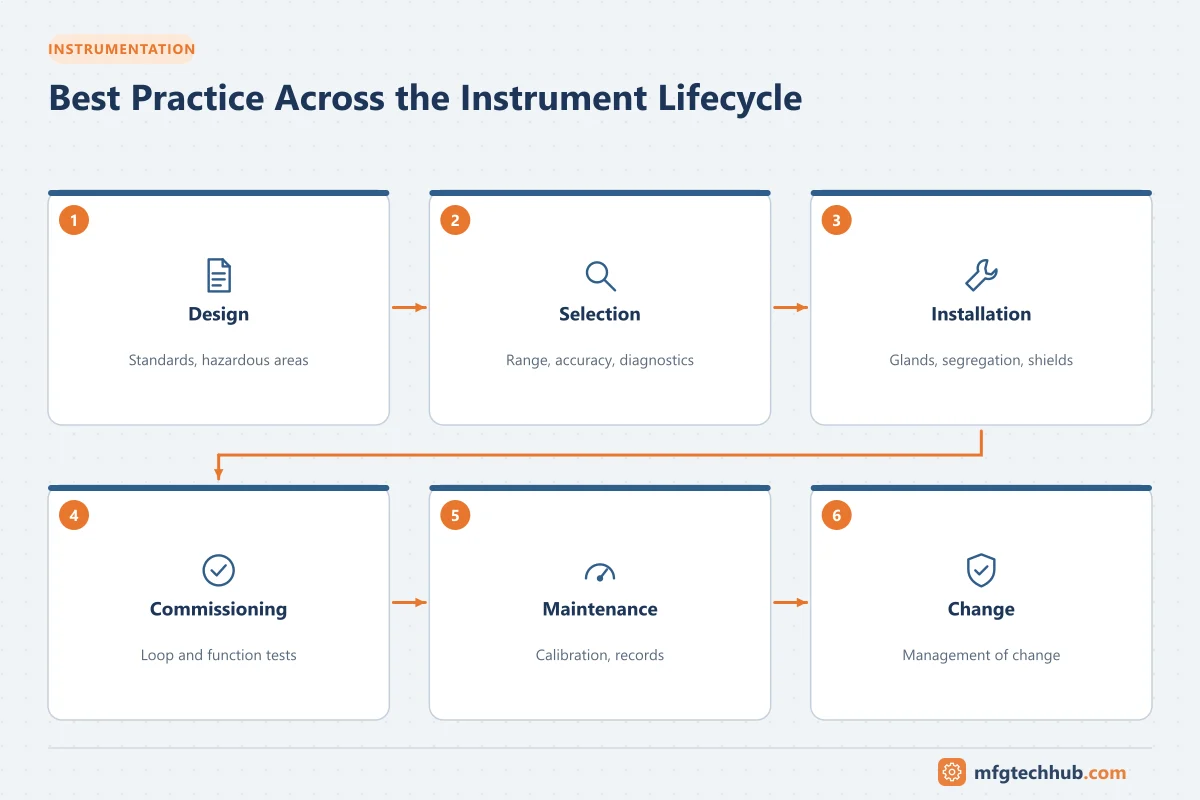
Quick best practice checklist
| Stage | Check |
|---|---|
| Design | Requirements defined, hazardous areas classified, safety separated, security designed in |
| Selection | Right technology and materials, suitable range, smart diagnostics |
| Installation | Manufacturer instructions followed, cables segregated, glands sealed, everything labeled |
| Documentation | As-built drawings, loop diagrams and datasheets up to date |
| Commissioning | Loop checks, functional tests and safety validation completed |
| Maintenance | Criticality-based, data recorded, failures analyzed |
| Change | Every change through MOC, documents updated |
Key takeaways
- Reliable plants apply good practice consistently from design through operation.
- Correct selection, installation and documentation prevent many future problems.
- Commissioning checks, criticality-based maintenance and failure analysis sustain reliability.
- Safety, cybersecurity and management of change protect people and the plant.
Related tutorials
Before you apply this in a plant: this article is for education. Always check the current edition of the relevant standards, the manufacturer's documentation for your exact product and version, and your site's procedures. Safety-related work needs qualified personnel. See our editorial policy.