
Electrical Hazard Prevention in Manufacturing
On this page
Electricity powers every machine in a factory, and it can injure or kill in an instant. Electric shock, arc flash, arc blast, fires and ignition of flammable atmospheres are all preventable with good design, safe work practices and a strong safety culture. This article summarizes the main electrical hazards and the controls that prevent them.
This is general educational information. Always follow your site’s electrical safety rules, local regulations and applicable standards.
Main electrical hazards
| Hazard | What happens | Typical causes |
|---|---|---|
| Electric shock | Current flows through the body, which can cause burns, heart fibrillation and death | Contact with live parts, damaged insulation, missing earthing |
| Arc flash | An electric arc releases intense heat and light, causing severe burns | Short circuits during work, dropped tools, failing equipment |
| Arc blast | Pressure wave, molten metal and shrapnel from an arc | High-energy faults in switchgear |
| Electrical fire | Overheating ignites insulation or nearby materials | Loose connections, overloads, damaged cables |
| Ignition of explosive atmospheres | Sparks or hot surfaces ignite gas, vapor or dust | Non-certified equipment in hazardous areas |
| Secondary injuries | Falls or involuntary movement after a shock | Working at height, reflex reactions |
The hierarchy of controls
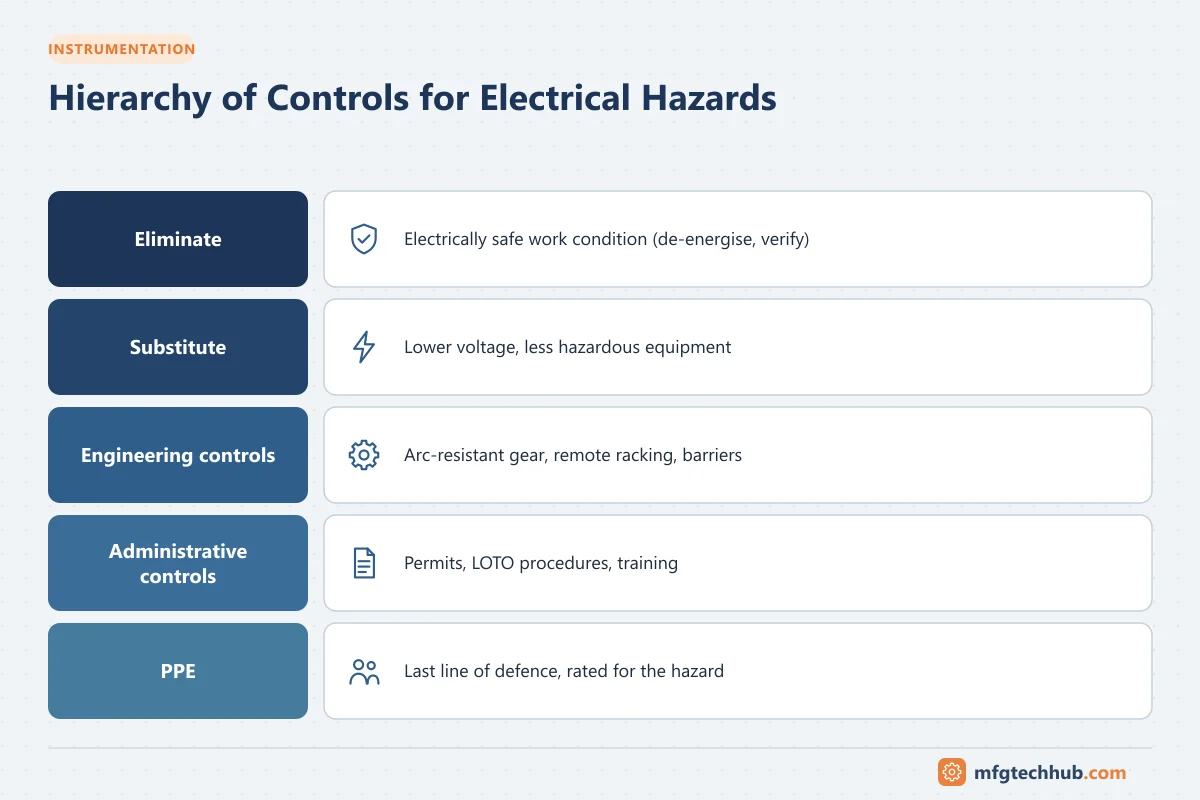
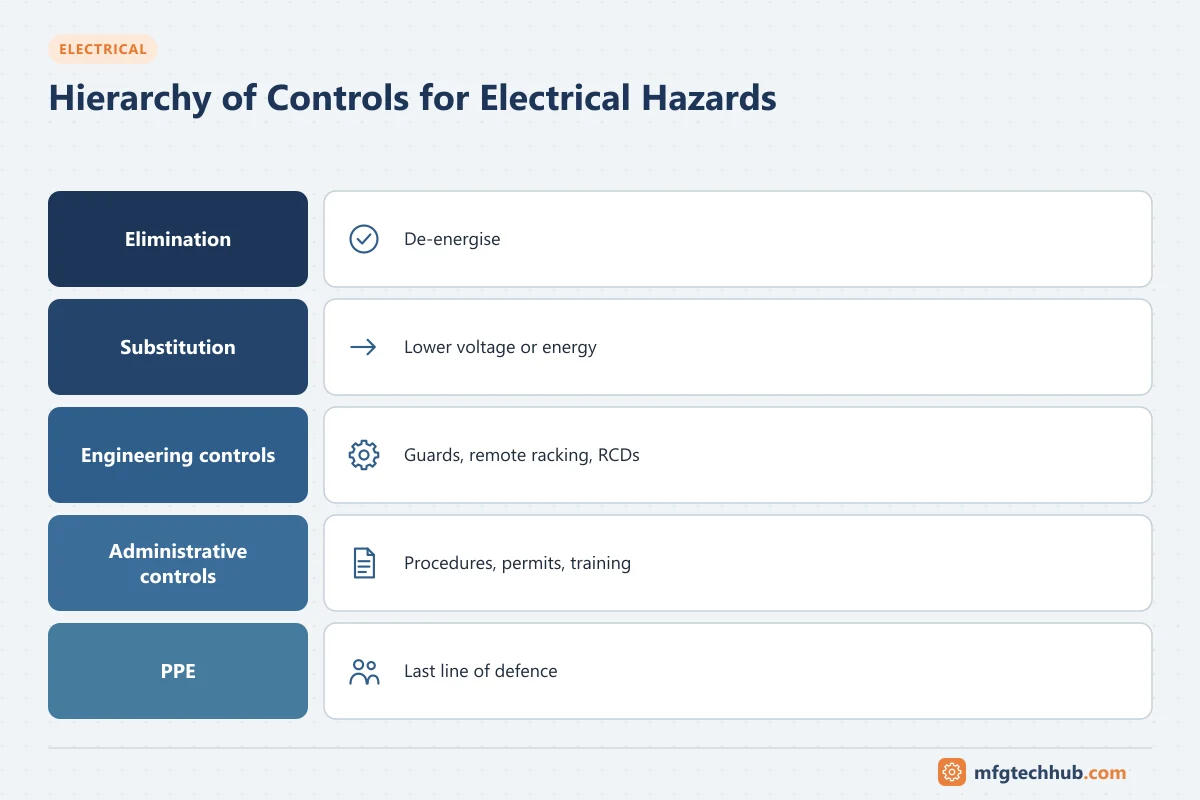
Safety programs apply controls in order of effectiveness:
- Elimination: de-energize equipment before work. Working on de-energized equipment is the default.
- Substitution: use lower voltages, for example 24 V DC control circuits.
- Engineering controls: enclosures, interlocks, insulated barriers, arc-resistant switchgear, remote racking, RCDs, finger-safe terminals.
- Administrative controls: procedures, permits, training, labeling, approach boundaries.
- Personal protective equipment (PPE): insulated gloves, arc-rated clothing, face shields; the last line of defense.
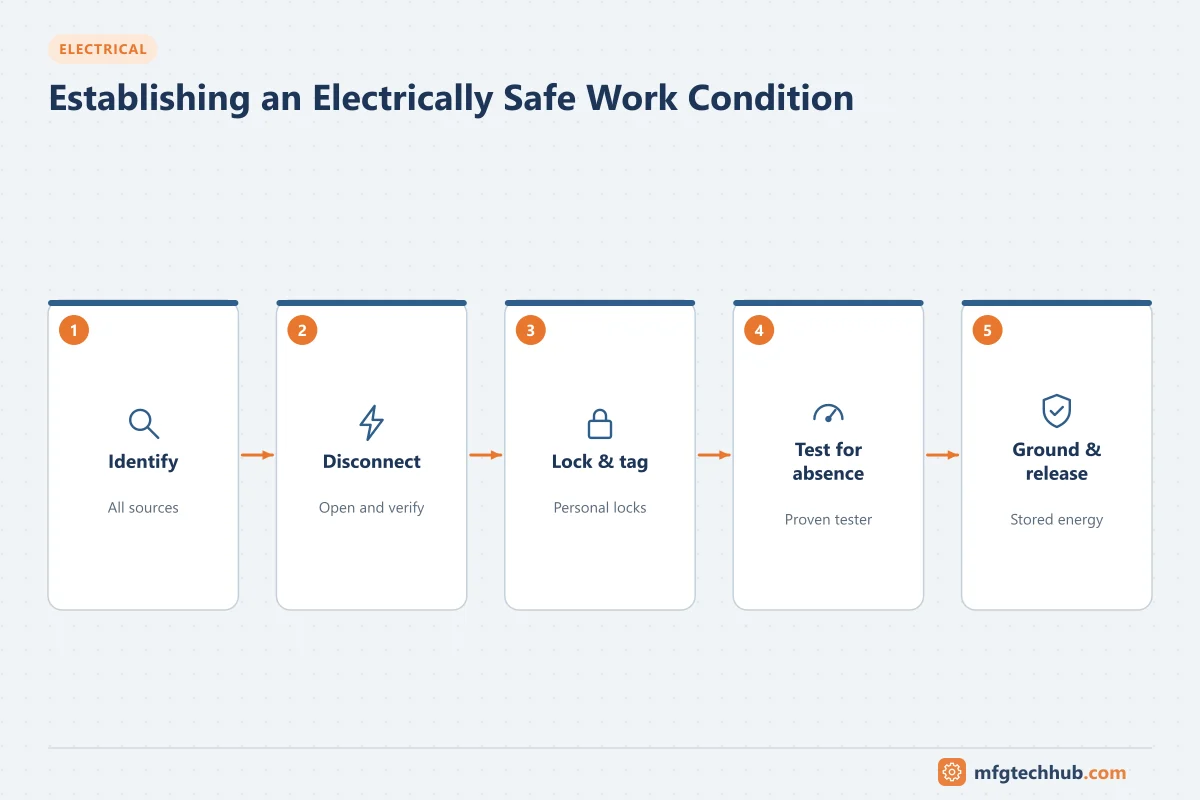
Establishing an electrically safe work condition
Before working on equipment, it must be proven dead and secured:
- Identify all sources of supply, including backfeeds, UPS outputs, generators, capacitors and control voltages from other panels.
- Disconnect each source using the correct isolating device.
- Lock and tag each isolation point (lockout/tagout). Each worker applies their own lock.
- Test for absence of voltage with a properly rated tester, using the live-dead-live method: test the tester on a known live source, test the circuit, then test the tester again.
- Ground (earth) conductors where there is a risk of induced voltage or stored energy, especially on high-voltage systems.
- Release stored energy: discharge capacitors (VFD DC bus capacitors can hold dangerous voltages for minutes after isolation).
Regulations and standards such as OSHA 29 CFR 1910.147 (US lockout/tagout), NFPA 70E (US electrical safety in the workplace) and EN 50110 (Europe, operation of electrical installations) define these practices in detail.
When live work cannot be avoided
Some tasks, such as voltage measurements and certain diagnostics, require working near energized parts. These need:
- A risk assessment and justification, and often a written energized work permit
- Qualified persons with specific training
- Approach boundaries that restrict who can come how close to exposed live parts
- Arc flash risk assessment defining incident energy and required PPE
- Properly rated test instruments (CAT ratings to IEC 61010) and insulated tools
Design measures that reduce hazards
- Finger-safe (IP20) terminals and covers in control panels
- Separation of power and control sections in cabinets
- Residual current devices for sockets and portable equipment. See Earth Leakage Protection
- Reliable protective earthing and bonding. See Grounding and Earthing Techniques
- Faster protection settings and maintenance modes to reduce arc flash energy
- Clear labeling of voltages, sources and arc flash hazards
- Adequate working space and lighting in front of electrical equipment
Hazardous areas
Where flammable gases, vapors or dusts may be present, electrical equipment must not become an ignition source. Areas are classified (for example Zones 0, 1, 2 for gas and 20, 21, 22 for dust under IEC 60079-10; Classes and Divisions in North America) and equipment is selected with suitable protection concepts:
| Protection concept | Principle |
|---|---|
| Intrinsic safety (Ex i) | Limits energy so sparks cannot ignite the atmosphere |
| Flameproof (Ex d) | Enclosure contains an internal explosion |
| Increased safety (Ex e) | Prevents arcs and hot surfaces by design |
| Pressurization (Ex p) | Keeps flammable gas out with positive pressure |
| Encapsulation (Ex m) | Seals components in compound |
Installation and inspection follow IEC 60079-14 and IEC 60079-17. Modifications must maintain certification.
Maintenance practices that prevent hazards
- Thermographic surveys find hot connections before they cause fires. See Infrared Thermography
- Regular testing of RCDs and earth continuity
- Inspection of portable equipment and extension leads
- Keeping panels closed and clean, with no storage in front of switchgear
- Replacing damaged cables and plugs immediately
Building a safety culture
- Train everyone on basic electrical hazards, and qualified workers on detailed procedures.
- Encourage stopping work when conditions are unclear.
- Investigate near misses, not only injuries.
- Audit lockout/tagout practices regularly.
Key takeaways
- Shock, arc flash, fire and explosion are the main electrical hazards.
- De-energize and prove dead before work: isolate, lock, tag, test (live-dead-live) and discharge stored energy.
- Engineering controls such as RCDs, finger-safe design and arc-resistant equipment reduce risk before PPE is needed.
- Hazardous areas require certified equipment and strict installation and inspection practices.
Related tutorials
Before you apply this in a plant: this article is for education. Always check the current edition of the relevant standards, the manufacturer's documentation for your exact product and version, and your site's procedures. Safety-related work needs qualified personnel. See our editorial policy.