
RFID and Barcode Scanners in Industrial Automation
On this page
Traceability, error-proofing and automated material handling all depend on one question: what is this item? Barcodes and RFID (radio frequency identification) answer it automatically. They identify parts, batches, containers, tools and finished products, feed data to PLCs and MES systems, and replace error-prone manual entry.
Barcodes
1D (linear) barcodes
1D barcodes encode data in bars and spaces of different widths.
| Symbology | Typical use |
|---|---|
| EAN-13 / UPC-A | Retail product identification |
| Code 128 / GS1-128 | Logistics, shipping labels, batch and expiry data |
| Code 39 | Industrial and automotive labels (older systems) |
| Interleaved 2 of 5 | Cartons and cases |
2D codes
2D codes store much more data in a small area and remain readable when partly damaged, thanks to error correction.
| Code | Typical use |
|---|---|
| Data Matrix | Small parts, electronics, pharmaceuticals, direct part marking |
| QR code | Documents, equipment labels, links to online information |
| PDF417 | Shipping documents, identification cards |
GS1 standards define how product identifiers (GTIN), batch numbers, serial numbers and dates are encoded, which is essential for supply chain and regulatory traceability, for example in pharmaceutical serialization.
Direct part marking (DPM)
Codes can be marked directly onto metal or plastic parts by laser marking, dot peen or inkjet, so the identity stays with the part through machining, heat treatment and assembly. DPM codes are usually Data Matrix and need special scanners with suitable lighting.
Barcode scanners
| Scanner type | Characteristics |
|---|---|
| Laser scanners | Fast reading of 1D codes, including at distance |
| Image-based scanners (area imagers) | Read 1D and 2D codes in any orientation, including on screens and damaged labels |
| Fixed-mount industrial scanners | Mounted on conveyors and machines; connect to PLCs over industrial Ethernet, fieldbus or serial links |
| Handheld scanners | Operator use at workstations and warehouses; wired or wireless |
| Mobile computers | Scanner plus touchscreen and wireless connection to MES or warehouse systems |
Code quality verification
Reading performance depends on print quality. Verifiers grade codes according to ISO/IEC 15416 (1D) and ISO/IEC 15415 (2D), and ISO/IEC TR 29158 for direct part marks. Grading codes at the point of printing prevents problems downstream.
RFID
An RFID system has tags (transponders) containing a chip and antenna, and readers (interrogators) with antennas that communicate by radio. Tags do not need line of sight and can often be read through packaging, dirt or paint.
Passive, active and semi-passive tags
- Passive tags have no battery; they are powered by the reader’s field. Cheap and long-lasting; most industrial tags are passive.
- Active tags have batteries, long read ranges and can broadcast; used for real-time location of vehicles and high-value assets.
- Semi-passive (battery-assisted) tags use a battery for sensors or the chip, but communicate like passive tags.
RFID frequency bands
| Band | Frequency | Typical range (passive) | Characteristics and uses |
|---|---|---|---|
| LF | 125-134 kHz | A few centimetres | Works near metal and liquids; animal ID, access control, tool identification |
| HF | 13.56 MHz | Up to around 1 m (often less) | ISO 15693 and ISO 14443/NFC; production tracking, workpiece carriers, libraries |
| UHF | 860-960 MHz (varies by region) | Several metres | ISO 18000-63 / EPC Gen2; logistics, pallets, bulk reading of many tags |
Metal and liquids reflect or absorb radio waves, especially at UHF. Use on-metal tags designed for mounting on metal surfaces, and test in the real environment.
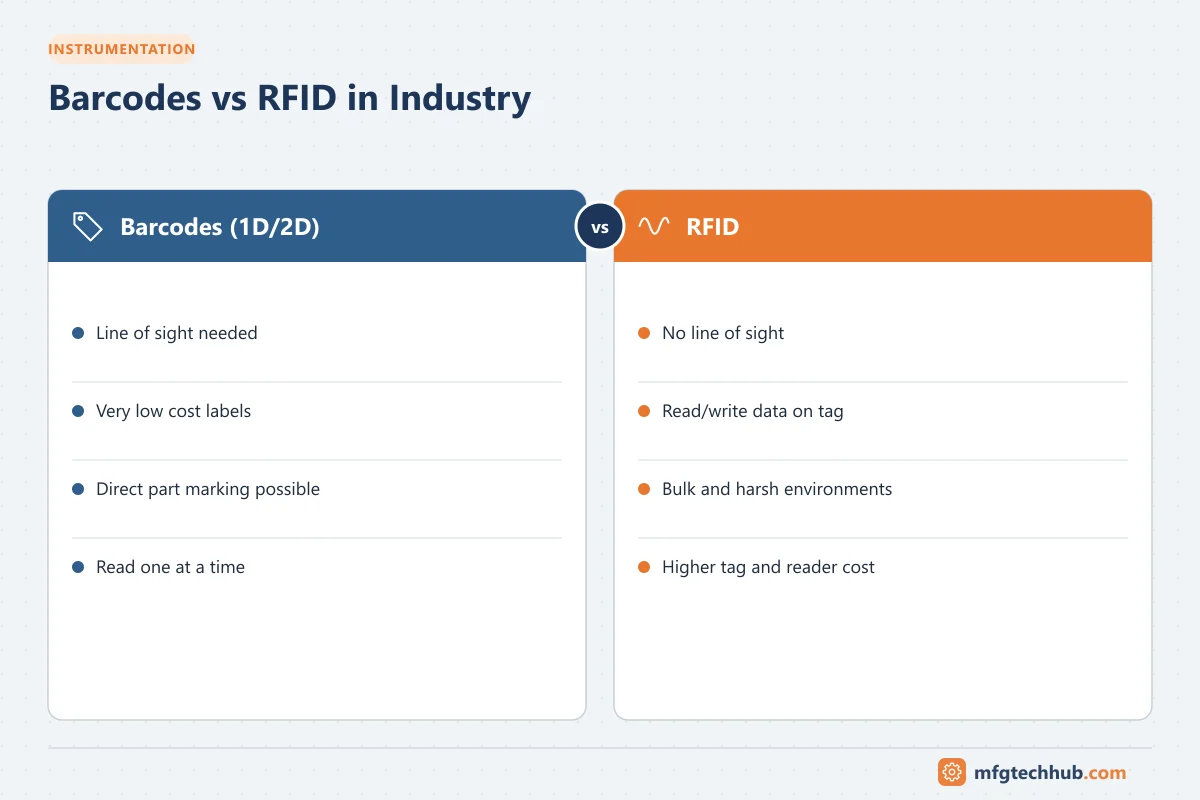
RFID vs barcodes
| Feature | Barcode | RFID |
|---|---|---|
| Line of sight | Required | Not required |
| Read multiple items at once | One at a time (mostly) | Yes, many tags |
| Data can be rewritten | No | Yes, on read/write tags |
| Durability | Labels can be damaged; DPM is durable | Tags can be rugged and encapsulated |
| Cost per item | Very low | Higher |
| Environment sensitivity | Dirt and damage | Metal and liquids |
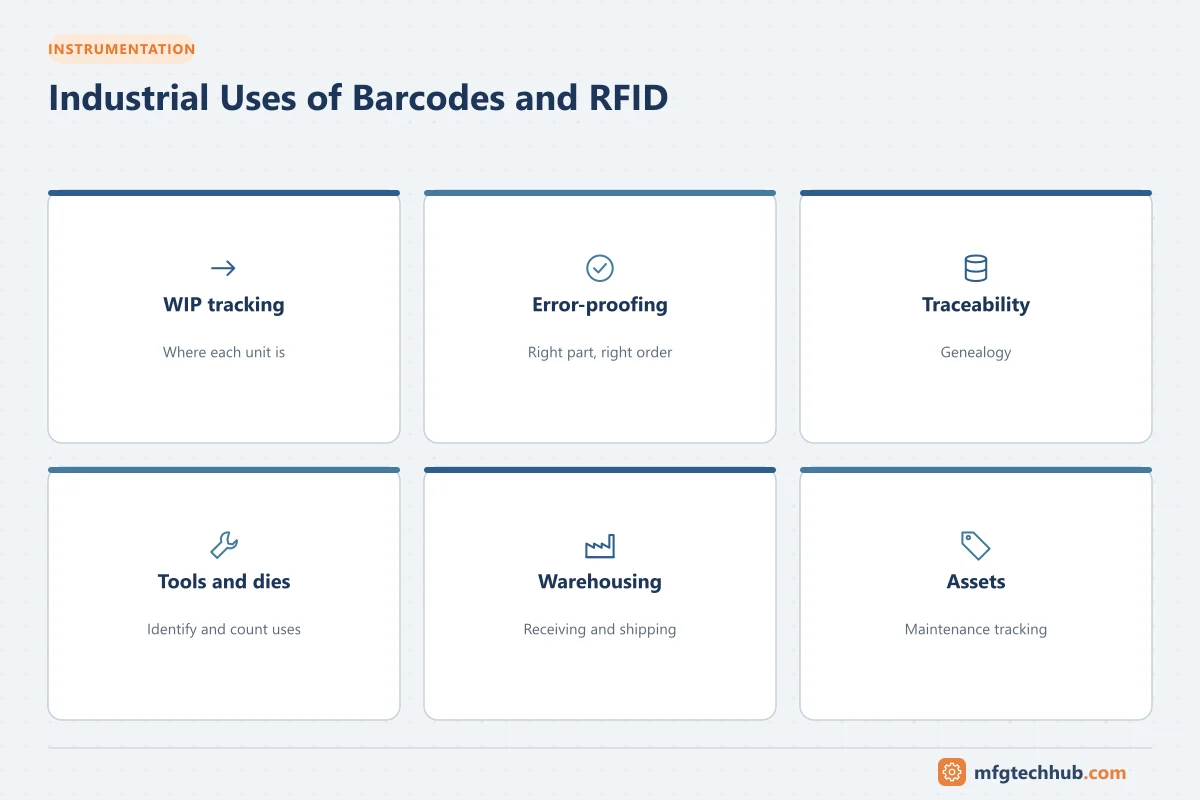
Industrial applications
- Work-in-progress tracking: RFID tags on workpiece carriers tell each station which product variant to build and record the results.
- Error-proofing: scanning components before assembly confirms the correct part is used.
- Traceability and genealogy: linking serial numbers of components and batches to finished products. See MES Real-Time Visibility and Traceability.
- Tool and die identification: RFID tags on tools ensure the right tool and settings are used.
- Warehousing and logistics: receiving, put-away, picking and shipping verification.
- Asset and maintenance tracking: equipment tags linked to maintenance records.
Integration with automation systems
- Fixed readers connect to PLCs through PROFINET, EtherNet/IP, Modbus TCP or IO-Link, often with function blocks provided by the manufacturer.
- Data is passed to MES and ERP systems for tracking and reporting.
- Middleware filters duplicate reads and converts raw reads into business events.
Implementation tips
- Define what must be identified and what data must be captured.
- Choose code types or RFID frequency based on environment, distance and speed.
- Test with real parts, materials and conveyor speeds before rollout.
- Standardize data formats (for example GS1).
- Plan exception handling: what happens when a read fails?
Key takeaways
- Barcodes and 2D codes are cheap and universal; Data Matrix and DPM keep identity on the part itself.
- RFID reads without line of sight and can read many tags at once; frequency choice depends on range and environment.
- Integration with PLCs and MES turns identification into traceability and error-proofing.
Related tutorials
Before you apply this in a plant: this article is for education. Always check the current edition of the relevant standards, the manufacturer's documentation for your exact product and version, and your site's procedures. Safety-related work needs qualified personnel. See our editorial policy.