
Websites and Online Learning Platforms for Instrumentation Engineers
On this page
Learning in instrumentation and automation never stops: technologies, standards and best practices keep evolving. Fortunately, there is a wealth of high-quality information online, much of it free. This guide lists the organizations, websites, courses and certifications that are most useful for instrumentation, control and industrial electrical engineers.
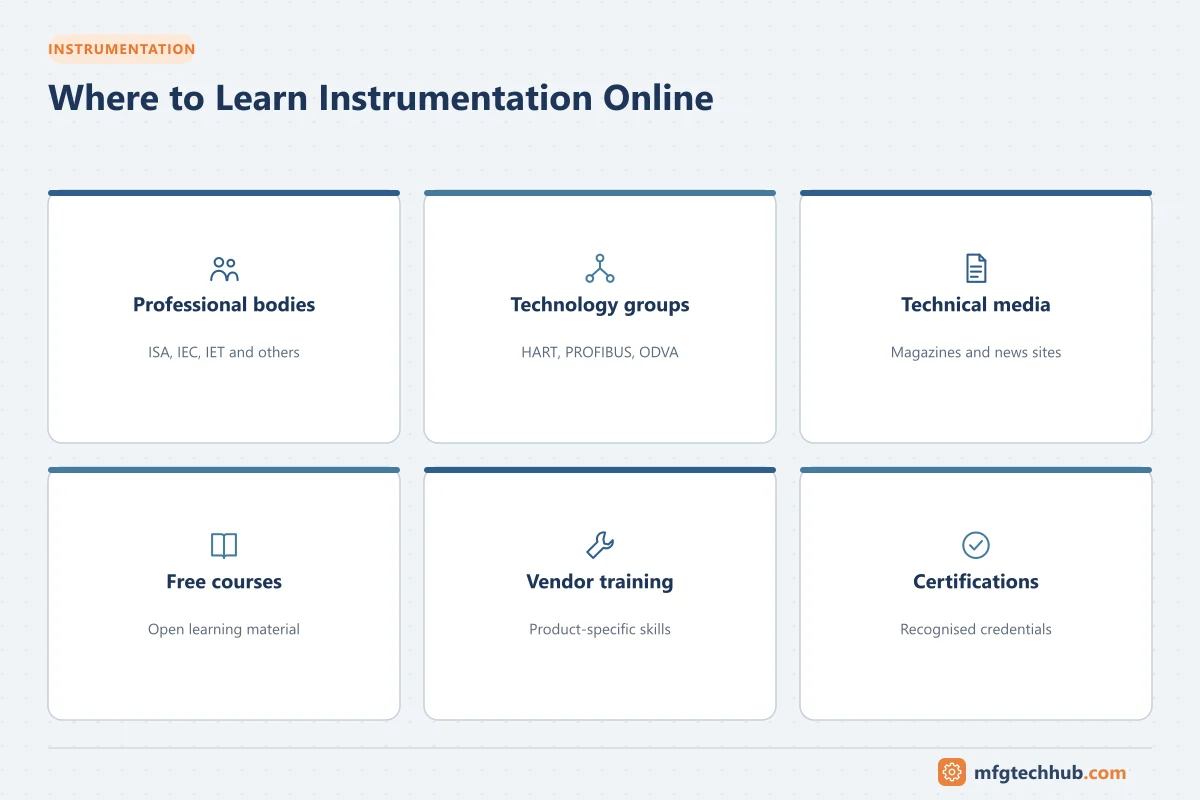
Professional organizations and standards bodies
| Organization | What it offers |
|---|---|
| ISA (International Society of Automation), isa.org | Standards (ISA-5.1, ISA-18.2, ISA-84, ISA/IEC 62443), training, certifications, publications and local sections |
| IEC (International Electrotechnical Commission), iec.ch | International electrical and electronic standards |
| IEEE, ieee.org | Power, industry applications and electrical standards; technical societies and papers |
| NIST, nist.gov | Measurement science, calibration traceability resources and cybersecurity frameworks |
| NAMUR, namur.net | Recommendations from process industry users (for example NE 43 and NE 107) |
| National standards bodies such as BIS (India), BSI (UK) and ANSI (US) | National adoptions of standards and national requirements |
Technology foundations and user groups
| Organization | Technology |
|---|---|
| FieldComm Group | HART, FOUNDATION Fieldbus, FDI and related device integration |
| PROFIBUS & PROFINET International (PI) | PROFIBUS, PROFINET and IO-Link |
| ODVA | EtherNet/IP and the Common Industrial Protocol (CIP) |
| OPC Foundation | OPC UA specifications and companion specifications |
| Modbus Organization | Modbus specifications |
| Ethernet-APL project | Ethernet Advanced Physical Layer for field instruments |
These organizations publish specifications, white papers, product catalogs of certified devices and training resources. See Industrial Communication Protocols.
Technical magazines and news sites
- InTech (ISA’s magazine)
- Control Global (Control magazine)
- Control Engineering
- Automation.com
- Plant Engineering
These publish application articles, product news, and discussions of industry trends.
Free learning resources
- Lessons In Industrial Instrumentation (Tony R. Kuphaldt): a free, comprehensive textbook, with related worksheets and practice material. See Recommended Books
- Manufacturer knowledge centers: instrument, valve, drive and calibration equipment manufacturers publish free guides, webinars and videos
- NPTEL (National Programme on Technology Enhanced Learning, India): free video courses from Indian Institutes of Technology on instrumentation, control and electrical engineering
- University open courseware on control systems, signals and power engineering
- MFG Tech Hub: structured tutorials on instrumentation, PLC, SCADA, DCS and MES, plus free engineering calculators
Online course platforms
General platforms such as Coursera, edX and Udemy offer courses on control systems, PLC programming, electrical engineering, industrial networking and data analytics, ranging from university-level courses to practical tutorials. Check course reviews, instructor background and syllabus before enrolling.
Vendor training
Automation vendors offer training on their systems, which is often essential for working with specific equipment:
- PLC and DCS vendors (for example Siemens, Rockwell Automation, Schneider Electric, ABB, Emerson, Honeywell and Yokogawa)
- Instrument and analyzer manufacturers
- Drive and motor manufacturers
- Calibration equipment manufacturers
Many offer free e-learning modules as well as paid instructor-led courses.
Certifications worth considering
| Certification | Offered by | Focus |
|---|---|---|
| CCST (Certified Control Systems Technician) | ISA | Technician-level instrumentation and control skills |
| CAP (Certified Automation Professional) | ISA | Automation project and engineering knowledge |
| ISA/IEC 62443 Cybersecurity certificates | ISA | Industrial control system security |
| Functional safety certifications | Various bodies (for example TÜV programs) | IEC 61508 / IEC 61511 safety systems |
| Hazardous area competency (for example CompEx, IECEx CoPC) | Various | Ex equipment installation and inspection |
| Vibration analyst (ISO 18436-2) | Various accredited bodies | Condition monitoring |
| Thermography (ISO 18436-7) | Various accredited bodies | Infrared inspection |
Requirements and recognition vary by country and employer.
Communities
- Local ISA sections and IEEE chapters, which hold meetings and technical talks
- Professional networking groups focused on automation and instrumentation
- Online engineering forums, where practitioners discuss real problems (verify advice against standards and manufacturer documentation)
Building a personal learning plan
- Identify your role and the skills it needs; see the Automation Engineer Roadmap.
- Combine one structured course or book with hands-on practice.
- Learn the standards that apply to your work.
- Choose a certification that matches your career direction.
- Stay current through magazines, webinars and professional events.
Key takeaways
- ISA, IEC, IEEE, NAMUR and technology foundations are primary sources of standards and authoritative information.
- Free resources, including Kuphaldt’s textbook, NPTEL and manufacturer guides, offer excellent learning at no cost.
- Vendor training and certifications build recognized, job-specific skills.
Related tutorials
Before you apply this in a plant: this article is for education. Always check the current edition of the relevant standards, the manufacturer's documentation for your exact product and version, and your site's procedures. Safety-related work needs qualified personnel. See our editorial policy.