
Process Controllers: ON/OFF, PID and Fuzzy Logic Control Compared
On this page
A controller decides how much to open a valve, how hard to drive a heater or how fast to run a pump, based on the difference between the measured value and the setpoint. Three families of control algorithms cover most industrial needs: ON/OFF control, PID control and fuzzy logic control. This article explains how each works, where it fits, and how to choose between them.
ON/OFF (two-position) control
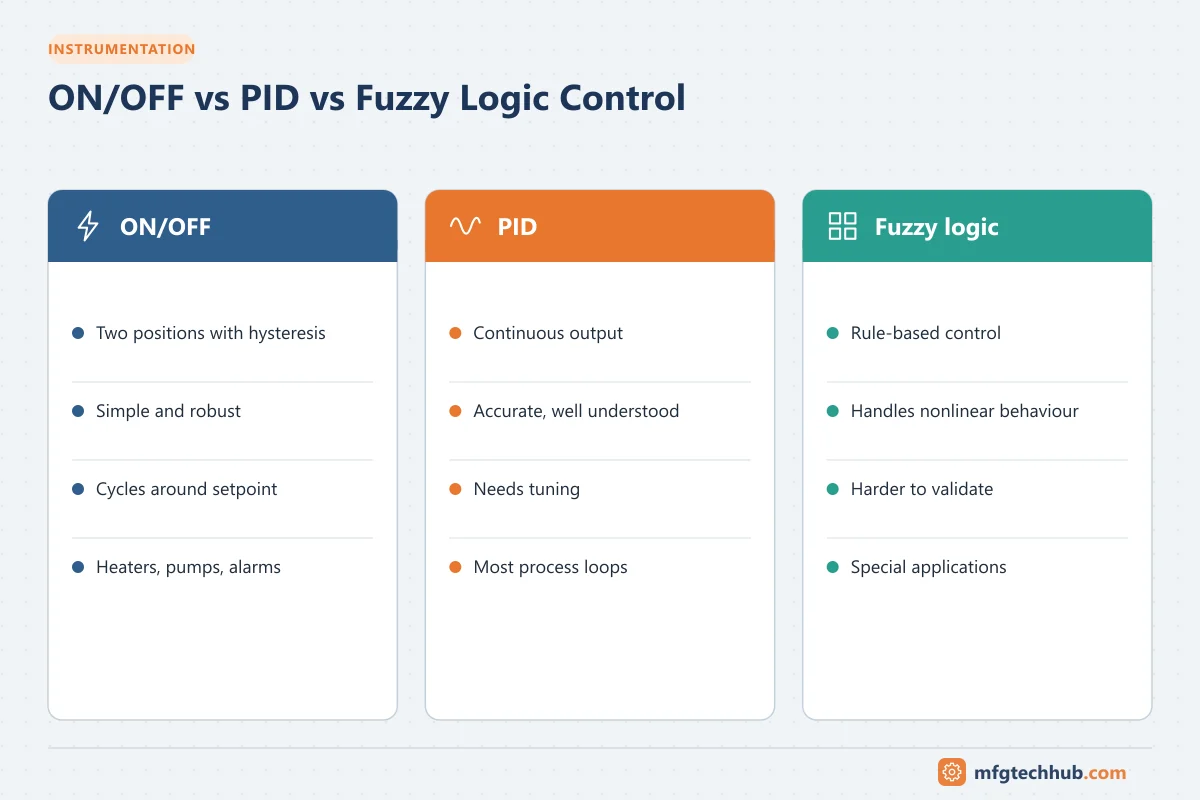
The simplest controller has only two output states: fully on or fully off. A household thermostat is the classic example.
If PV < SP − hysteresis/2  → output ON
If PV > SP + hysteresis/2  → output OFF
Hysteresis (deadband)
Without a deadband, the output would switch on and off rapidly around the setpoint (“chattering”), wearing out contactors and relays. A hysteresis band makes the controller wait until the process moves a defined amount before switching. The trade-off: a wider band means less switching but larger swings in the process variable.
Where ON/OFF control is used
- Tank level control with pumps (start at low level, stop at high level)
- Simple heating and refrigeration
- Air compressors (load/unload between two pressures)
- Sump pumps and alarm-based actions
Pros and cons
| Advantages | Limitations |
|---|---|
| Very simple, cheap, easy to understand | The process variable always cycles around the setpoint |
| No tuning required | Unsuitable where tight control is needed |
| Works with simple on/off actuators | Frequent switching wears equipment; minimum on/off times may be needed |
Time-proportioning control is a variation where an on/off output (such as a solid-state relay driving a heater) is switched on for a percentage of a fixed cycle time. Combined with PID, it gives smooth temperature control with a simple actuator.
PID control
A PID controller produces a continuously variable output from three actions:
- Proportional (P): responds to the size of the error
- Integral (I): removes steady-state offset by accumulating error over time
- Derivative (D): responds to the rate of change, damping overshoot
Output = Kp × [ e + (1/Ti) ∫ e dt + Td × de/dt ]PID is the default choice for continuous processes: flow, pressure, temperature, level and speed. Most loops use PI control; derivative is added mainly for slow temperature loops with significant lag.
For a full explanation, see PID Control Explained, and calculate starting settings with the PID tuning calculator.
Pros and cons
| Advantages | Limitations |
|---|---|
| Smooth, accurate control with no offset | Requires tuning, and poor tuning causes oscillation or slow response |
| Universally available in PLCs, DCS and single-loop controllers | Struggles with strongly nonlinear processes and long dead times |
| Well understood, with established tuning methods | Needs a continuously adjustable final element for best results |
Fuzzy logic control
Fuzzy logic controls a process using rules expressed in words, similar to how an experienced operator thinks:
IF temperature is "slightly low" AND temperature is "rising slowly"
THEN increase heating "a little"
How it works
- Fuzzification: measured values are converted into degrees of membership in linguistic sets such as “low”, “normal” and “high”. A temperature of 78 °C might be 0.7 “slightly low” and 0.3 “normal”.
- Rule evaluation: a rule base combines these memberships to decide what to do.
- Defuzzification: the combined result is converted back into a precise output value, for example 62% valve opening.
Where fuzzy logic is used
- Processes that are difficult to model mathematically, such as cement kilns, some water treatment processes and certain food processes
- Consumer products, such as washing machines, air conditioners and cameras
- Supervisory control that adjusts setpoints for underlying PID loops, capturing operator expertise
Pros and cons
| Advantages | Limitations |
|---|---|
| Handles nonlinear and poorly understood processes | Designing membership functions and rules takes expertise and testing |
| Can encode operator experience | Stability is harder to prove than with PID |
| Tolerant of imprecise measurements | Less standard in industrial controllers; harder for others to maintain |
Other control approaches you may meet
- Cascade, ratio, feedforward and split-range control: combinations of PID loops for better performance. See DCS Control Strategies.
- Model Predictive Control (MPC): advanced process control that uses a process model to optimize several variables at once, common in refining and petrochemicals.
- Gain scheduling: changing PID settings according to operating conditions to handle nonlinearity.
Comparison summary
| Feature | ON/OFF | PID | Fuzzy logic |
|---|---|---|---|
| Output | Two states | Continuous | Continuous |
| Accuracy | Low; PV cycles | High | Good, depends on design |
| Tuning or design effort | Minimal | Moderate | High |
| Handles nonlinearity | Poorly | Moderately | Well |
| Typical applications | Pumps, simple heating, compressors | Most process loops | Complex or poorly modeled processes |
How to choose
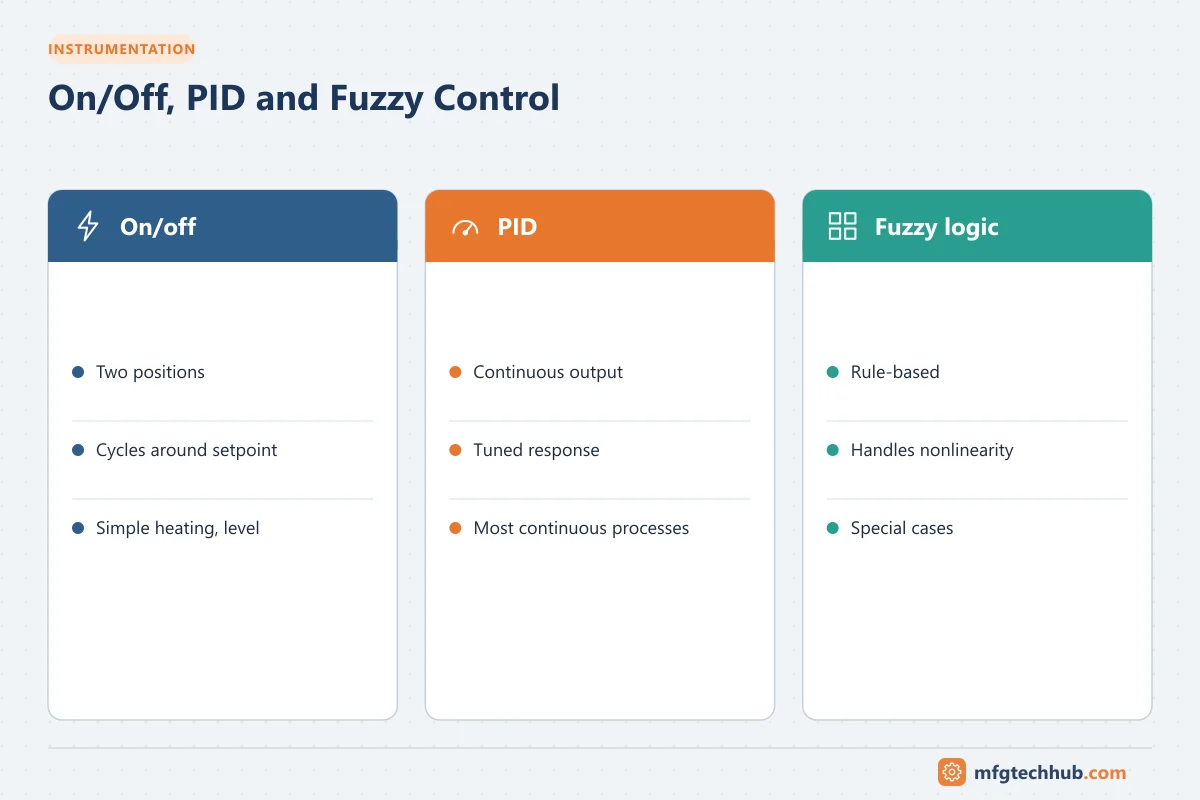
- Start with the requirement. If cycling within a band is acceptable, ON/OFF is simplest.
- Use PID for most continuous processes. It is standard, well supported and easy to maintain.
- Consider advanced or fuzzy control only when PID cannot meet the requirement, and when you have the skills and time to design, test and maintain it.
- Think about the final element. A pump that can only start and stop suits ON/OFF; a control valve or VFD suits PID.
Key takeaways
- ON/OFF control is simple and robust but causes the process to cycle.
- PID gives accurate continuous control and is the industrial standard.
- Fuzzy logic handles complex, nonlinear processes using rule-based reasoning, at the cost of design effort.
Related tutorials
Before you apply this in a plant: this article is for education. Always check the current edition of the relevant standards, the manufacturer's documentation for your exact product and version, and your site's procedures. Safety-related work needs qualified personnel. See our editorial policy.