
Smart Sensors in Oil and Gas: Applications and Examples
On this page
Oil and gas operations are spread across remote wells, long pipelines, offshore platforms, terminals and refineries, often in hazardous areas and harsh climates. Smart sensors, with digital communication, diagnostics and increasingly wireless connectivity, give operators visibility of assets that are expensive or dangerous to visit. This article describes the main applications and walks through a typical implementation.
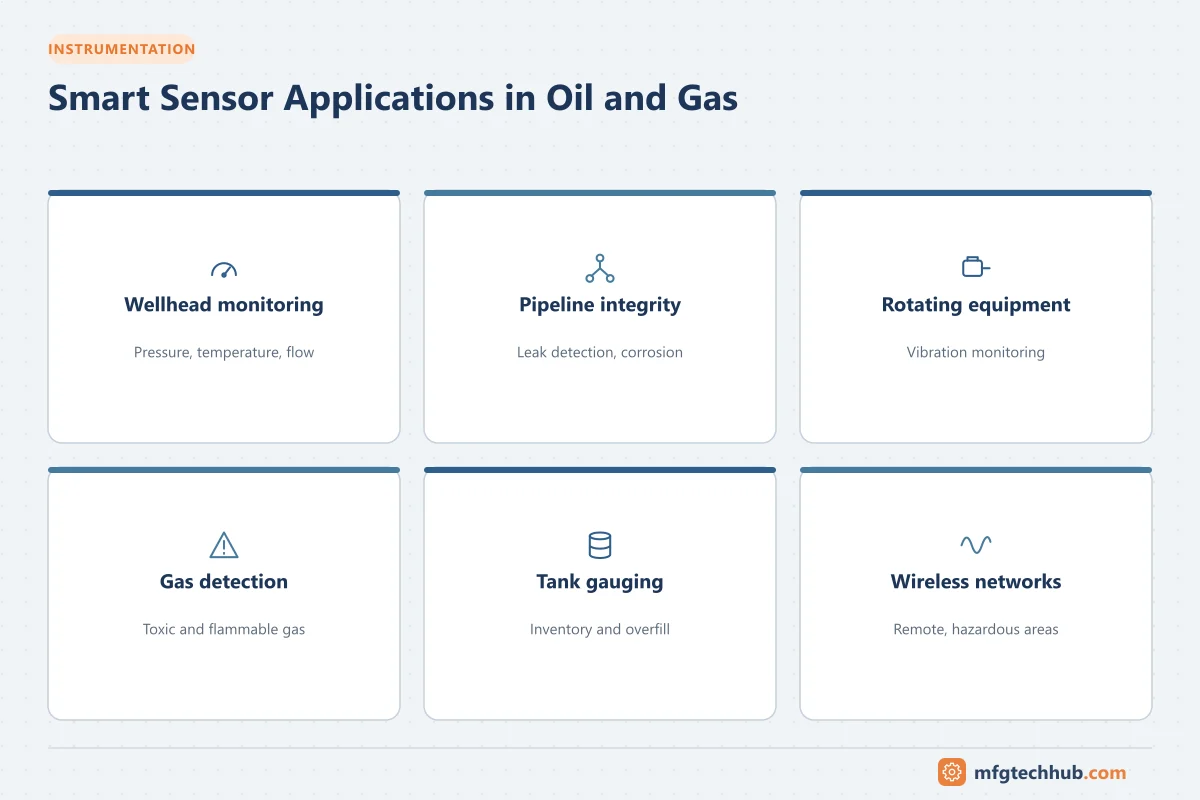
The example in this article is an illustrative composite based on common industry practice, not a report of a specific company’s project.
Why smart sensors matter in oil and gas
- Remote assets: wells and pipeline stations may be hundreds of kilometres from control centers.
- Hazardous areas: instruments must be certified for explosive atmospheres.
- Safety and environmental risk: leaks and releases must be detected quickly.
- High cost of downtime: unplanned shutdowns of wells, compressors or units are extremely expensive.
- Reduced staffing: fewer people on site means more reliance on remote monitoring.
Key applications
Wellhead and production monitoring
- Pressure and temperature transmitters on tubing and casing
- Multiphase or wet gas flowmeters, or well test separators
- Chemical injection flow monitoring
- Artificial lift monitoring (rod pumps, electric submersible pumps)
Wireless transmitters (WirelessHART or ISA100) and RTUs send data to SCADA over radio, cellular or satellite links. See Wireless Sensor Networks.
Pipeline monitoring and leak detection
- Pressure, temperature and flow measurement at stations along the pipeline
- Computational pipeline monitoring (CPM) systems that use mass balance and pressure behavior to detect leaks (API 1130 provides guidance)
- Fiber-optic sensing (distributed temperature and acoustic sensing) for leaks and third-party interference
- Cathodic protection monitoring for corrosion control
See SCADA for Utilities for how pipeline SCADA works.
Tank farms and terminals
- Radar level gauges for accurate inventory and custody transfer
- Multi-point temperature measurement for volume correction
- Independent high-level alarms and overfill prevention systems
- See Radar vs Ultrasonic Level Sensors
Gas detection and safety
- Fixed flammable and toxic gas detectors (for example hydrocarbon and H₂S)
- Flame detectors
- Integration with fire and gas systems and emergency shutdown
Rotating equipment health
- Vibration and temperature sensors on pumps and compressors
- Online monitoring for critical compressors and turbines
- See Vibration Monitoring Programs
Corrosion and integrity monitoring
- Wireless ultrasonic wall-thickness sensors on pipes and vessels
- Corrosion probes and coupons
- Acoustic sensors for valve leak-through and steam trap failures
Typical implementation example
Scenario (illustrative): an onshore oil field operator has about 150 wells spread over a large area. Operators drive to each well to read gauges and check equipment, and problems such as failed pumps are often found days later.
Solution:
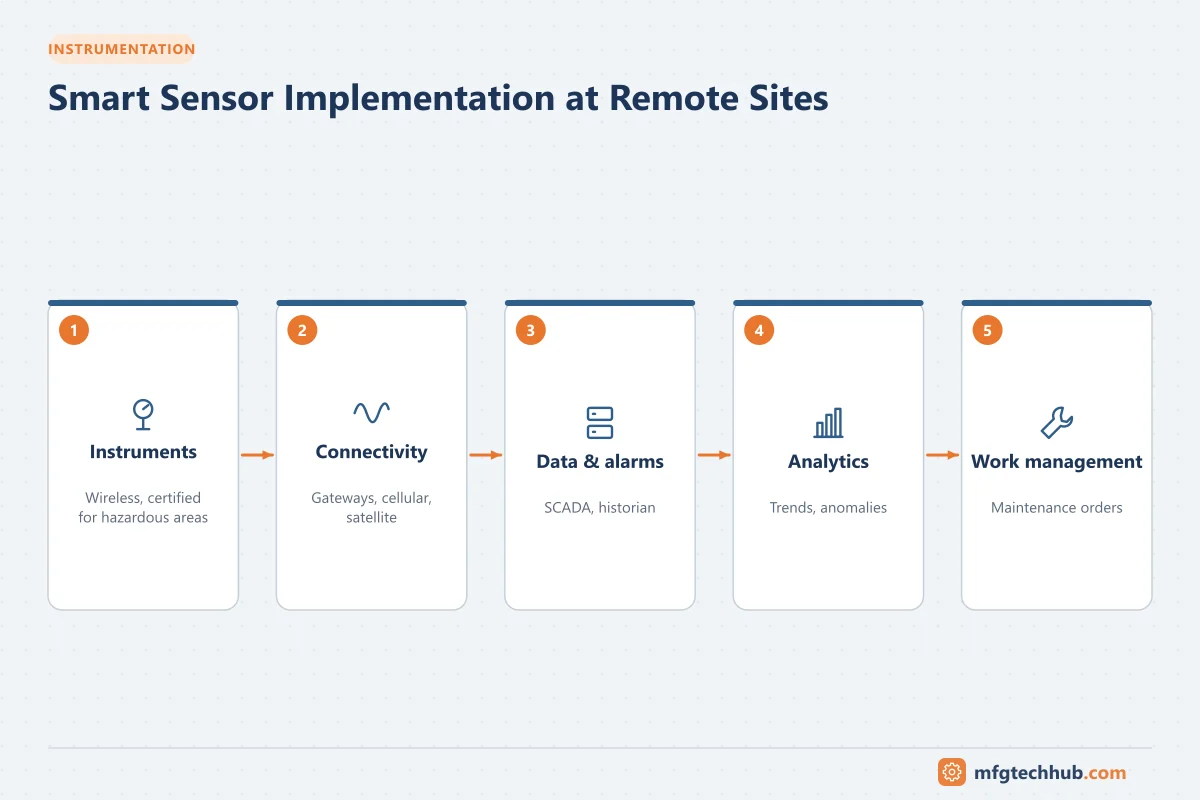
- Instrumentation: each well is fitted with wireless pressure and temperature transmitters and a power/status monitor on the artificial lift equipment.
- Connectivity: wireless networks at well pads connect to RTUs, which send data over a private radio or cellular network to a central SCADA system.
- Data and alarms: SCADA provides dashboards, trends and alarms for low production, pump failures and abnormal pressures.
- Analytics: production and equipment data are compared against expected performance to flag underperforming wells.
- Work management: alarms create work orders so field crews visit wells that need attention instead of following fixed routes.
Typical outcomes reported for this kind of project include faster detection of failed wells, fewer routine site visits, lower driving-related safety exposure, and better data for production optimization. Actual results vary widely with field size, existing infrastructure and operating practices.
Implementation considerations
| Topic | Consideration |
|---|---|
| Hazardous areas | Certified equipment (for example ATEX/IECEx), correct installation and inspection |
| Power | Battery life, solar power and energy harvesting at remote sites |
| Communication | Radio, cellular or satellite coverage; latency and bandwidth |
| Cybersecurity | Secure remote connections, network segmentation, IEC 62443 practices. See ISA-99 |
| Data quality | Calibration, diagnostics and time synchronization |
| Maintenance | Battery replacement planning and spare devices |
Frequently asked questions
Can wireless sensors be used in hazardous areas?
Yes. Many wireless transmitters are certified intrinsically safe for hazardous areas under schemes such as ATEX and IECEx. As with any Ex equipment, the certification, installation and battery replacement procedures must be followed.
Are wireless sensors suitable for control?
Wireless sensors are mainly used for monitoring, where update rates of seconds to minutes are acceptable. Fast control loops and safety functions normally use wired instruments unless a solution has been specifically designed and approved for that purpose.
What is computational pipeline monitoring?
Computational pipeline monitoring (CPM) uses measurements such as flow, pressure and temperature along a pipeline, together with software models, to detect leaks. API 1130 provides guidance on the design and operation of these systems.
Key takeaways
- Smart and wireless sensors provide visibility of remote, hazardous and high-value oil and gas assets.
- Major applications include wellhead monitoring, pipeline leak detection, tank gauging, gas detection and equipment health.
- Value comes from integrating sensor data with SCADA, analytics and work management.
Related tutorials
Before you apply this in a plant: this article is for education. Always check the current edition of the relevant standards, the manufacturer's documentation for your exact product and version, and your site's procedures. Safety-related work needs qualified personnel. See our editorial policy.