
SCADA Applications by Industry: Utilities, Power, Pipelines, Manufacturing and Energy
On this page
SCADA looks different in every industry. A water utility monitors hundreds of small remote sites over radio or cellular links; a manufacturing plant supervises a few dozen PLCs on a fast local network; a pipeline operator needs leak detection across thousands of kilometres. This article describes typical SCADA architectures in six sectors (building and transport systems are covered in Building Automation and Transportation), with the protocols, key design decisions and lessons that recur in real projects.
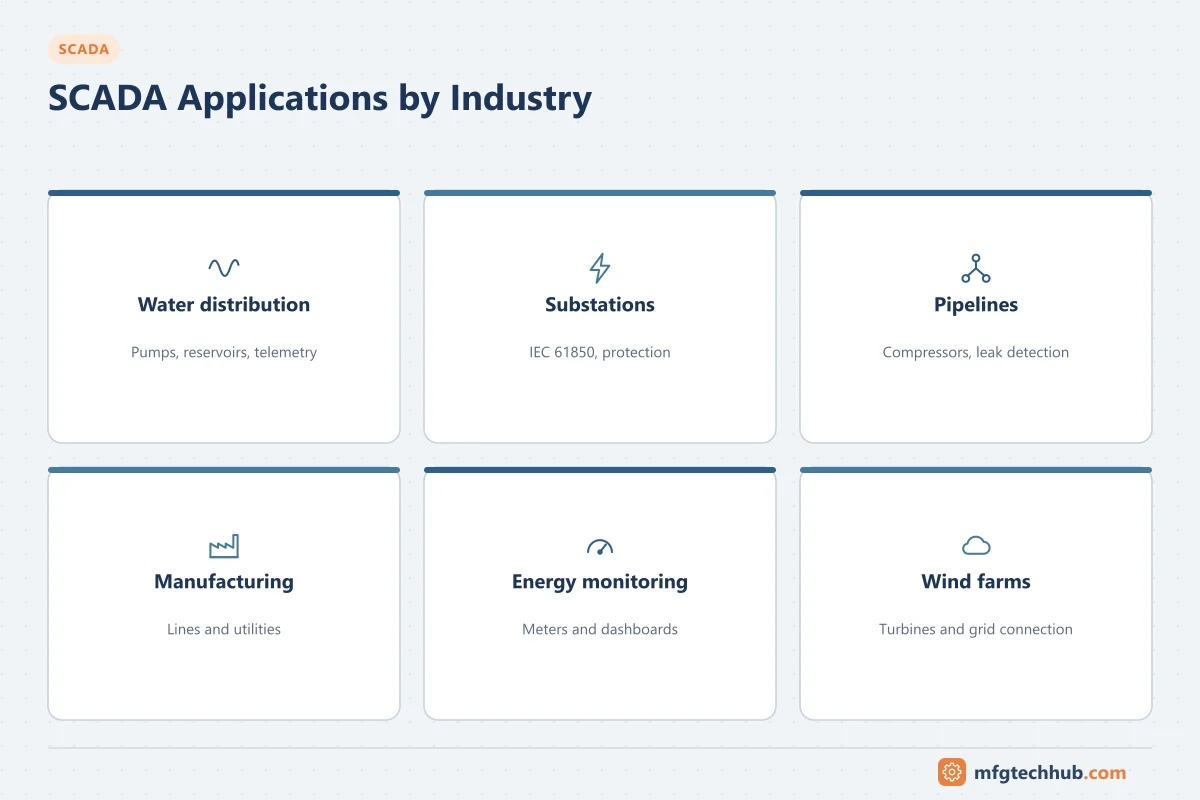
The examples are generic designs based on common industry practice, not descriptions of specific organisations.
Comparison at a glance
| Sector | Typical field devices | Common protocols | Main design challenge |
|---|---|---|---|
| Water and wastewater | RTUs/small PLCs at pump stations, reservoirs, treatment plants | DNP3, Modbus, IEC 60870-5-104, vendor protocols over radio/cellular | Many remote sites with limited bandwidth and power |
| Electrical substations | Protection relays, bay controllers, gateways | IEC 61850, DNP3, IEC 60870-5-101/104 | Time accuracy, high availability, protection integration |
| Oil and gas pipelines | RTUs, flow computers, valve actuators | DNP3, Modbus, IEC 60870-5-104 | Long distances, leak detection, safety |
| Manufacturing plants | PLCs, drives, robots | OPC UA, EtherNet/IP, PROFINET, Modbus TCP | Integration with MES, high tag counts, fast updates |
| Plant utilities and energy | Power meters, utility PLCs, boiler and compressor controllers | Modbus, BACnet, OPC UA, M-Bus | Collecting consistent data from many meter and equipment types |
| Wind and solar farms | Turbine controllers, inverters, meters | IEC 61400-25, Modbus TCP, OPC UA, IEC 61850 | Fleet-level monitoring and grid-code compliance |
For protocol background, see Industrial Communication Protocols.
1. Water distribution network
Typical scope: Reservoirs, pump stations, pressure-reducing valves and treatment works spread over a city or region.
Architecture:
- RTUs or small PLCs at each remote site, battery-backed, measuring levels, flows, pressures, pump status and power.
- Communication over licensed radio, cellular (4G/5G) or fibre, often with a secondary path.
- Report-by-exception protocols such as DNP3 send changes and time-stamped events, reducing bandwidth.
- Central SCADA servers (redundant) with historian, alarm management and operator stations in a control room; secure remote access for on-call staff.
Key design decisions:
- Local autonomy: each pump station must continue operating (for example level-based pump control) if communication is lost.
- Time-stamping at the source, so events are recorded correctly even when data arrives late.
- Data for leakage analysis: night-flow measurements in district metered areas are a common method of estimating leakage.
Lessons learned: Communication outages are normal, so design for them. Alarm floods after a communication restore are common unless alarms are suppressed or filtered correctly.
Gas distribution networks follow a similar pattern: RTUs at pressure-regulating stations and district governors report pressures, flows and odorant levels, and SCADA supports pressure management and leak response.
2. Electrical substation automation
Typical scope: High-voltage substations with protection relays, circuit breakers and transformers.
Architecture:
- Intelligent electronic devices (IEDs) such as protection relays at bay level.
- IEC 61850 station bus for data exchange; GOOSE messages for fast peer-to-peer signals between IEDs; sampled values where process bus is used.
- Station HMI and gateway passing data to the utility’s control centre SCADA/EMS, often via IEC 60870-5-104 or DNP3.
- Precise time synchronisation (for example IEEE 1588 PTP or IRIG-B) for sequence-of-events records.
Key design decisions:
- Redundant networks (PRP/HSR are used in IEC 61850 substations).
- Clear separation between protection functions (which must work independently of SCADA) and supervisory functions.
- Cybersecurity aligned with utility regulations and IEC 62351/IEC 62443.
Lessons learned: Configuration management of IED settings and the substation configuration files is as important as the SCADA database itself.
3. Oil and gas pipeline
Typical scope: A pipeline with pump or compressor stations, block valves and metering stations over long distances.
Architecture:
- RTUs at valve and metering sites, flow computers for custody-transfer metering, and station PLC/DCS systems at compressor or pump stations.
- Communication over fibre along the pipeline, satellite or radio for remote sites, with backup paths.
- Central control room with redundant SCADA servers, often with a backup control centre.
- Leak detection systems (for example computational pipeline monitoring based on flow and pressure balances), integrated with SCADA alarms.
Key design decisions:
- Remote valve operation needs confirmation of position and careful command authorisation.
- Pipeline safety regulations and operator qualification requirements influence alarm management and control-room procedures (for example API RP 1165 for displays and API RP 1167 for alarm management are referenced in the pipeline industry).
Lessons learned: Alarm management and control-room human factors are critical; a leak alarm must be distinguishable from nuisance alarms caused by transients.
4. Manufacturing plant supervisory system
Typical scope: A plant with several production lines, utilities and packaging, each controlled by PLCs.
Architecture:
- SCADA/HMI servers connected to PLCs via native drivers or OPC UA.
- Redundant servers with thin-client or web-based operator stations.
- Historian for process and production data; MES integration for orders, counts and downtime.
- A DMZ between the plant network and the business network for data sharing.
Key design decisions:
- Tag structure and templates (object-based faceplates for motors, valves and analog loops) make large systems consistent and maintainable. See Customising SCADA HMI Displays.
- High-performance HMI principles (grey backgrounds, colour for abnormal conditions only) improve operator response.
- Clear responsibility for which data goes to MES and which to the historian.
Lessons learned: Without a tag naming standard and templates, SCADA projects become hard to maintain. Plan the data model with MES and historian teams early.
5. Plant utilities and energy monitoring
Typical scope: Electricity, steam, compressed air, chilled water, natural gas and water across a manufacturing site.
Architecture:
- Meters (multifunction power meters, flow meters for steam, air and gas) connected via Modbus, M-Bus or BACnet, often through gateways.
- Utility PLCs controlling boilers, compressors, chillers and water treatment, supervised by the SCADA.
- SCADA with historian providing consumption per area, line and shift, peak demand monitoring and alarms for abnormal consumption (for example compressed-air use during non-production hours, which often reveals leaks).
- Integration with MES to calculate energy per unit produced.
Key design decisions: consistent metering hierarchy (site → building → area → line → machine), data quality handling when meters fail, and time alignment with production data. See Energy Management with PLCs.
Lessons learned: Energy data only leads to savings when someone owns the KPIs and reviews them regularly; dashboards alone do not reduce consumption.
6. Wind farm
Typical scope: Dozens of turbines, a substation and grid connection, often monitored remotely from a central operations centre.
Architecture:
- Turbine controllers from the turbine manufacturer, each with its own local control.
- Wind farm SCADA collecting turbine status, power, wind speed and alarms, often over a fibre ring.
- Park controller managing active/reactive power at the grid connection point to meet grid-code requirements.
- Remote operations centre monitoring multiple farms; data to asset-management and analytics platforms.
Key design decisions:
- Standardised data models (IEC 61400-25 defines communications for wind power plant monitoring and control).
- High-resolution data for performance analysis and condition monitoring (vibration, temperatures).
Lessons learned: Availability definitions and data quality must be agreed contractually, because performance guarantees depend on them.
Lessons that apply to every SCADA project
| Lesson | Practical action |
|---|---|
| Communications fail | Local autonomy at remote sites, store-and-forward, source time-stamping |
| Alarm floods overwhelm operators | Alarm philosophy and rationalisation (ISA-18.2 / IEC 62682). See Setting Up SCADA Alarms |
| Security must be designed in | Segmentation, secure remote access, IEC 62443. See ISA/IEC 62443 |
| Consistency reduces cost | Tag naming standards, templates and object libraries |
| Data is used beyond the control room | Historian and MES integration planned from the start |
| Operators are the users | Involve them in display design and alarm reviews |
Frequently asked questions
What protocols are used in SCADA systems?
It depends on the industry: DNP3 and IEC 60870-5-104 are common in utilities and pipelines, IEC 61850 in substations, and OPC UA, Modbus TCP, EtherNet/IP and PROFINET in manufacturing. Many systems use several protocols at once.
Why do remote sites need local control?
Communication links to remote sites can fail. Local controllers keep essential functions such as pump control running and store data until the link is restored, so the site remains safe and data is not lost.
What is report-by-exception?
A communication method where a field device sends data only when it changes beyond a deadband or when an event occurs, rather than being polled continuously. It reduces bandwidth use, which matters on radio and cellular links.
Key takeaways
- SCADA design depends on the sector: remote sites and bandwidth for utilities, precise timing for substations, safety and leak detection for pipelines, integration for manufacturing.
- Common lessons are local autonomy, alarm management, security, standards and early data planning.
Related tutorials
Before you apply this in a plant: this article is for education. Always check the current edition of the relevant standards, the manufacturer's documentation for your exact product and version, and your site's procedures. Safety-related work needs qualified personnel. See our editorial policy.