
Surge Protection Devices and Lightning Arresters for Industrial Plants
On this page
A single lightning strike or switching surge can destroy transmitters, PLC input cards, drives and communication equipment across a plant. Surge protective devices (SPDs) and lightning arresters limit these fast, high-energy overvoltages and divert the surge current safely to earth. For instrumentation engineers, protecting long field cables and signal loops is just as important as protecting power circuits.
What causes surges
| Source | Description |
|---|---|
| Direct lightning strike | Strike to a building, structure, tank or overhead line; extremely high currents |
| Nearby lightning | Induced voltages in cables and coupling through the ground |
| Switching surges | Switching capacitor banks, transformers, large motors or inductive loads |
| Faults on the network | Short circuits and their clearing on the utility system |
| Electrostatic discharge | Local, low energy but damaging to electronics |
Surges last from microseconds to milliseconds but can reach thousands of volts. Sensitive electronics can be damaged instantly or degraded so they fail later.
How an SPD works
An SPD is connected in parallel with the equipment it protects. At normal voltage, it has very high impedance and does nothing. When voltage rises above a threshold, it switches to low impedance and diverts the surge current to earth, clamping the voltage to a level the equipment can tolerate.
Common SPD components:
- Metal oxide varistors (MOVs): the most common; fast and able to handle high currents, but they degrade with repeated surges
- Gas discharge tubes (GDTs) and spark gaps: handle very high currents, used in lightning-current SPDs and telecom lines
- Transient voltage suppression (TVS) diodes: very fast and precise, used in signal and data line protectors
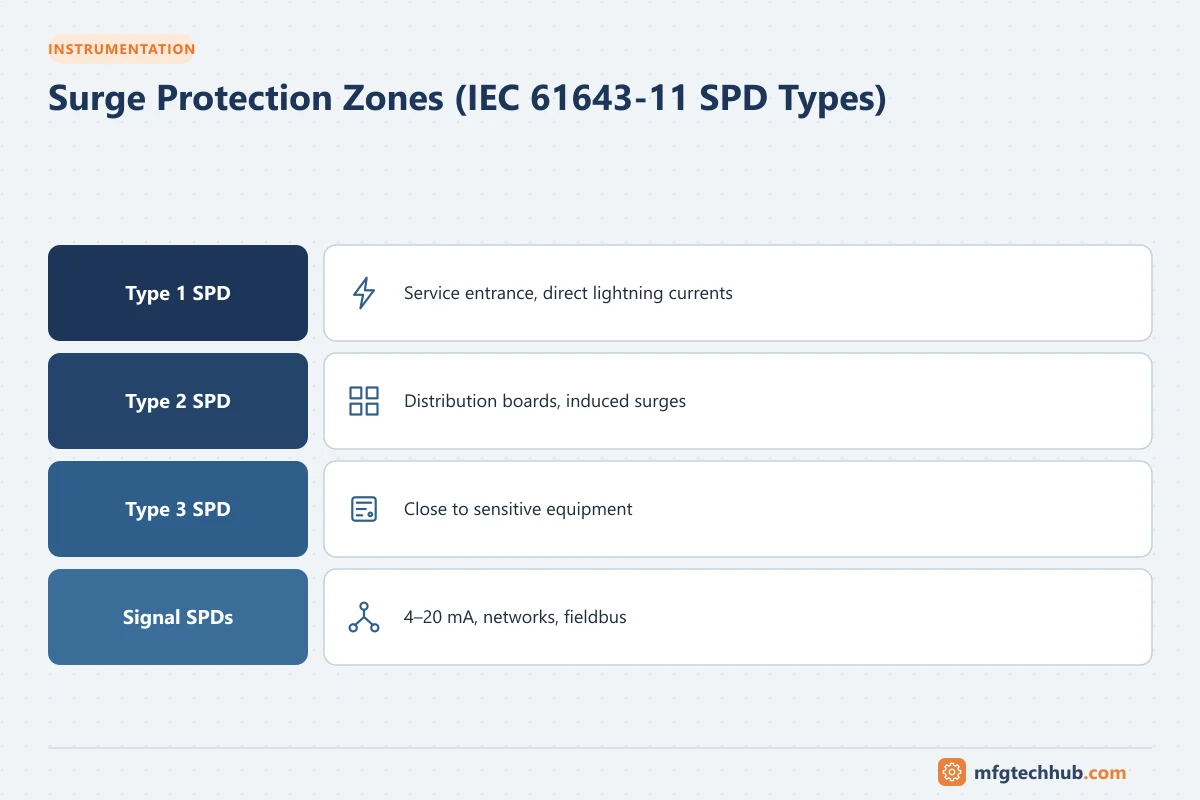
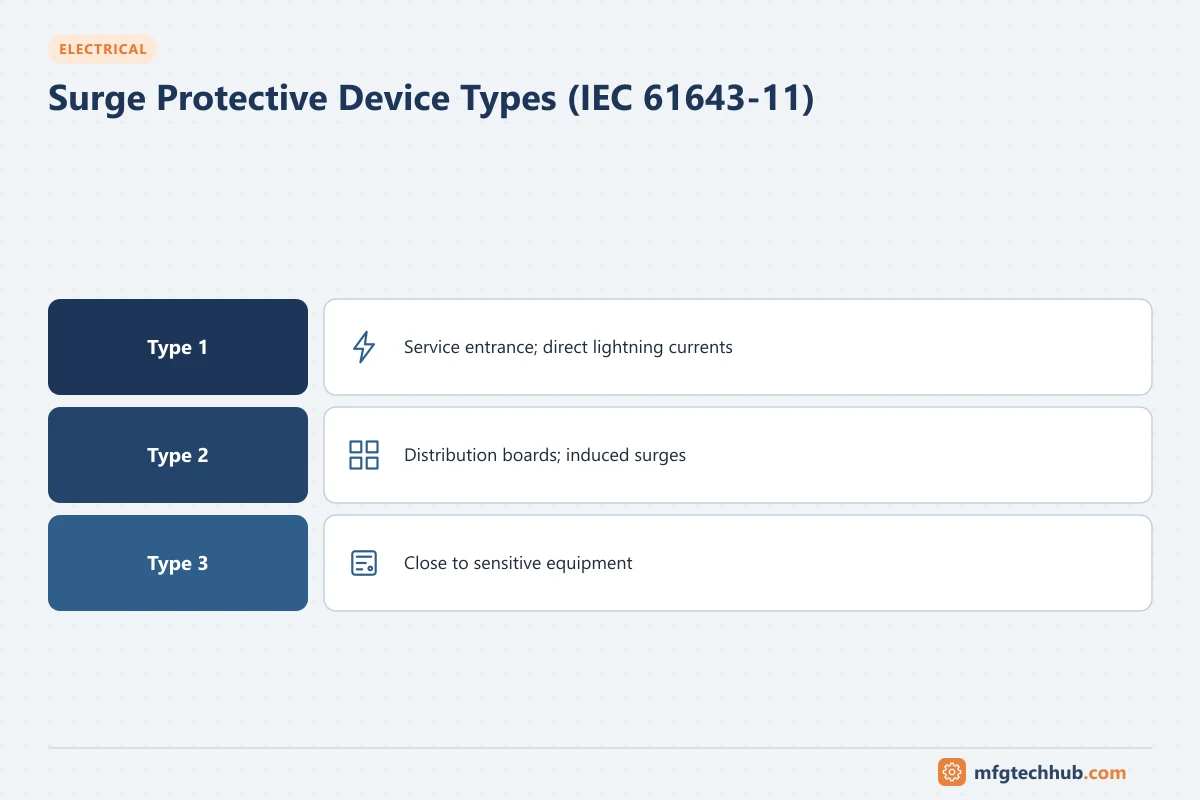
SPD types (IEC 61643-11)
| Type | Tested with | Location | Purpose |
|---|---|---|---|
| Type 1 | 10/350 µs waveform (lightning current) | Main incomer, where a building has external lightning protection or overhead supplies | Handle partial lightning currents |
| Type 2 | 8/20 µs waveform | Sub-distribution boards | Limit induced and switching surges |
| Type 3 | Combination wave | Close to sensitive equipment | Fine protection for electronics |
| Type 1+2 combined | Both | Main boards | Space-saving combination |
A layered (cascaded) approach coordinates Type 1, 2 and 3 devices so each stage reduces the surge further.
Key SPD specifications
| Parameter | Meaning |
|---|---|
| Uc | Maximum continuous operating voltage |
| Iimp | Impulse current (Type 1, 10/350 µs) |
| In / Imax | Nominal and maximum discharge current (8/20 µs) |
| Up | Voltage protection level: the let-through voltage; must be lower than the equipment’s withstand |
| Status indication | Visual or remote contact showing when the SPD needs replacement |
Installation tip: keep SPD connection leads as short and straight as possible (ideally under 0.5 m in total). Every metre of lead adds inductance and can add hundreds of volts to the let-through voltage during a fast surge.
Lightning protection systems (IEC 62305)
External lightning protection intercepts direct strikes and conducts the current safely to earth:
- Air terminals (lightning rods) and conductors on roofs and structures
- Down conductors to the earth termination system
- Earth electrodes with low impedance
- Equipotential bonding of metal services entering the building
IEC 62305 covers risk assessment, lightning protection levels (LPL I to IV), protection of structures, and lightning protection zones (LPZ), where SPDs are installed at each zone boundary.
Lightning arresters on power systems
On medium- and high-voltage systems, surge arresters (usually metal-oxide types) are installed at transformers, overhead line entries and cable terminations. They protect insulation from lightning and switching overvoltages. They are rated for system voltage, discharge current class and energy capability.
Protecting instrumentation and control signals
Field instruments on tanks, pipelines, stacks and remote sites are especially exposed. Surge protection for signal circuits includes:
- Loop SPDs for 4-20 mA and HART circuits, installed at both the field end (at the transmitter) and the control room end (marshalling cabinet)
- Transmitters with built-in surge protection terminal blocks
- Data line protectors for RS-485, Ethernet and fieldbus
- Intrinsically safe compatible SPDs where required for hazardous areas
Guidelines:
- Protect both ends of long cables between buildings or to exposed field locations.
- Bond the SPD earth to the local equipotential earth with a short conductor.
- Check that the SPD’s resistance and capacitance do not affect the loop or signal.
- Follow the grounding philosophy for signal shields carefully. See Grounding and Earthing Techniques.
Maintenance
- Inspect SPD status indicators regularly and after storms.
- Replace MOV-based SPDs that show end-of-life indication.
- Check earth connections and lightning protection conductors for corrosion and damage.
- Test earth electrode resistance periodically.
- Record surge-related failures to identify weak points.
Key takeaways
- SPDs clamp overvoltages and divert surge currents to earth; they must be coordinated in layers.
- Type 1, 2 and 3 SPDs protect at the incomer, distribution and equipment levels.
- IEC 62305 covers lightning risk assessment and protection of structures.
- Field instrument loops need surge protection at both ends and good bonding.
Related tutorials
Before you apply this in a plant: this article is for education. Always check the current edition of the relevant standards, the manufacturer's documentation for your exact product and version, and your site's procedures. Safety-related work needs qualified personnel. See our editorial policy.