
5G and Edge Computing in Industrial IoT
On this page
Two technologies are often mentioned together in discussions of smart factories: 5G, the fifth generation of cellular communication, and edge computing, which processes data close to where it is produced. Together they promise flexible wireless connectivity with low latency, and local processing for time-sensitive applications. This article explains what each offers, where they genuinely help, and what to consider before adopting them.
What 5G offers industry
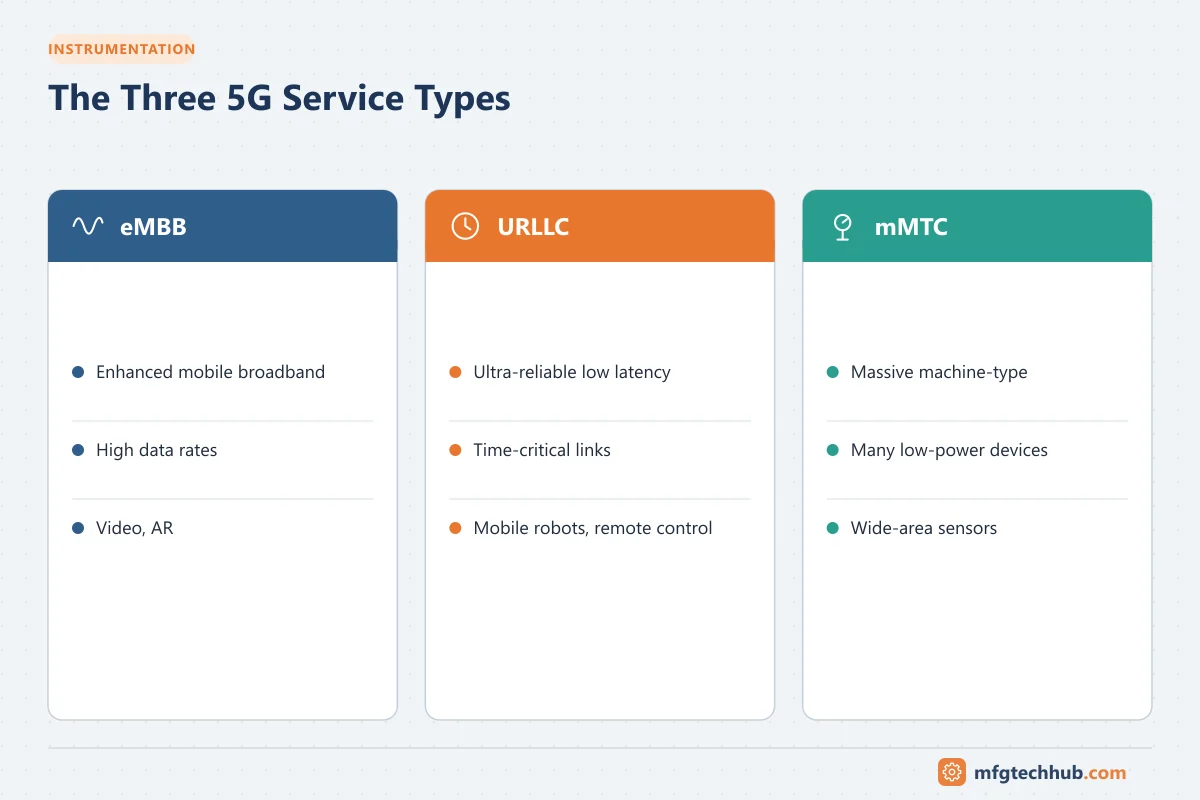
The 5G standards (developed by 3GPP) define three main service categories:
| Capability | Meaning | Industrial relevance |
|---|---|---|
| eMBB (enhanced mobile broadband) | High data rates | Video inspection, augmented reality, large data transfers |
| URLLC (ultra-reliable low-latency communication) | Very low latency and high reliability | Mobile robots, remote control, some motion applications |
| mMTC (massive machine-type communication) | Many low-power devices | Large numbers of sensors |
Further 3GPP releases have added industrial features such as time-sensitive networking (TSN) integration and improved positioning.
Private 5G networks
Many manufacturers use private (non-public) 5G networks, operated on site using licensed, shared or locally allocated spectrum depending on the country. Private networks give control over coverage, capacity, security and data, independent of public mobile networks.
What edge computing is
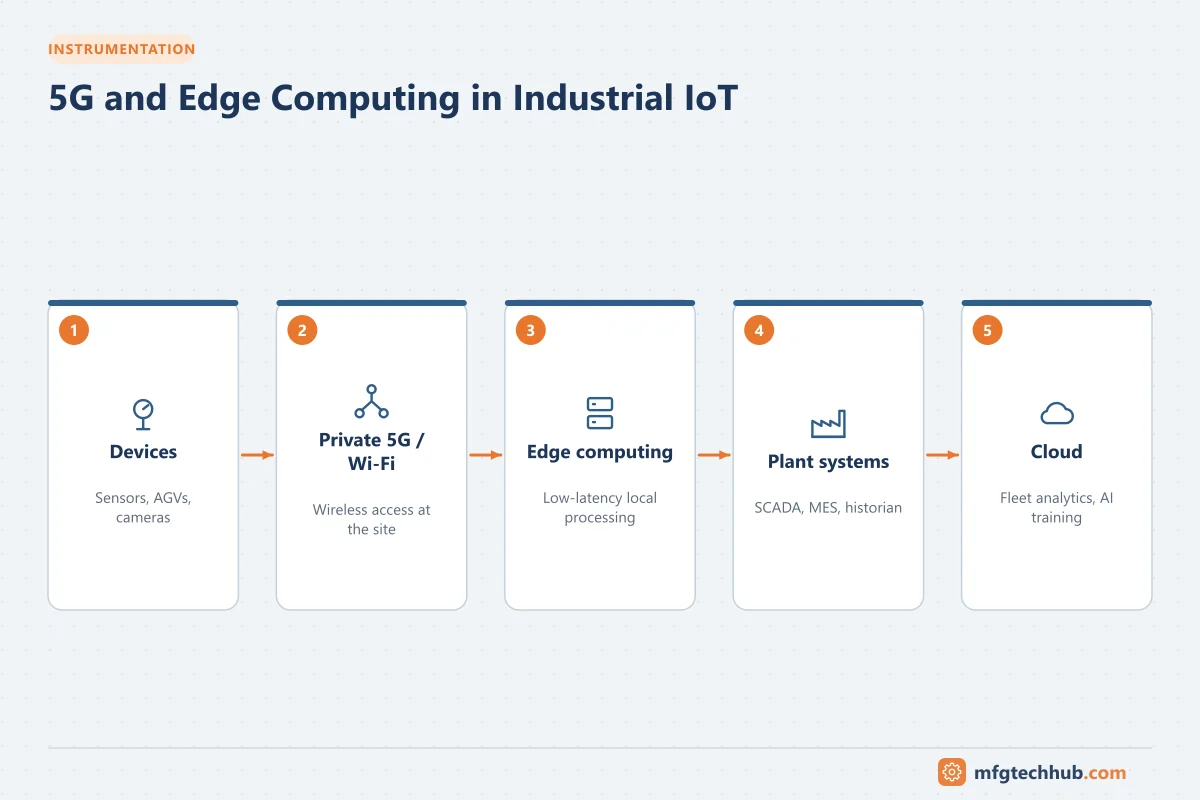
Edge computing runs applications close to machines, on industrial PCs, edge gateways or servers in the plant, instead of sending all data to a distant cloud.
Sensors/machines → Edge devices (local processing, buffering, analytics) → Plant systems / cloudBenefits:
- Low latency for time-sensitive analysis, such as vision inspection
- Reduced bandwidth by sending summaries rather than raw data
- Operation during network outages
- Data sovereignty and security, keeping sensitive data on site
Multi-access edge computing (MEC) places computing resources inside the 5G network infrastructure, so wireless devices can use nearby processing with very low latency.
See Industrial IoT (IIoT) Explained for how edge computing fits into IIoT architectures.
Realistic industrial use cases
| Use case | Why 5G and edge help |
|---|---|
| Autonomous mobile robots (AMRs) and AGVs | Reliable mobile connectivity and handover across large sites |
| Machine vision and quality inspection | High bandwidth video, processed at the edge |
| Augmented reality for maintenance | Video and data streams to tablets and headsets |
| Flexible production lines | Reconfigure machines without rewiring |
| Wide-area sensor networks | Many sensors across ports, mines, utilities and large plants |
| Remote operation of equipment | Low-latency video and control for cranes and vehicles |
5G compared with other networks
| Feature | Wired Ethernet | Wi-Fi 6/6E/7 | Private 5G |
|---|---|---|---|
| Reliability and determinism | Highest | Good, but contention-based | High, with managed scheduling |
| Mobility and handover | None | Moderate | Strong |
| Coverage of large outdoor areas | Requires cabling | Limited | Strong |
| Device ecosystem | Very mature | Very mature | Growing |
| Cost and complexity | Low per device (where cabling exists) | Low to moderate | Higher, with specialized skills |
Wired networks remain the best choice for fixed equipment and real-time control. Wi-Fi is often sufficient for tablets and many applications. Private 5G is most compelling where mobility, coverage, many devices and reliability are all needed.
Considerations before adopting 5G
- Start with the use case, not the technology. Confirm that current networks cannot meet the need.
- Check device availability for the industrial devices you need.
- Understand spectrum options and regulations in your country.
- Plan integration with existing OT networks and security zones. See ISA-99 / IEC 62443.
- Evaluate total cost, including operations and skills.
- Pilot first, measuring latency, reliability and coverage in the real environment.
Edge computing best practices
- Standardize edge platforms and manage software updates centrally.
- Use containerized applications for easier deployment.
- Secure edge devices: hardened operating systems, certificates and outbound-only connections.
- Buffer data locally so nothing is lost during outages.
- Decide clearly what runs at the edge and what runs in the cloud.
Key takeaways
- 5G offers high bandwidth, low-latency reliable communication and support for many devices; private networks give local control.
- Edge computing processes data close to machines for speed, bandwidth savings and resilience.
- The strongest use cases involve mobility, video, AR and large-scale sensing.
- Wired networks remain best for fixed real-time control; choose 5G where its strengths are needed.
Related tutorials
Before you apply this in a plant: this article is for education. Always check the current edition of the relevant standards, the manufacturer's documentation for your exact product and version, and your site's procedures. Safety-related work needs qualified personnel. See our editorial policy.