
Safety When Working on Instruments and Electrical Systems: Permits, Isolation, Hazardous Areas and Safety Systems
On this page
Instrument and electrical technicians face two kinds of hazard at once: the electrical hazards of the circuits they work on and the process hazards of the fluids and equipment the instruments are connected to. Removing a pressure transmitter from a line that is still pressurised, or bypassing a trip without controls, has caused serious incidents. Safe I&E work depends on permits, proper isolation, hazardous-area discipline and careful control of safety system bypasses.
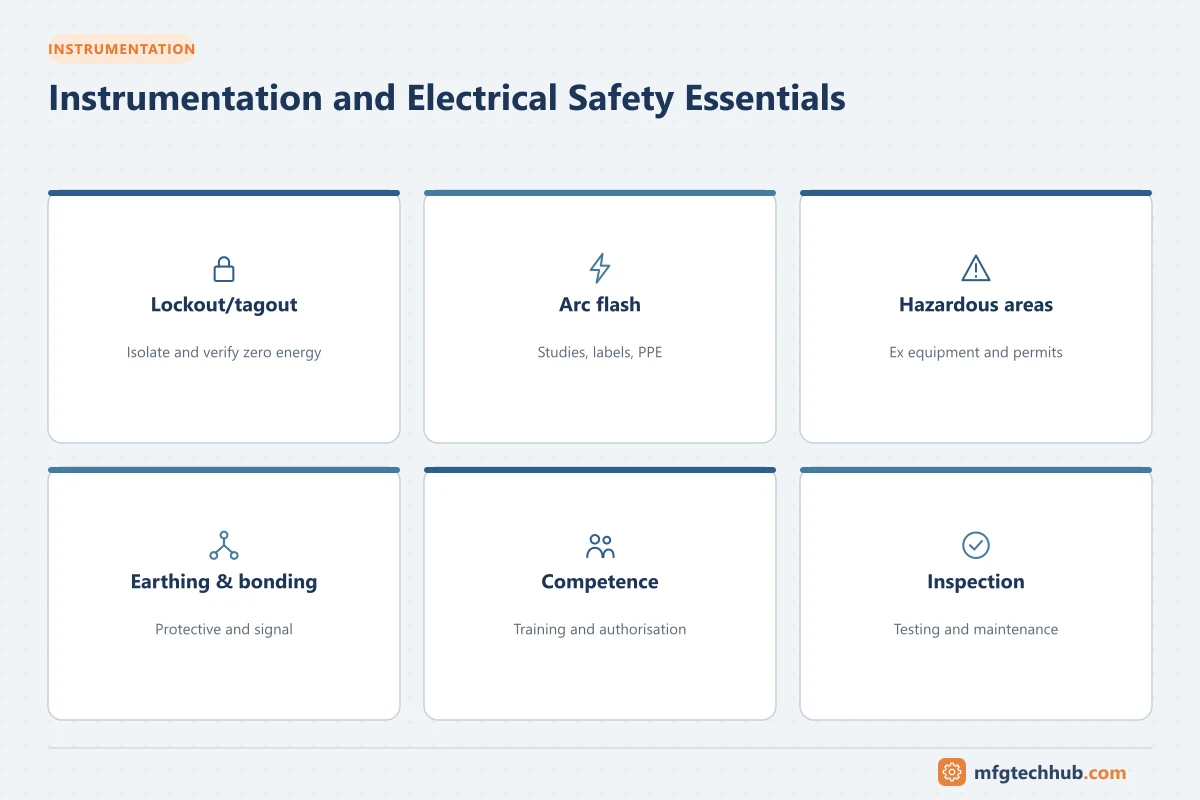
For shock, arc flash and electrically safe work conditions in detail, see Electrical Hazard Prevention.
Hazards specific to instrument work
| Hazard | Example | Control |
|---|---|---|
| Stored pressure | Impulse lines and manifolds still pressurised | Isolate, vent and verify zero pressure before disconnecting |
| Hot, cold or toxic media | Steam, hot oil, acids, H₂S in impulse lines | Isolation, draining to safe location, PPE, gas testing |
| Unexpected valve movement | Control valve strokes when a signal is forced | Put loop in manual, inform operators, isolate air supply |
| Unexpected trips or starts | Signal change triggers an interlock | Plan with operations, bypass under control only |
| Electrical | 230 V AC in field instruments or heaters, 24 V circuits near power | Isolate and test, segregation, qualified persons |
| Radiation sources | Radiometric level or density gauges | Licensed procedures, shutter locking, dose monitoring |
| Working at height and confined spaces | Instruments on tanks and in pits | Access equipment, permits, gas testing |
Permits to work
Most sites require a permit for I&E work in operating plants. A good permit:
- Describes the job and the equipment precisely (tag numbers).
- Lists isolations: electrical, process, pneumatic, and who applied them.
- States the effect on control and safety systems: loops in manual, trips bypassed, alarms suppressed.
- Includes gas testing and hazardous-area conditions where relevant.
- Is accepted and closed formally, with the plant returned to normal state.
Isolation for instrument work
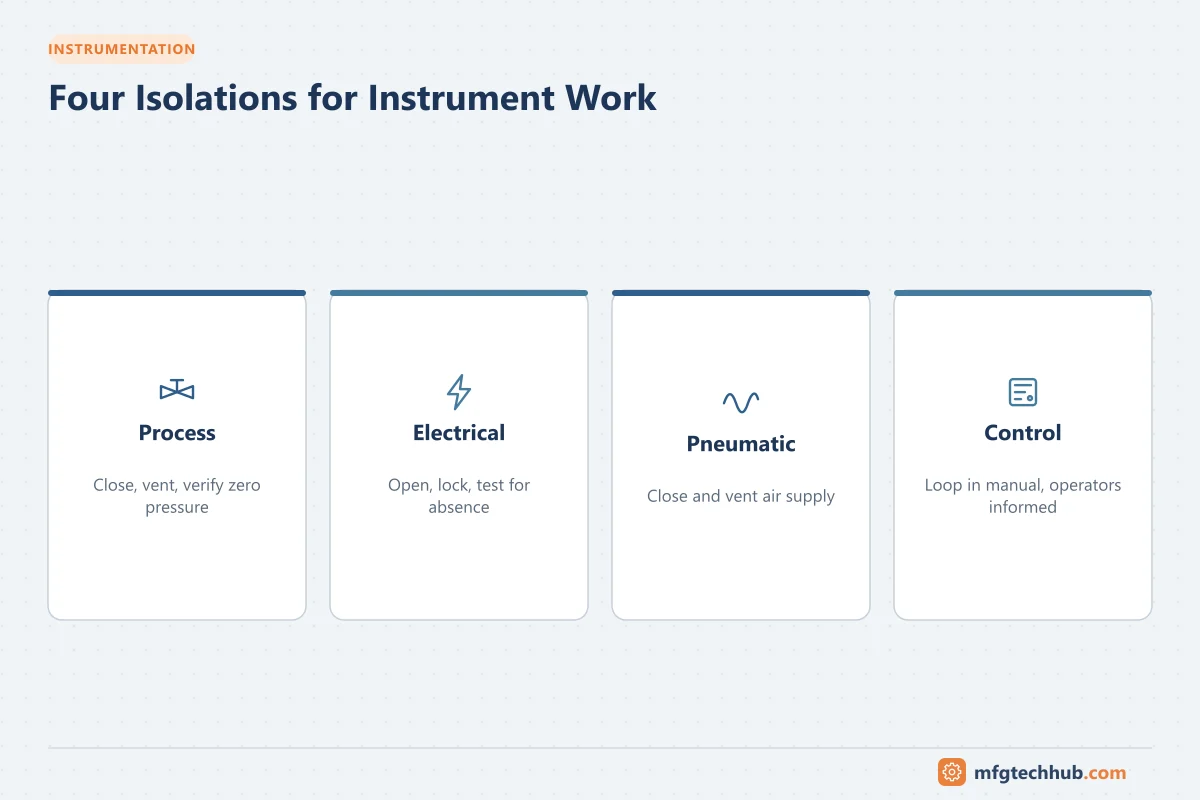
| Isolation type | Typical method |
|---|---|
| Process | Close root and manifold valves, vent or drain, verify pressure is zero |
| Electrical | Open and lock the supply, test for absence of voltage |
| Pneumatic | Close and lock the air supply, vent the actuator |
| Control | Loop to manual, output to safe value, operator informed |
Lock and tag each isolation personally; verify it before starting. See Electrical Hazard Prevention.
Working in hazardous areas
- Know the zone and the protection concept of each device (for example Ex i intrinsic safety, Ex d flameproof).
- Intrinsically safe loops: use only certified replacement parts; do not connect non-IS test equipment unless it is approved for the zone and loop; keep IS and non-IS wiring separated.
- Flameproof enclosures: do not open while energised in a hazardous atmosphere; check flame paths and bolts on closing.
- Hot work and gas testing before using non-certified tools.
- Keep the Ex register and inspection records current (IEC 60079-17).
Safety instrumented functions: bypasses and testing
Safety instrumented functions (SIFs) must work when needed. Work on them needs extra control:
- Bypasses only with authorisation, a time limit, compensating measures (for example an operator watching a local gauge) and a bypass log.
- Visibility: bypasses shown on the operator display and reviewed each shift.
- Proof tests follow written procedures that test the whole function from sensor to final element.
- Return to service checked and signed: bypass removed, function verified.
See Functional Safety.
Competence
- Only qualified and authorised persons perform electrical work and work on hazardous-area equipment.
- Hazardous-area competence schemes (for example based on IEC 60079-14 and IEC 60079-17 requirements) apply to Ex installation and inspection.
- Training on site-specific permits, isolation procedures and safety systems.
Pre-job checklist
- Permit issued and understood; job scope and tags clear
- Operations informed; loop in manual or equipment stopped as required
- Process, electrical and pneumatic isolations applied, locked and verified
- Hazardous area status known; gas test done where required
- Correct, certified test equipment for the area and circuit (see measurement categories in IEC 61010-1)
- Safety function bypasses authorised, logged and visible
- PPE for electrical and process hazards
- Return-to-service steps planned
Frequently asked questions
Why is removing a transmitter dangerous?
Because the impulse lines and manifold can still contain pressurised, hot or toxic fluid. The process connection must be isolated, vented or drained and verified before disconnecting.
Can I connect a normal multimeter to an intrinsically safe loop?
Only if the meter and the connection are acceptable for the hazardous area and the loop’s safety parameters. Use approved intrinsically safe test equipment or work under a gas-free permit, according to site rules.
How should safety function bypasses be managed?
With authorisation, time limits, compensating measures, a bypass log, visibility to operators, and a formal check when the bypass is removed.
Key takeaways
- Instrument work combines electrical and process hazards.
- Use permits and verified process, electrical and pneumatic isolations.
- Follow hazardous-area rules for Ex equipment and intrinsically safe loops.
- Control and log every bypass of a safety instrumented function.
Related tutorials
Before you apply this in a plant: this article is for education. Always check the current edition of the relevant standards, the manufacturer's documentation for your exact product and version, and your site's procedures. Safety-related work needs qualified personnel. See our editorial policy.