
RTDs vs Thermistors: Pt100 Classes, 2-, 3- and 4-Wire Connections, NTC Behaviour and How to Choose
On this page
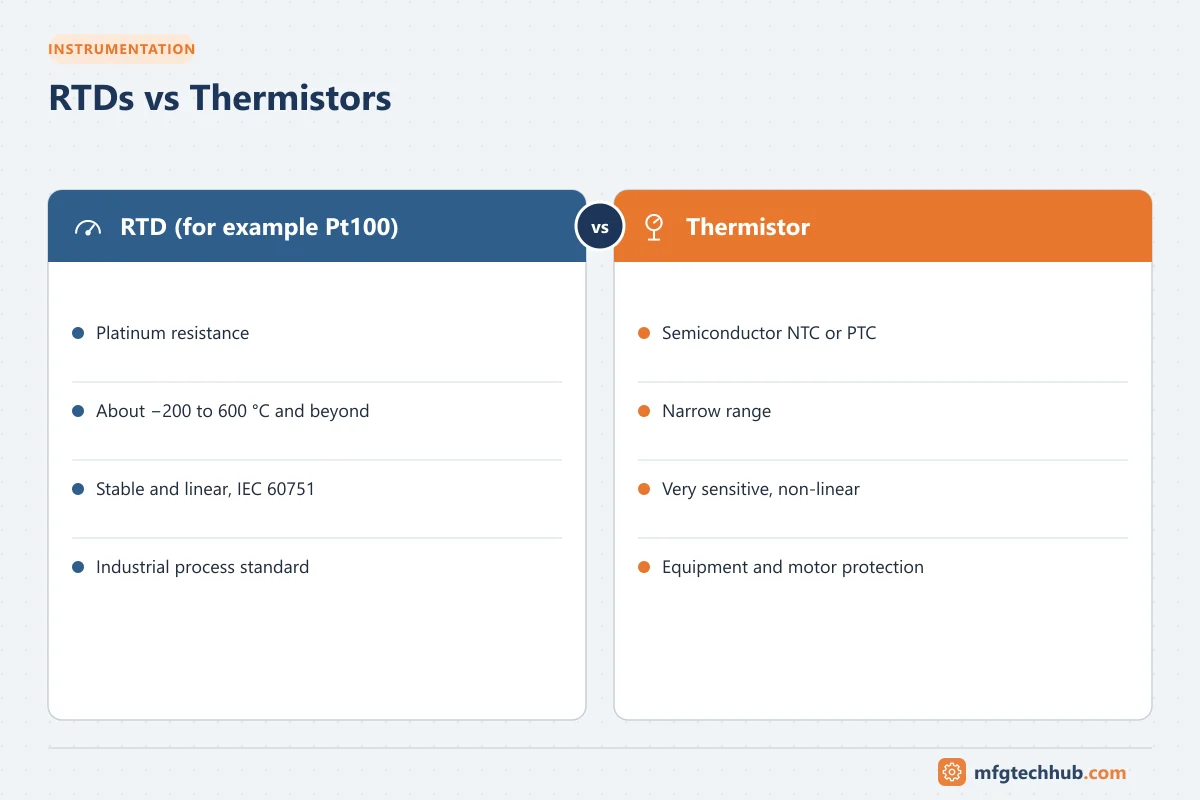
Resistance temperature detectors (RTDs) and thermistors both measure temperature through a change in electrical resistance, but they behave very differently. Platinum RTDs are the industrial standard for accurate, stable measurement from cryogenic to several hundred degrees. Thermistors are very sensitive over a narrow range and are common in equipment, motors and electronics rather than in process piping.
RTDs: platinum resistance thermometers
- A Pt100 has 100 Ω at 0 °C; a Pt1000 has 1,000 Ω. Resistance rises almost linearly with temperature.
- The industrial standard curve (IEC 60751) has a mean temperature coefficient of 0.00385 Ω/Ω/°C, so a Pt100 changes by about 0.385 Ω per °C.
- Construction: wire-wound (high accuracy, wide range) or thin-film (robust, small, low cost).
Tolerance classes (IEC 60751)
| Class | Tolerance | At 100 °C |
|---|---|---|
| AA | ±(0.10 + 0.0017 × |t|) °C | ±0.27 °C |
| A | ±(0.15 + 0.002 × |t|) °C | ±0.35 °C |
| B | ±(0.30 + 0.005 × |t|) °C | ±0.80 °C |
| C | ±(0.60 + 0.01 × |t|) °C | ±1.60 °C |
Each class applies over a specified temperature range that depends on construction; check the data sheet.
Connection methods and lead-wire error
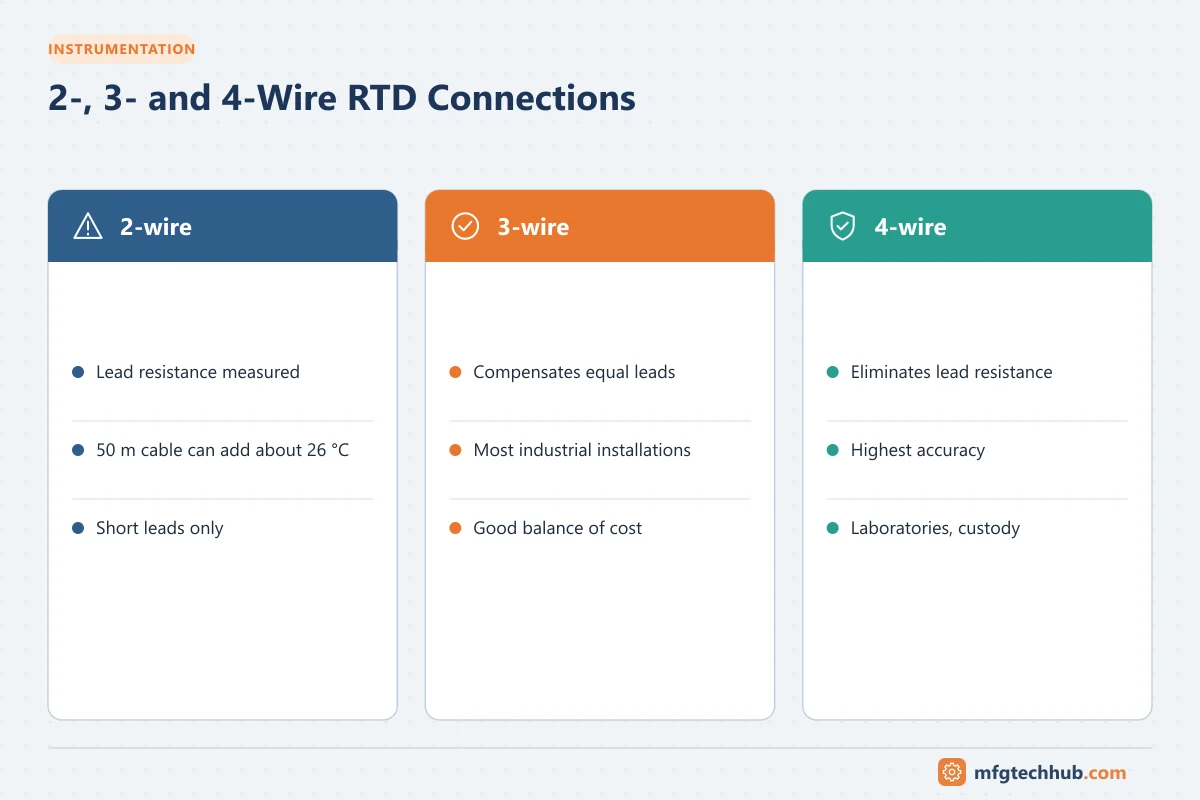
Cable resistance adds directly to the sensor resistance and is read as temperature.
| Connection | How it works | Typical use |
|---|---|---|
| 2-wire | Lead resistance included in the measurement | Short leads, head-mounted transmitters |
| 3-wire | Compensates lead resistance if all leads are equal | Most industrial installations |
| 4-wire | Separate current and measurement leads; eliminates lead resistance | Highest accuracy, laboratories, custody transfer |
Worked example (illustrative): a 2-wire Pt100 on 50 m of cable with 0.1 Ω per metre per conductor adds 2 × 50 × 0.1 = 10 Ω. At 0.385 Ω/°C, that is an error of about 26 °C. With a 3-wire connection most of this is compensated; with a 4-wire connection it is eliminated. Head-mounted transmitters avoid the problem by converting to 4–20 mA at the sensor. Check conversions with the RTD Calculator.
Self-heating
The measuring current heats the sensor slightly. Keep the current low (typically about 1 mA for a Pt100) and ensure good thermal contact, especially in still air or gas.
Thermistors
| Type | Behaviour | Typical use |
|---|---|---|
| NTC (negative temperature coefficient) | Resistance falls strongly as temperature rises | Temperature measurement in equipment, HVAC, electronics, battery packs |
| PTC (positive temperature coefficient) | Resistance rises sharply above a switching temperature | Motor winding protection, overcurrent protection |
- NTC thermistors are very sensitive (several percent resistance change per °C) but strongly non-linear.
- Linearisation uses the Steinhart–Hart equation (1/T = A + B·ln R + C·(ln R)³) or a B-value approximation over a limited range.
- Interchangeability between devices is poorer than for standard Pt100s unless matched types are used.
- PTC thermistors in motor windings are connected to thermistor protection relays and trip the motor at their rated temperature. See Motor Protection.
RTD vs thermistor vs thermocouple
| Criterion | Pt100 RTD | NTC thermistor | Thermocouple |
|---|---|---|---|
| Range | Wide (cryogenic to several hundred °C) | Narrow (typically moderate temperatures) | Widest, to very high temperatures |
| Accuracy and stability | High | High in a narrow range, poorer interchangeability | Lower |
| Linearity | Good | Poor (needs linearisation) | Moderate |
| Sensitivity | Moderate | Very high | Low (µV per °C) |
| Response | Moderate | Fast (small beads) | Fast |
| Typical industrial use | Process temperature, pharma, food, custody transfer | Equipment, HVAC, electronics, motor protection (PTC) | Furnaces, exhaust, high temperatures |
See Thermocouples.
Calibration
- Compare against a reference thermometer in a dry block or stirred bath at several points covering the working range.
- For critical measurements, calibrate the sensor and transmitter together (loop calibration) or use sensor-matching: many transmitters accept Callendar–Van Dusen coefficients from a calibrated sensor to reduce error.
- Record as-found and as-left values. See Calibration and Traceability.
Troubleshooting
| Symptom | Likely cause | First check |
|---|---|---|
| Reads high by a steady amount | 2-wire lead resistance, wrong wiring configuration | Connection type in transmitter; lead resistance |
| Reads very high or overrange | Open circuit | Resistance at the sensor terminals |
| Reads very low | Short circuit | Insulation and wiring |
| Unstable reading | Moisture in the sensor or head, loose terminal | Insulation resistance, terminals |
| Drift after vibration or shock | Damaged element | Compare with reference; replace |
| Reads high in still gas | Self-heating | Measuring current, thermal contact |
Frequently asked questions
What is a Pt100?
A platinum RTD with a resistance of 100 Ω at 0 °C, following the IEC 60751 standard curve (about 0.385 Ω change per °C). It is the most common industrial RTD.
Why use a 3-wire RTD?
A 3-wire connection compensates for the resistance of the connecting cable (assuming equal lead resistances), preventing large temperature errors on long cable runs.
What is the difference between an NTC and a PTC thermistor?
An NTC thermistor’s resistance falls as temperature rises and is used for measurement. A PTC thermistor’s resistance rises sharply above a set temperature and is used mainly for protection, such as motor winding over-temperature.
Key takeaways
- Pt100 RTDs are accurate, stable and standardised by IEC 60751 classes AA, A, B and C.
- Use 3- or 4-wire connections or head-mounted transmitters to avoid lead-resistance errors.
- NTC thermistors are very sensitive but non-linear; PTCs are used for protection.
- Choose RTD, thermistor or thermocouple by range, accuracy, environment and cost.
Related tutorials
Before you apply this in a plant: this article is for education. Always check the current edition of the relevant standards, the manufacturer's documentation for your exact product and version, and your site's procedures. Safety-related work needs qualified personnel. See our editorial policy.