
Absolute, Gauge and Differential Pressure: References, Units, Conversions and Common Mistakes
On this page
A pressure value is meaningless without its reference. “2 bar” could mean 2 bar above atmosphere, 2 bar above perfect vacuum, or a 2 bar difference between two points. Mixing up references is a common cause of wrong readings, especially in vacuum systems, at high altitude and when comparing instruments from different suppliers.
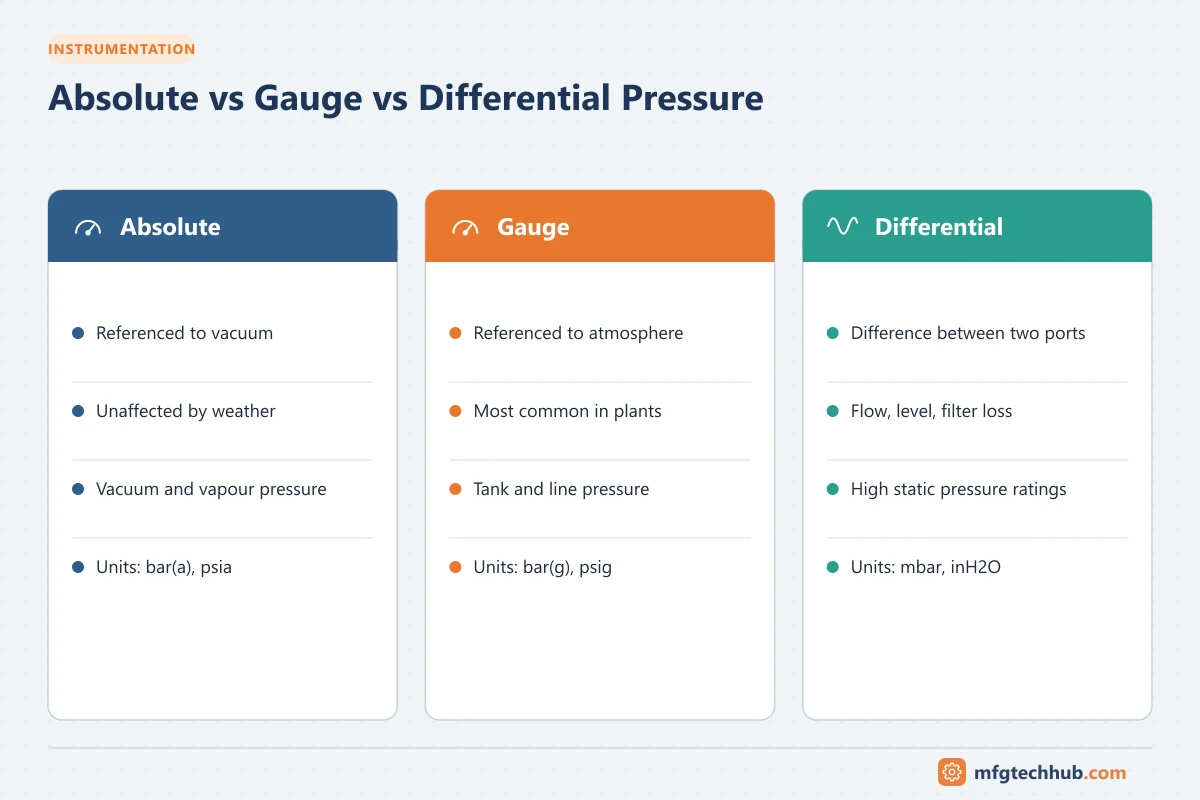
The references
| Reference | Measured relative to | Written as | Typical uses |
|---|---|---|---|
| Absolute | Perfect vacuum | bar(a), psia, kPa abs | Vacuum processes, vapour pressure, barometric, gas density and flow compensation |
| Gauge | Local atmospheric pressure | bar(g), psig | Most process pressures, pumps, hydraulics, compressed air |
| Sealed gauge | A fixed reference sealed in the sensor (usually about standard atmosphere) | bar(sg) | High pressures where atmospheric variation is negligible, harsh environments |
| Vacuum (negative gauge) | Below atmosphere, expressed as a gauge value | −0.8 bar(g) | Suction lines, vacuum systems (often better measured as absolute) |
| Differential | Another process pressure | bar(d), ΔP | Flow (orifice, venturi), level in pressurised tanks, filter clogging, pump head |
Relationship: absolute pressure = gauge pressure + atmospheric pressure. At sea level, atmospheric pressure is about 1.013 bar, but it varies with weather and falls with altitude.
Worked examples (illustrative)
| Situation | Calculation |
|---|---|
| Gauge reads 5.0 bar(g) at sea level | Absolute ≈ 5.0 + 1.013 = 6.01 bar(a) |
| Vacuum vessel at 0.1 bar(a) | Gauge ≈ 0.1 − 1.013 = −0.91 bar(g) |
| Same vessel at a site where atmosphere is 0.90 bar | Gauge ≈ 0.1 − 0.90 = −0.80 bar(g): the gauge reading changes with site altitude and weather even though the process is unchanged |
The last example shows why vacuum processes should be measured in absolute pressure.
Units and conversions
| Unit | Equivalent |
|---|---|
| 1 bar | 100 kPa = 0.1 MPa ≈ 14.504 psi |
| 1 psi | ≈ 6.895 kPa ≈ 0.0689 bar |
| 1 standard atmosphere | 101.325 kPa ≈ 1.013 bar |
| 1 mbar | 100 Pa ≈ 10.2 mm water column |
| 1 inch water column (at 4 °C) | ≈ 249 Pa |
Use the Unit Converter for other conversions. Always state the reference with the unit.
Which reference for which application
| Application | Recommended reference | Why |
|---|---|---|
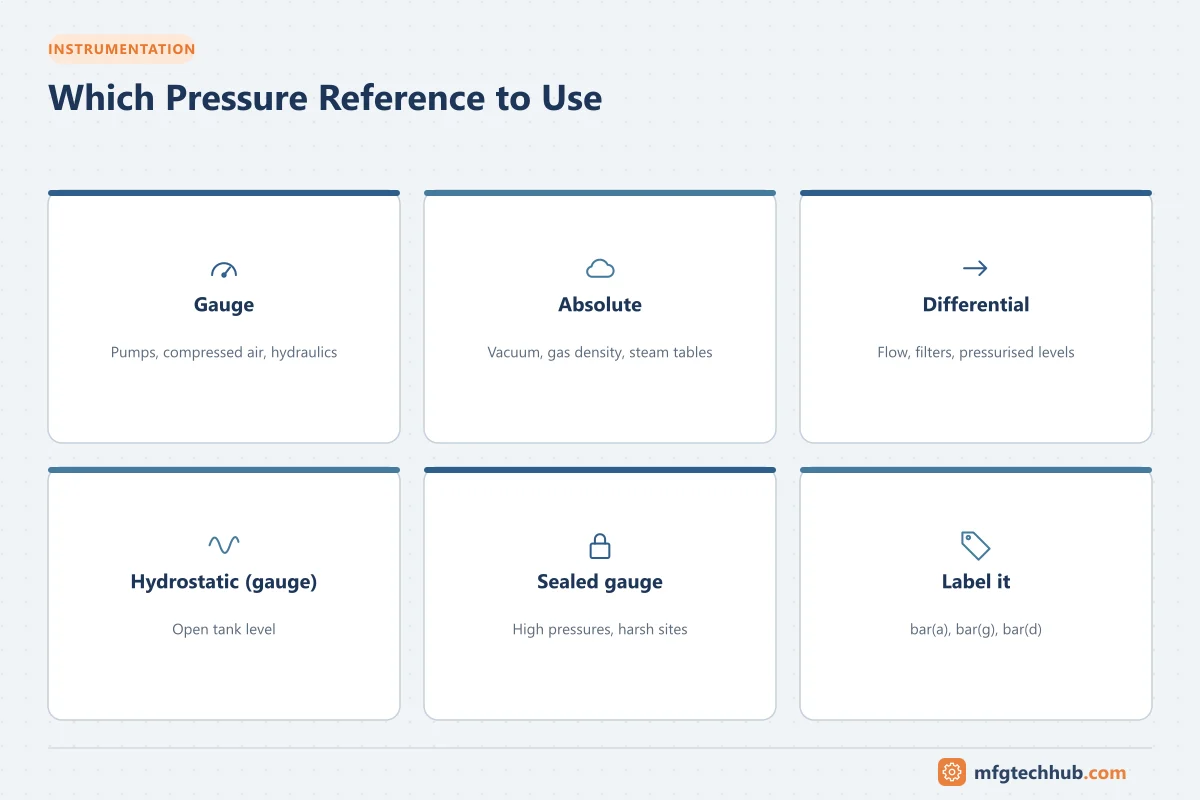
| Pump discharge, compressed air, hydraulics | Gauge | Relevant to equipment stress and operation |
| Vacuum distillation, drying, packaging | Absolute | Independent of weather and altitude |
| Steam | Absolute or gauge, but consistently | Steam tables use absolute pressure |
| Gas flow compensation | Absolute | Gas density depends on absolute pressure |
| Tank level in open tanks | Gauge (hydrostatic) | Head of liquid above atmosphere |
| Tank level in pressurised tanks | Differential | Cancels the vapour-space pressure |
| Flow through orifices and venturis | Differential | Flow is proportional to √ΔP; see DP Flowmeters |
| Filter condition | Differential | Rising ΔP shows clogging |
Sensor technologies
| Technology | Principle | Notes |
|---|---|---|
| Piezoresistive | Strain-sensitive resistors on a silicon diaphragm | Common in transmitters and sensors |
| Capacitive | Diaphragm moves between capacitor plates | Common in high-accuracy DP transmitters |
| Resonant | Frequency of a resonating element changes with pressure | Very high accuracy and stability |
| Thin-film and strain gauge | Metal diaphragm with strain gauges | Robust, industrial sensors |
| Piezoelectric | Charge from a crystal under dynamic pressure | Dynamic only; see Manometers vs Piezoelectric Sensors |
| Mechanical | Bourdon tube, diaphragm, bellows | Local gauges; see Pressure Gauges |
For transmitter selection, accuracy terms and installation, see Pressure Transmitters.
Common mistakes
| Mistake | Effect | Prevention |
|---|---|---|
| Gauge transmitter on a vacuum process | Reading varies with weather and altitude | Use absolute |
| Mixing bar(a) and bar(g) in calculations | Errors of about 1 bar | Always label references |
| Blocked vent on a gauge sensor | Behaves like a sealed or absolute sensor | Keep vents clear; correct cable or vent type |
| DP transmitter high and low sides reversed | Negative or wrong readings | Check H and L connections at commissioning |
| Ignoring liquid head in impulse lines | Offset in readings | Account for elevation; zero with lines filled |
Frequently asked questions
What is the difference between absolute and gauge pressure?
Absolute pressure is measured from perfect vacuum; gauge pressure is measured from local atmospheric pressure. Absolute equals gauge plus atmospheric pressure.
Why measure vacuum in absolute pressure?
Because gauge readings change with atmospheric pressure (weather and altitude) even when the process is unchanged. Absolute measurement shows the true process condition.
When is differential pressure used?
For flow measurement with primary elements, level in pressurised vessels, filter monitoring and any measurement that depends on the difference between two pressures.
Key takeaways
- Always state the reference: absolute, gauge, sealed gauge or differential.
- Absolute = gauge + atmospheric; atmospheric pressure varies with altitude and weather.
- Use absolute for vacuum and gas density, differential for flow, filters and pressurised levels.
- Label units and references in every document and HMI.
Related tutorials
Before you apply this in a plant: this article is for education. Always check the current edition of the relevant standards, the manufacturer's documentation for your exact product and version, and your site's procedures. Safety-related work needs qualified personnel. See our editorial policy.