
Transformer Monitoring and Protection Systems
On this page
Power transformers are among the most valuable and critical assets in an industrial electrical system. A transformer failure can stop an entire plant, and replacement lead times for large units can be many months. Protection systems disconnect a transformer quickly when a fault occurs, while monitoring systems detect developing problems early enough to plan maintenance.
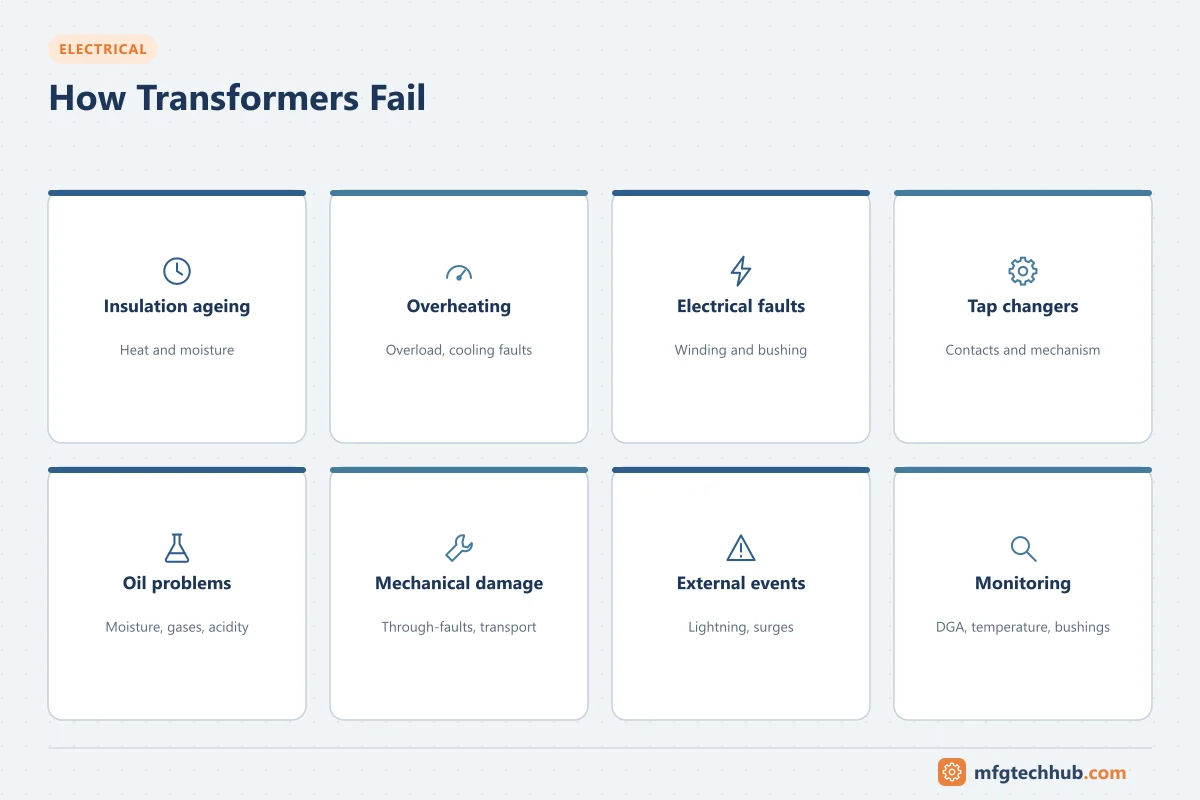
How transformers fail
| Failure cause | Examples |
|---|---|
| Insulation ageing | Paper insulation degrades with heat, moisture and oxygen |
| Overheating | Overload, cooling failure, harmonics, high ambient temperature |
| Electrical faults | Winding short circuits, partial discharge, bushing failures |
| Mechanical damage | Winding movement from through-faults (short circuits downstream) |
| Tap changer problems | Contact wear, mechanism failure |
| Oil problems | Moisture, contamination, low oil level |
| External events | Lightning and switching surges, animals, poor maintenance |
The life of a transformer is closely linked to the condition of its paper insulation, which is why temperature and moisture are monitored so carefully.
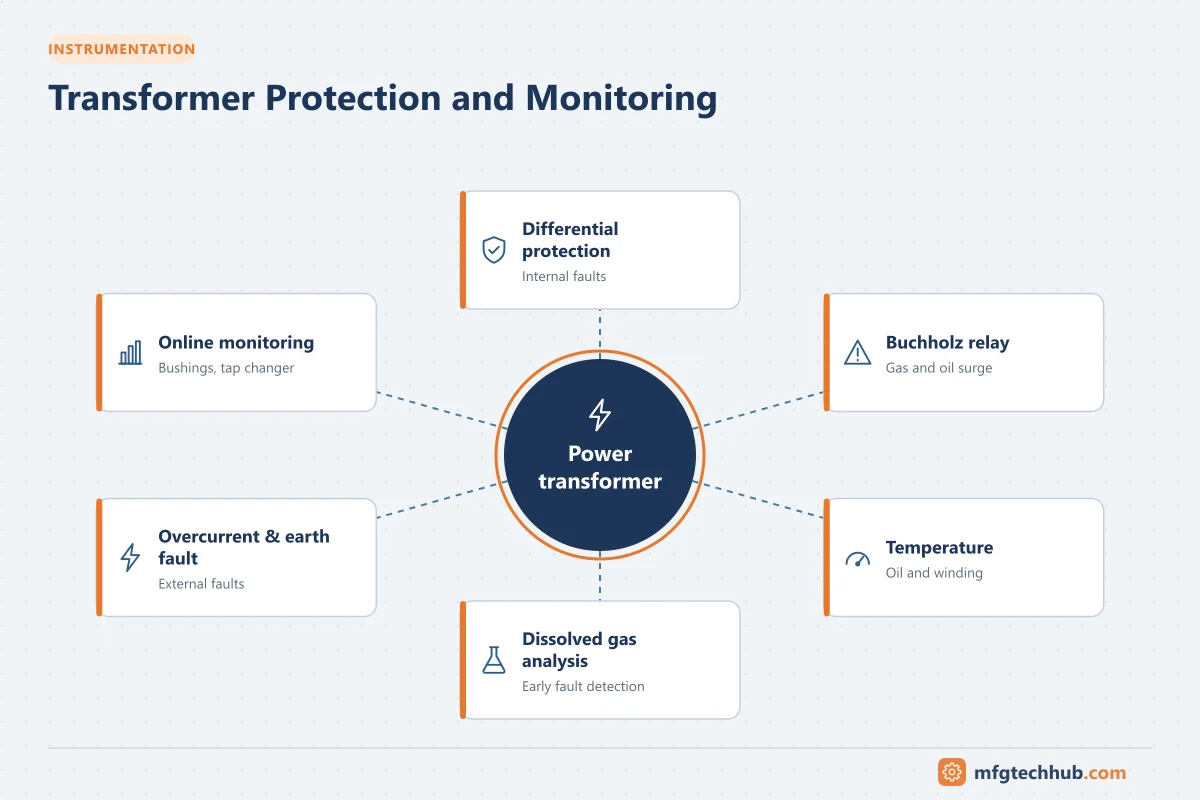
Protection devices
Mechanical and oil-based protection (oil-filled transformers)
- Buchholz relay: installed in the pipe between the tank and the conservator. Slow gas accumulation from minor faults operates an alarm; a sudden surge of oil from a major internal fault operates a trip.
- Sudden pressure relay / pressure relief device: responds to rapid pressure rise inside the tank and vents pressure to prevent rupture.
- Oil level indicator: alarms on low oil level.
- Oil temperature indicator (OTI) and winding temperature indicator (WTI): alarm and trip on high temperatures, and control cooling fans and pumps. The WTI uses a thermal image of the hottest winding region.
Sealed and dry-type transformers use winding temperature sensors (often PT100) with temperature relays.
Electrical protection relays
| Protection (ANSI) | Purpose |
|---|---|
| 87T Transformer differential | Compares currents entering and leaving the transformer; fast, selective protection against internal faults |
| 64REF Restricted earth fault | Sensitive detection of earth faults in a winding |
| 50/51 Overcurrent | Backup protection for faults and overloads |
| 50N/51N Earth fault overcurrent | Backup earth fault protection |
| 49 Thermal overload | Protects against sustained overload based on a thermal model |
| 24 Overexcitation (V/Hz) | Protects against overfluxing, mainly on generator transformers |
Differential relays must be stable during magnetizing inrush when a transformer is energized, usually by detecting the second harmonic content of the inrush current.
Condition monitoring techniques
Dissolved gas analysis (DGA)
When insulating oil or paper is stressed by heat or electrical discharge, it breaks down into gases that dissolve in the oil. DGA measures gases such as hydrogen, methane, ethane, ethylene, acetylene, carbon monoxide and carbon dioxide.
| Dominant gas pattern | Typical indication |
|---|---|
| Hydrogen | Partial discharge |
| Methane, ethane, ethylene | Thermal faults in oil at increasing temperatures |
| Acetylene | High-energy arcing |
| Carbon monoxide and carbon dioxide | Overheating of paper insulation |
Interpretation methods are described in IEEE C57.104 and IEC 60599. Trends and rates of change are more important than single results. Online DGA monitors provide continuous measurement for critical transformers.
Oil quality tests
- Breakdown voltage (dielectric strength)
- Moisture content
- Acidity and interfacial tension, indicating oil ageing
- Furan analysis, indicating paper insulation degradation
Electrical tests
- Insulation resistance and polarization index
- Winding resistance and turns ratio
- Power factor / tan delta (dissipation factor) of insulation and bushings
- Frequency response analysis (FRA) to detect winding movement after faults or transport
Thermography and visual inspection
Infrared thermography finds hot connections, blocked radiators and cooling problems. Visual inspections check for leaks, silica gel breather condition, bushing damage and noise changes.
Online monitoring systems
Critical transformers increasingly use continuous monitoring that combines:
- Load current and top-oil and winding hot-spot temperatures
- Online DGA and moisture-in-oil sensors
- Bushing monitoring
- Tap changer monitoring
- Cooling system status
Data is sent to SCADA or asset management systems, which calculate insulation ageing, estimate remaining life and alarm on abnormal trends. IEC 60076-7 and IEEE C57.91 provide loading guides and thermal models used in these calculations.
Operating good practice
- Avoid sustained overloads, especially at high ambient temperatures.
- Keep cooling systems (fans, radiators, pumps) clean and functional.
- Replace silica gel breathers before they are fully saturated.
- Investigate every Buchholz alarm and gas accumulation.
- Trend DGA results and act on rising gas generation rates.
- Test protection relays and trip circuits periodically.
Key takeaways
- Transformer protection combines mechanical devices (Buchholz, pressure relief, temperature) with electrical relays (differential, overcurrent, earth fault).
- Dissolved gas analysis is the most powerful early warning tool for oil-filled transformers.
- Online monitoring enables condition-based maintenance and life assessment.
Related tutorials
Before you apply this in a plant: this article is for education. Always check the current edition of the relevant standards, the manufacturer's documentation for your exact product and version, and your site's procedures. Safety-related work needs qualified personnel. See our editorial policy.