
Industry 4.0 and Smart Instrumentation in Manufacturing
On this page
Industry 4.0 describes the digital transformation of manufacturing: connected equipment, data flowing freely between systems, and decisions based on real-time information. Instrumentation sits at the very start of that chain. Every analytics dashboard, AI model and digital twin depends on measurements from the field. Smart instruments do far more than measure; they diagnose themselves, communicate rich data, and help plants run more reliably and efficiently.
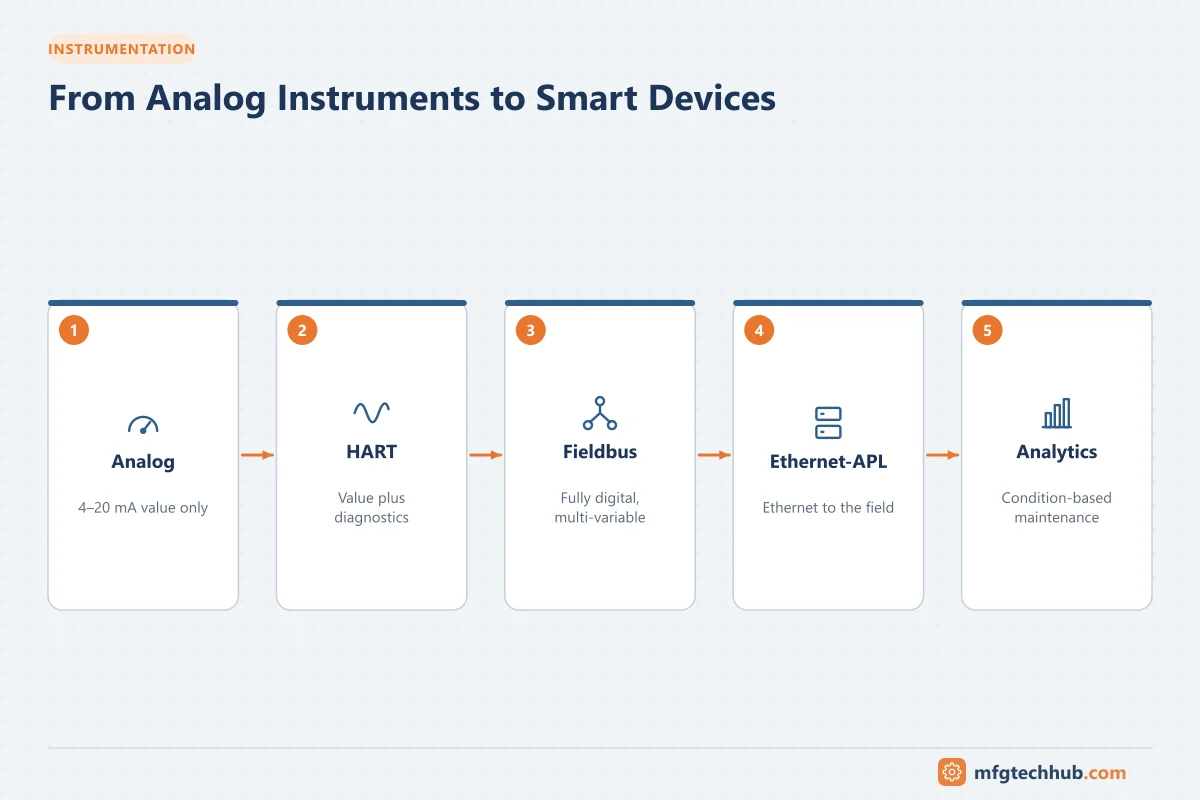
From analog instruments to smart devices
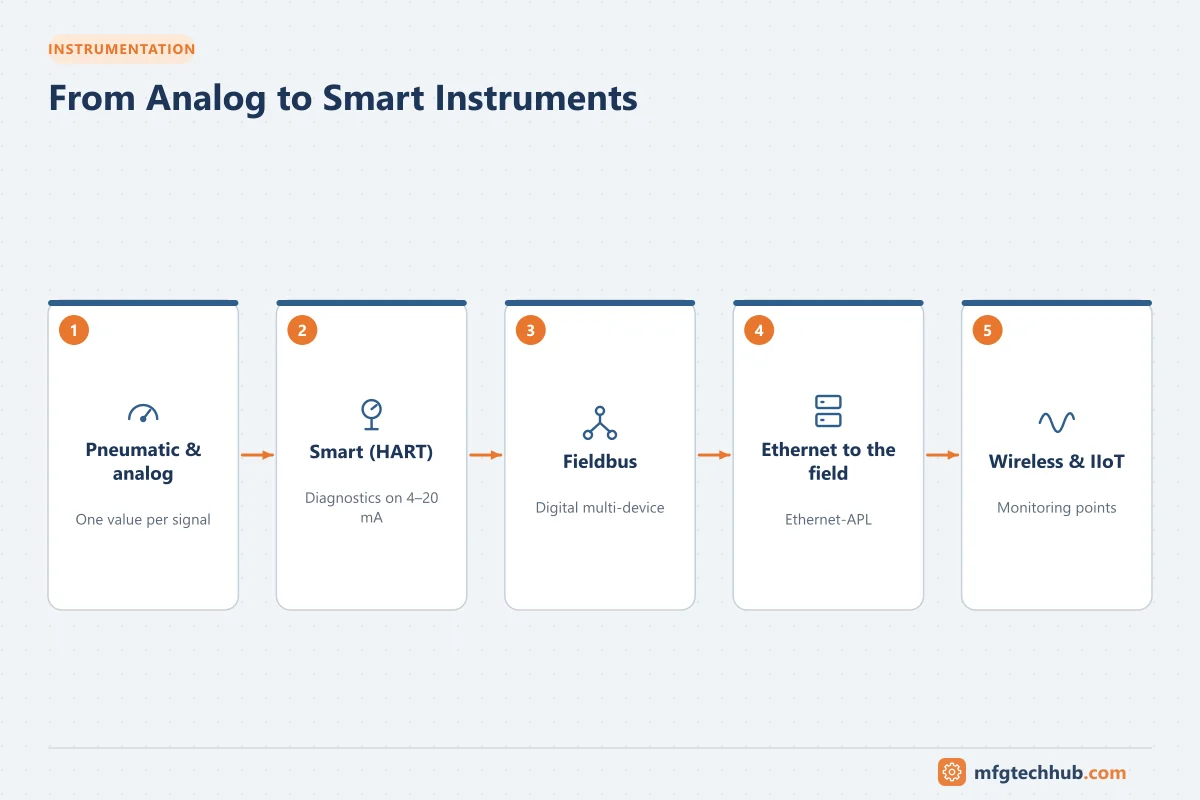
| Generation | Characteristics |
|---|---|
| Pneumatic and analog electronic | One measurement, one signal (3-15 psi or 4-20 mA); no diagnostics |
| Smart (HART) | 4-20 mA plus digital data for configuration and diagnostics |
| Fieldbus | Fully digital communication with multiple variables per device |
| Industrial Ethernet to the field | High-bandwidth digital communication all the way to instruments (for example Ethernet-APL) |
| Wireless and IIoT sensors | Battery-powered sensors adding measurements without cables |
What makes an instrument “smart”
- Multiple variables: a Coriolis meter reports mass flow, density, temperature and diagnostics; a smart pressure transmitter reports sensor temperature and statistics.
- Self-diagnostics: detection of sensor failure, plugged impulse lines, electrode coating, empty pipes and electronics faults.
- Standardized status: NAMUR NE 107 categories (failure, function check, out of specification, maintenance required).
- Remote configuration and verification, reducing trips to the field.
- Heartbeat or in-situ verification: some flowmeters can verify their own measurement integrity without removal, supporting longer calibration intervals where justified.
Key technologies
HART and HART-IP
Most installed smart instruments use HART. Much of this digital data is unused because many control systems only read the 4-20 mA signal. HART multiplexers, HART-enabled I/O and HART-IP make it available to asset management systems.
Ethernet-APL
Ethernet Advanced Physical Layer (Ethernet-APL) brings Ethernet to field instruments over two-wire cables, with power and intrinsic safety for hazardous areas, over long distances. It enables high-speed digital protocols such as PROFINET, EtherNet/IP, HART-IP and OPC UA directly to transmitters and analyzers.
Wireless sensors
WirelessHART, ISA100 and IIoT sensors add measurements such as vibration, temperature and acoustic monitoring without cabling. See Wireless Sensor Networks.
NAMUR Open Architecture (NOA)
NOA provides a secure “second channel” to take data from existing control systems and field devices for monitoring and optimization, without interfering with the core control system. It supports Industry 4.0 applications in brownfield process plants.
Module Type Package (MTP)
MTP standardizes how modular process units (skids) describe their functions and interfaces, making it faster to integrate them into a plant’s orchestration layer.
What Industry 4.0 instrumentation enables
| Application | How instrumentation contributes |
|---|---|
| Predictive maintenance | Device diagnostics and condition sensors reveal problems early |
| Energy management | Additional flow, power and temperature measurements show where energy goes |
| Quality and traceability | Accurate, time-stamped process data linked to batches |
| Remote operations | Diagnostics and configuration from central locations |
| Digital twins and analytics | Reliable, contextualized data feeds models. See Digital Twins |
| Reduced maintenance effort | Condition-based calibration and fewer unnecessary field visits |
Challenges
- Brownfield plants have many legacy instruments and control systems not designed for data sharing.
- Data without context: raw tags must be linked to assets, units and processes.
- Cybersecurity: more connectivity means more attack surface. See ISA-99 / IEC 62443.
- Skills: technicians need both instrumentation and IT/OT networking knowledge.
- Organizational silos between OT, IT and maintenance.
A practical roadmap for modernizing instrumentation
- Unlock existing data: make HART diagnostics available to an asset management system.
- Standardize on smart devices for new projects and replacements, with NE 107 diagnostics.
- Add wireless sensors for monitoring where wiring is expensive.
- Plan Ethernet-APL and modern architectures for new plants and major upgrades.
- Build the data infrastructure: historian, contextualization and secure connectivity. See Industrial IoT.
- Focus on use cases with clear value, such as reducing unplanned downtime or energy use.
Frequently asked questions
Do I need to replace all my instruments for Industry 4.0?
No. Many existing HART instruments already contain useful diagnostic data. HART-enabled I/O, multiplexers and asset management software can make that data available. Replacements can be planned over time as instruments reach end of life.
What is Ethernet-APL?
Ethernet Advanced Physical Layer is a two-wire Ethernet technology for field instruments that provides power and data over long cable runs and supports hazardous area installations. It brings high-speed Ethernet protocols directly to process instruments.
What does NAMUR NE 107 do?
NE 107 standardizes the status signals of field devices into four categories: failure, function check, out of specification and maintenance required. This makes diagnostics from different manufacturers consistent and easier for operators and technicians to act on.
Key takeaways
- Smart instruments provide multiple variables, diagnostics and remote configuration.
- HART-IP, Ethernet-APL, wireless and NOA make field data available for Industry 4.0 applications.
- Value comes from applications such as predictive maintenance, energy management and remote operations.
- Brownfield integration, data context, security and skills are the main challenges.
Related tutorials
Before you apply this in a plant: this article is for education. Always check the current edition of the relevant standards, the manufacturer's documentation for your exact product and version, and your site's procedures. Safety-related work needs qualified personnel. See our editorial policy.