
Smart Grid and Load Management in Manufacturing
On this page
Electricity costs for a factory depend not only on how much energy it uses but when and how fast it uses it. Peak demand charges, time-of-use tariffs and grid constraints mean that shifting or smoothing load can save as much as reducing it. Load management uses metering, control systems and on-site resources to shape a plant’s electrical demand, and the smart grid provides the signals and markets that reward it.
Understanding industrial electricity bills
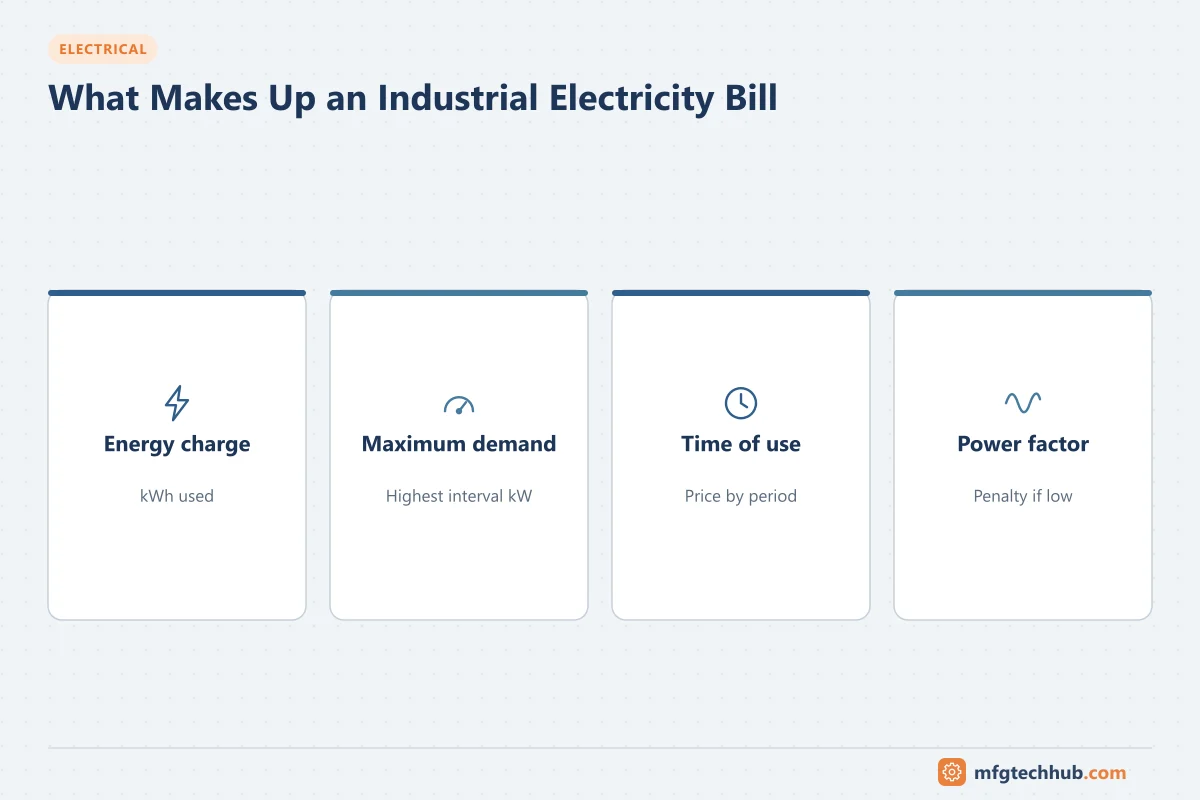
Many industrial tariffs include several components:
| Charge | Based on | How to reduce it |
|---|---|---|
| Energy charge | kWh consumed | Efficiency improvements, reduced waste |
| Maximum demand charge | Highest average kW or kVA over a demand interval (often 15 or 30 minutes) in the billing period | Peak shaving, staggered starts |
| Time-of-use rates | kWh at different prices by time of day | Shifting flexible loads to off-peak periods |
| Power factor penalty | Low power factor or excessive kvarh | Power factor correction |
A single 15-minute peak, for example when several large motors start together after a shutdown, can set the demand charge for the whole month.
What is a smart grid?
A smart grid is an electricity network that uses digital communication, sensing and automation to balance supply and demand more flexibly. For manufacturers, the relevant features are:
- Smart meters with interval data and remote reading
- Dynamic pricing signals and time-of-use tariffs
- Demand response programs that pay customers to reduce load when the grid is stressed
- Distributed energy resources: on-site solar, wind, combined heat and power, and batteries
- Two-way power flow where plants can export electricity
Load management techniques
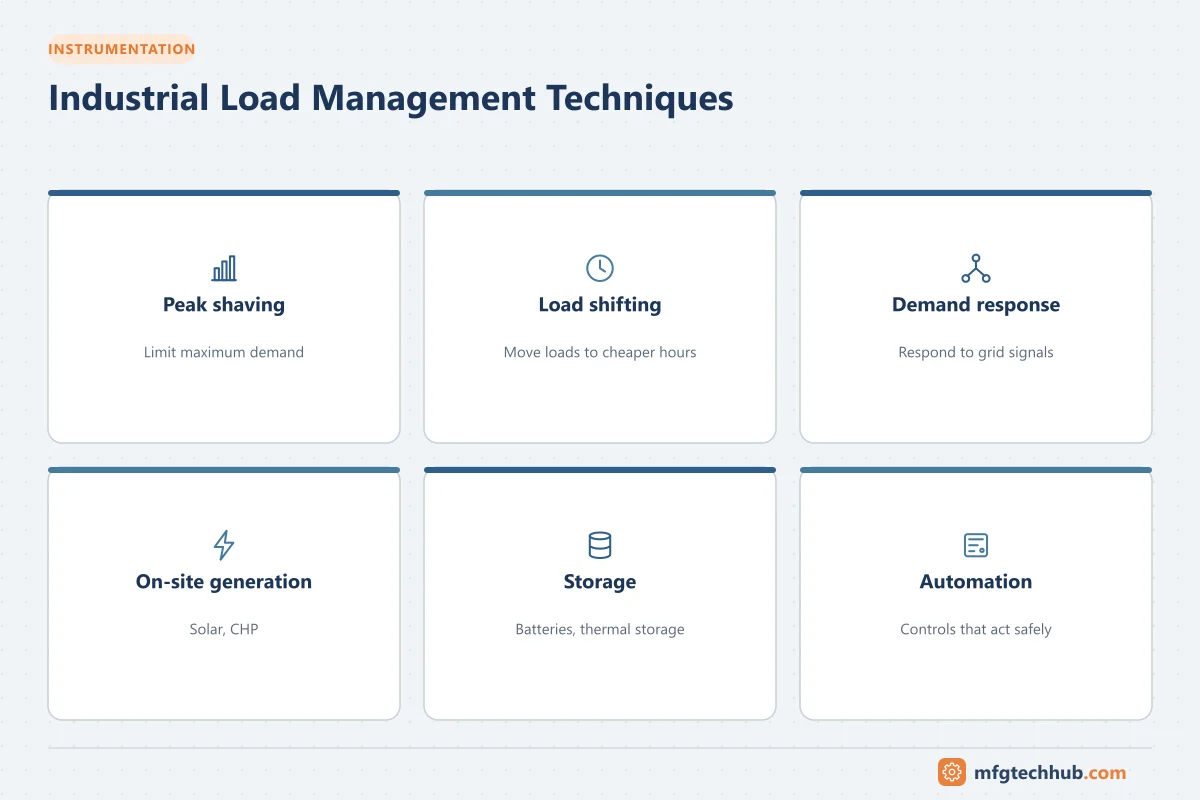
Peak shaving
Keep demand below a target limit by temporarily reducing controllable loads when demand approaches the limit. A demand controller monitors the utility meter in real time, predicts the demand at the end of the interval, and sheds or delays loads in a defined priority order.
Load shifting
Move flexible energy use to cheaper periods, for example:
- Running batch processes, pumping to storage or charging forklifts at night
- Producing ice or chilled water at night for use during the day (thermal storage)
- Pre-heating or pre-cooling buildings before peak periods
Staggered starting
Sequence the startup of large motors, compressors and furnaces instead of starting everything at once after a shutdown. Soft starters and VFDs also reduce starting current.
Load shedding
Automatically disconnect non-critical loads when supply is limited, such as during a generator run or a utility emergency, while keeping critical processes running.
Demand response
Participate in utility or grid operator programs that pay for reducing load on request. Signals may arrive manually or automatically through protocols such as OpenADR. The key is to identify loads that can be reduced for an hour or two without affecting safety or quality.
Which loads are flexible?
| Usually flexible | Usually not flexible |
|---|---|
| HVAC with thermal inertia | Continuous processes with tight quality limits |
| Water and wastewater pumping to storage | Safety systems and critical cooling |
| Compressed air with adequate storage | Furnaces during critical heat treatment |
| Battery chargers and electric vehicle charging | Cleanrooms and regulated environments |
| Batch processes that can be rescheduled | Processes where restart is costly |
On-site generation and storage
- Solar PV reduces daytime purchases; export limits and self-consumption must be managed.
- Battery energy storage systems (BESS) can shave peaks, shift energy and provide backup.
- Combined heat and power (CHP) generates electricity and useful heat on site.
- Backup generators can sometimes participate in demand response, subject to emissions rules. See Industrial Generators and Emergency Backup.
When a site combines these resources with controls that can operate independently of the grid, it becomes a microgrid.
The role of automation
Effective load management depends on:
- Metering: real-time interval data from the main meter and major loads. See Digital Power Meters.
- A control platform: PLC, SCADA or an energy management system that implements shedding priorities and demand limits.
- Integration with production: MES and scheduling systems that know which batches can move.
- Clear rules: agreed priorities so that no load is shed that affects safety or product quality.
Getting started
- Analyze 12 months of interval data to understand peaks, baseload and tariff structure.
- List loads with their power, flexibility and restrictions.
- Implement simple wins: staggered starts, scheduling and alarms for approaching peaks.
- Add automated demand control where savings justify it.
- Evaluate storage, solar and demand response programs.
Key takeaways
- Demand charges and time-of-use tariffs make the timing of energy use as important as the amount.
- Peak shaving, load shifting and staggered starts are low-cost ways to reduce bills.
- Smart grid programs reward flexible loads, and storage and on-site generation add further flexibility.
- Good metering and integration with production scheduling are essential.
Related tutorials
Before you apply this in a plant: this article is for education. Always check the current edition of the relevant standards, the manufacturer's documentation for your exact product and version, and your site's procedures. Safety-related work needs qualified personnel. See our editorial policy.