
Mass Flowmeters: Coriolis and Thermal Mass Meters Explained, Compared and Installed
On this page
Most flowmeters measure volume, but many processes care about mass: recipes are weighed, reactions depend on mass ratios, custody transfer is often by mass, and gas volume changes with pressure and temperature. Coriolis meters measure mass flow of liquids and gases directly and also give density. Thermal mass meters measure gas mass flow from heat transfer. Both avoid the pressure and temperature compensation that volumetric meters need.
Why measure mass
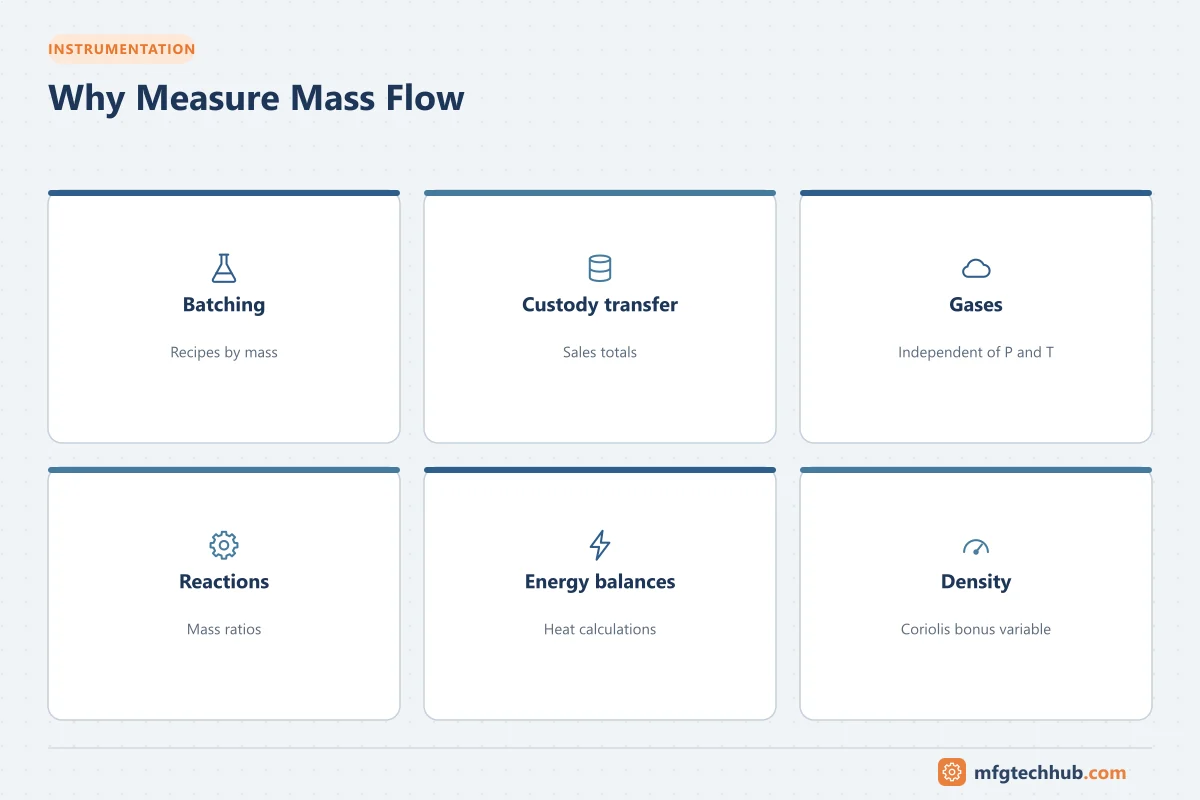
| Situation | Why mass flow helps |
|---|---|
| Batching and dosing | Recipes are specified by mass |
| Custody transfer | Sales often by mass; accurate totals |
| Gas flow | Mass is independent of pressure and temperature changes |
| Reactions and blending | Stoichiometry and ratios are mass-based |
| Energy balances | Heat calculations use mass |
Coriolis flowmeters
Principle: the fluid flows through one or two vibrating tubes. Mass flow causes the tubes to twist slightly (the Coriolis effect), producing a phase difference between sensors at the inlet and outlet. The phase difference is proportional to mass flow. The vibration frequency gives density, and a temperature sensor corrects for temperature.
| Measures | Detail |
|---|---|
| Mass flow | Directly, for liquids and gases |
| Density | From tube frequency; can derive concentration (for example sugar content, alcohol content) |
| Temperature | Built-in sensor |
| Volume flow | Calculated from mass and density |
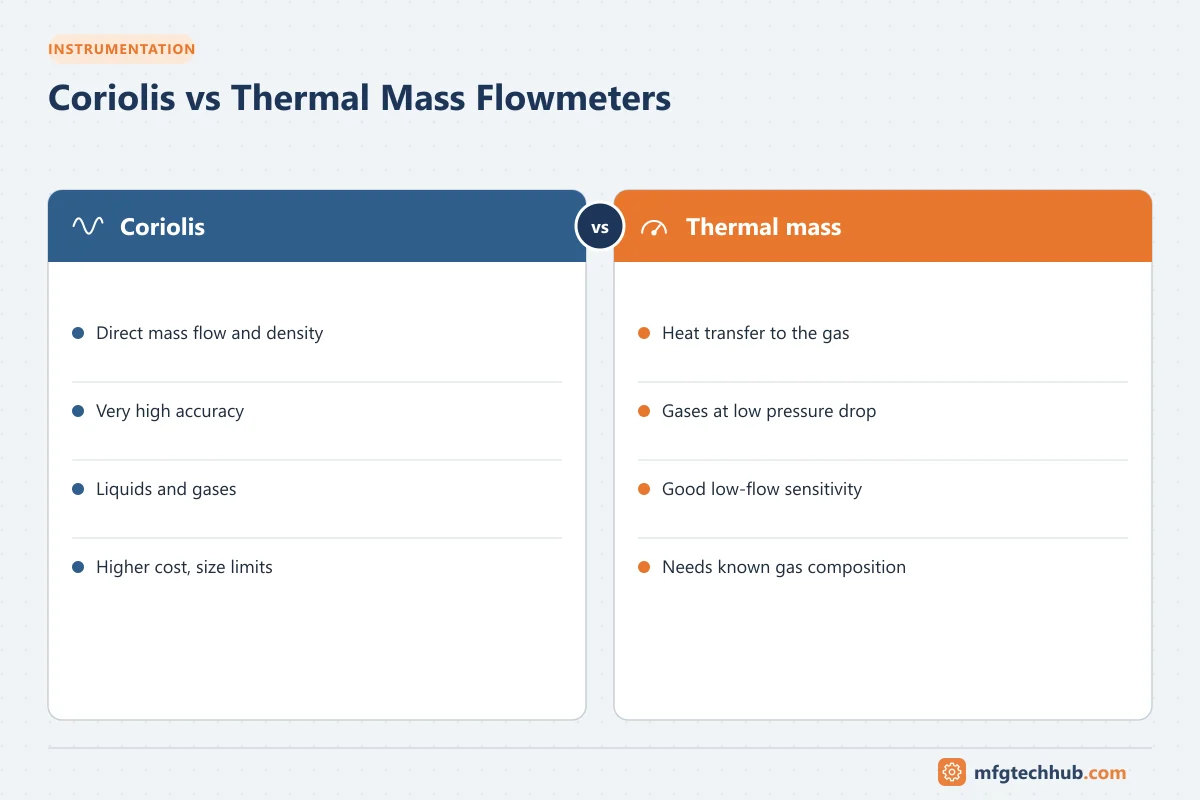
Strengths: high accuracy, no straight-run requirement in most designs, works with viscous and non-Newtonian fluids, multiple variables from one instrument.
Limitations: cost rises steeply with size; pressure drop can be significant for viscous fluids and small meters; gas bubbles in liquids (two-phase flow) affect performance; sensitive to external vibration and pipe stress in some designs.
Thermal mass flowmeters
Principle: a heated sensor in the gas stream loses heat in proportion to gas mass flow.
| Method | How it works |
|---|---|
| Constant temperature difference | Power needed to keep the heated sensor at a fixed temperature above the gas indicates mass flow |
| Constant power | Temperature difference between heated and reference sensors indicates mass flow |
Strengths: direct gas mass flow without pressure and temperature compensation, very low pressure drop (insertion types for large pipes and ducts), good at low flows.
Limitations: calibrated for a specific gas or gas mixture; composition changes cause errors; moisture or condensation affects readings; not for liquids.
Typical uses: compressed air consumption, natural gas to burners, biogas, nitrogen and other industrial gases, air flow in ducts.
Comparison
| Aspect | Coriolis | Thermal mass | Volumetric meters (for comparison) |
|---|---|---|---|
| Fluids | Liquids and gases | Gases | Depends on type |
| Output | Mass flow, density, temperature | Gas mass flow | Volume flow (compensation needed for gas) |
| Accuracy | High | Moderate | Varies |
| Pressure drop | Can be significant | Very low | Varies |
| Line sizes | Small to medium (large sizes expensive) | Small to very large (insertion) | All |
| Cost | High | Moderate | Varies |
See Flowmeter Selection Guide.
Sizing and installation
- Size Coriolis meters for pressure drop and accuracy, not just line size; a smaller meter gives better low-flow performance but higher pressure drop.
- Avoid gas entrainment in liquid service: install where the pipe stays full, away from pump suction problems and high points.
- For liquids, horizontal meters with tubes down, or vertical with upward flow, help keep tubes full; follow the manufacturer’s orientation guidance.
- Support the pipe so the meter is not stressed; isolate from strong vibration.
- Zero the meter at operating conditions with the meter full and flow stopped (blocked in), if the manufacturer recommends a field zero.
- For thermal meters, ensure the gas composition matches the calibration and keep the sensor dry; insertion meters need correct insertion depth and straight runs.
Troubleshooting
| Symptom | Meter | Likely cause | First check |
|---|---|---|---|
| Flow reading at zero flow | Coriolis | Zero offset, pipe stress | Zero at conditions; check supports |
| Erratic readings, drive gain high | Coriolis | Gas bubbles or two-phase flow | Process conditions, installation location |
| Density wrong | Coriolis | Coating or erosion of tubes, two-phase flow | Density diagnostics, meter verification |
| Reading wrong for a new gas | Thermal | Calibrated for a different gas | Gas selection and calibration |
| Reading drifts | Thermal | Sensor fouling or moisture | Inspect and clean sensor |
| Low flow not measured | Both | Low-flow cut-off, oversized meter | Sizing, cut-off setting |
Frequently asked questions
How does a Coriolis flowmeter work?
Fluid flows through vibrating tubes; mass flow causes the tubes to twist slightly, creating a phase difference between two sensors that is proportional to mass flow. The vibration frequency also gives the fluid density.
Can thermal mass flowmeters measure liquids?
No. Thermal mass flowmeters are designed for gases and must be calibrated for the specific gas or mixture.
Why choose a Coriolis meter over a magnetic meter?
When mass flow, density or very high accuracy is needed, or when the liquid is not conductive. Magnetic meters are usually cheaper for conductive liquids in larger pipes where volume flow is sufficient.
Key takeaways
- Mass flow matters for batching, custody transfer, gases and reactions.
- Coriolis meters measure mass flow and density directly for liquids and gases.
- Thermal mass meters measure gas mass flow and need the right gas calibration.
- Size for pressure drop, avoid two-phase flow and follow installation guidance.
Related tutorials
Before you apply this in a plant: this article is for education. Always check the current edition of the relevant standards, the manufacturer's documentation for your exact product and version, and your site's procedures. Safety-related work needs qualified personnel. See our editorial policy.