
Industrial Power Outages: Impact, Causes and Mitigation
On this page
A power interruption of even a fraction of a second can stop a production line, trip a process unit, scrap work in progress and take hours to recover from. For many manufacturers, voltage dips (sags) cause more trips than full outages. Understanding how disturbances affect a plant, and planning mitigation, reduces both downtime and safety risk.
How outages and dips affect a plant
| Impact | Examples |
|---|---|
| Lost production | Lines stop; continuous processes take hours to restart and stabilize |
| Scrap and rework | Partially processed batches, molded parts, extruded products and coatings lost |
| Equipment damage | Molten or solidified material in equipment, thermal stress, motor restart damage |
| Safety and environmental risk | Loss of cooling, ventilation, flares or safety systems; uncontrolled releases |
| Data loss | Corrupted PLC programs or databases if control power fails unsafely |
| Quality problems | Out-of-specification product during restart |
The total cost is often much larger than the lost production time, once scrap, restart effort, overtime and delivery penalties are included.
Causes
- Utility network faults: lightning, storms, equipment failures and trees on lines, which often cause voltage dips rather than full outages
- Grid capacity problems and planned load shedding in some regions
- Internal faults: cable failures, transformer faults and protection mis-coordination within the plant
- Human error during switching or maintenance
- Large motor starts within the plant, causing local voltage dips
Why sensitive equipment trips
- Contactors and relays drop out when voltage falls below their holding level, even briefly.
- VFDs trip on DC bus undervoltage.
- PLCs and power supplies reset if their hold-up time is exceeded.
- Undervoltage protection settings may be more sensitive than necessary.
Often one weak component, such as a contactor coil or a control power supply, trips an entire line.
Mitigation strategies
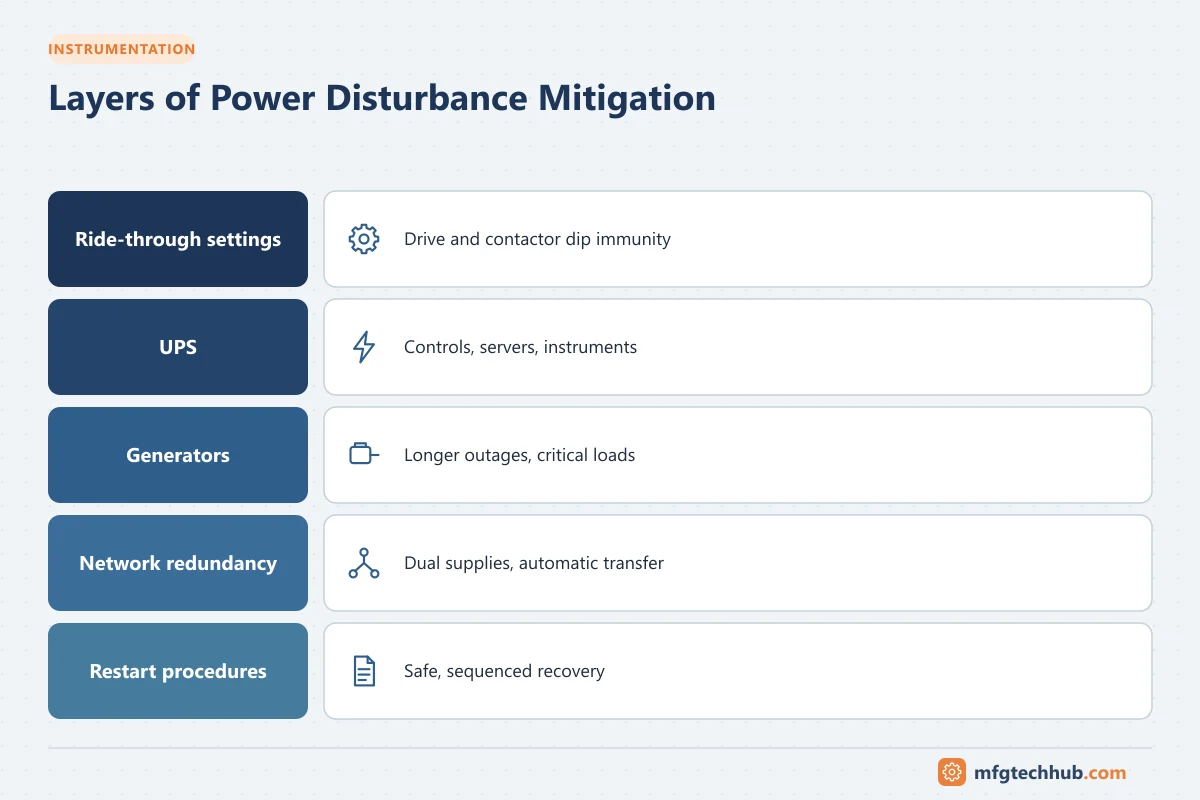
1. Understand the problem
Install power quality monitoring at the main incomer and critical feeders to record the depth, duration and frequency of events. Correlate trips with recorded events. See Power Quality Analyzers.
2. Improve ride-through of equipment
- Supply control circuits from UPS or DC power supplies with adequate hold-up time
- Use DC-powered or ride-through-rated contactor coils, or coil hold-in devices
- Enable VFD ride-through (kinetic buffering) and automatic restart (flying restart) where safe
- Review undervoltage protection settings and time delays
These low-cost measures often eliminate a large share of dip-related trips.
3. Protect critical loads with UPS
Control systems, safety systems, servers and networks should be on UPS. See Industrial UPS and Battery Backup.
4. Provide backup generation
Generators support essential loads during long outages, with automatic transfer. See Industrial Generators and Emergency Backup.
5. Build redundancy into distribution
- Dual utility feeds or ring connections where available
- Bus couplers and automatic transfer schemes between transformers
- Redundant power supplies in control cabinets fed from separate sources
- Correct protection coordination so that internal faults trip only the affected feeder
See Switchgear, Busbars and Power Distribution Panels.
6. Plan for safe shutdown and recovery
- Design processes to go to a safe state on power loss (fail-safe valves, safety systems on UPS)
- Write restart procedures that sequence loads to avoid overloading generators and supplies
- Stagger motor starts after power returns
- Train operators and practice recovery
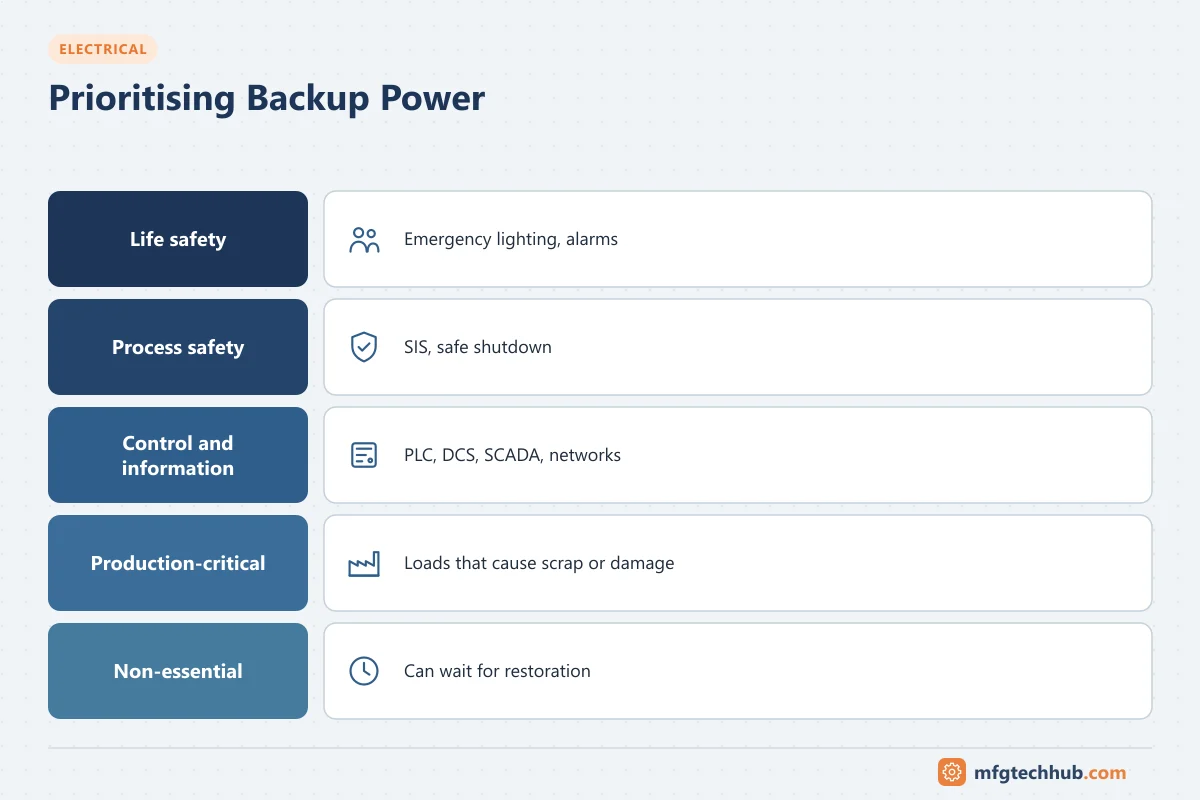
Prioritizing investment
| Priority | Loads |
|---|---|
| Life safety | Emergency lighting, fire systems, gas detection, safety systems |
| Process safety | Cooling, ventilation, flare systems, shutdown valves, SIS |
| Control and information | DCS/PLC, SCADA, networks, servers |
| Production-critical | Equipment where interruption causes large scrap or long restart |
| Non-essential | Offices, general lighting, non-critical utilities |
Assign backup solutions to each level, balancing cost against the consequences of interruption.
Frequently asked questions
What is the difference between a voltage sag and an outage?
A voltage sag (dip) is a short reduction in voltage, typically lasting from half a cycle to a few seconds, while the supply is still present. An outage (interruption) is a complete loss of voltage. Sags are far more frequent and cause many unexplained trips of sensitive equipment.
Why does one short dip stop a whole production line?
Often a single weak component, such as a contactor coil, a control power supply or a drive with sensitive undervoltage settings, drops out and triggers the line to stop. Identifying and hardening these weak points can eliminate many dip-related stoppages.
Should the whole plant be on UPS?
Usually not. UPS systems are used for control, safety and IT loads and a few sensitive processes. Large motors and heaters are better supported by ride-through settings, generators or process design, because UPS capacity for large loads is expensive.
Key takeaways
- Short voltage dips cause many industrial trips, not only full outages.
- Monitoring identifies which events cause trips and which equipment is weak.
- Ride-through improvements, UPS, generators and redundancy address different parts of the problem.
- Safe shutdown design and practiced recovery plans reduce the impact when outages happen.
Related tutorials
Before you apply this in a plant: this article is for education. Always check the current edition of the relevant standards, the manufacturer's documentation for your exact product and version, and your site's procedures. Safety-related work needs qualified personnel. See our editorial policy.