
Variable Frequency Drives (VFDs) and Soft Starters Explained
On this page
Most motors need some form of starting control, and many benefit from speed control. Soft starters limit the stress of starting and stopping a fixed-speed motor. Variable frequency drives (VFDs), also called variable speed drives or AC drives, control motor speed continuously, often saving large amounts of energy on pumps and fans. This article explains how each works and how to choose between them.
Direct-on-line starting and its problems
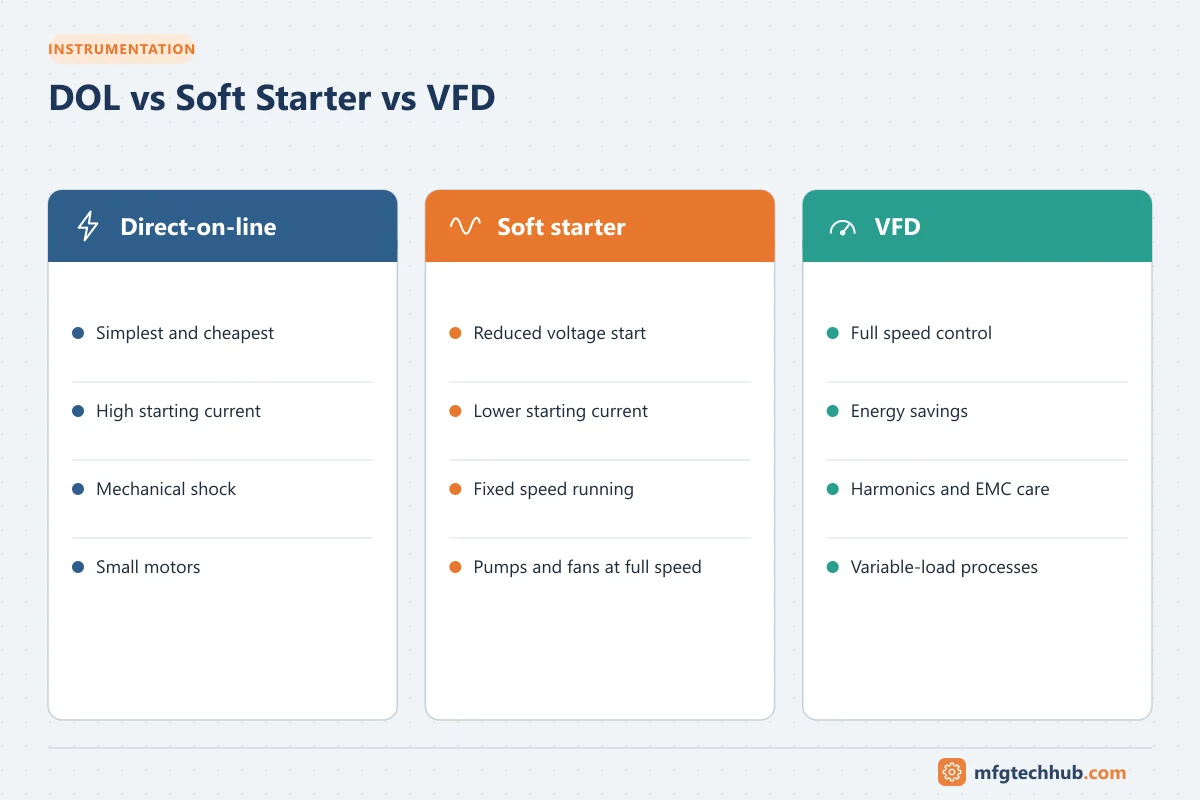
Connecting an induction motor directly to the supply (DOL) is the simplest method, but it causes:
- High inrush current, typically 6-8 times full-load current, causing voltage dips that can affect other equipment
- High starting torque, creating mechanical shock on couplings, belts, gearboxes and conveyors
- Water hammer in pumping systems when pumps start and stop abruptly
Star-delta starters reduce starting current to about one third of the DOL value, but with a transition that causes current and torque transients.
Soft starters
A soft starter uses pairs of thyristors (SCRs) in each phase to reduce the voltage applied to the motor during starting. The voltage ramps up over a set time, so current and torque rise gradually.
Features
- Adjustable start ramp and current limit (starting current typically 2-4 times full-load current, depending on the load)
- Soft stop ramp to reduce water hammer in pumps
- Built-in motor protection in many models
- Bypass contactor: after starting, many soft starters close an internal or external contactor so the thyristors do not carry current during running, reducing heat
Limitations
- The motor still runs at fixed speed; there are no energy savings during running.
- Reduced voltage also reduces starting torque, so soft starters may struggle with high-inertia or high-torque starts.
Variable frequency drives
A VFD controls motor speed by changing the frequency (and voltage) supplied to the motor.
How a VFD works
AC supply ──► Rectifier ──► DC bus (capacitors) ──► Inverter (IGBTs, PWM) ──► Motor- Rectifier: converts incoming AC to DC, typically with a six-pulse diode bridge.
- DC bus: capacitors smooth the DC voltage.
- Inverter: fast-switching IGBTs create a pulse-width-modulated (PWM) output that the motor sees as a variable-frequency, variable-voltage AC supply.
Control modes
| Mode | Description | Typical use |
|---|---|---|
| V/f (scalar) | Keeps voltage proportional to frequency | Pumps, fans, simple applications, multiple motors on one drive |
| Sensorless vector | Uses a motor model to control torque and speed without an encoder | Most general industrial applications |
| Closed-loop vector | Uses encoder feedback for precise speed and full torque at zero speed | Hoists, winders, extruders, precision applications |
| Direct torque control (DTC) | Directly controls motor flux and torque (vendor-specific technique) | Demanding dynamic applications |
Energy savings: the affinity laws
For centrifugal pumps and fans:
Flow ∝ speed Pressure (head) ∝ speed² Power ∝ speed³Reducing speed to 80% reduces theoretical power to 0.8³ ≈ 51%. Controlling flow by speed instead of a throttling valve or damper often saves a large share of the energy. In real systems with static head, savings are lower than the ideal cube law, so analyze the system curve before promising savings.
Other benefits
- Soft starting with full torque available from low speed
- Precise speed and process control, often with a built-in PID controller
- Reduced mechanical wear
- Communication with PLCs over fieldbus or industrial Ethernet, with diagnostics
VFD installation issues
| Issue | Cause | Mitigation |
|---|---|---|
| Harmonics on the supply | Rectifier draws non-sinusoidal current | Line reactors or DC chokes, harmonic filters, active front-end drives |
| Motor insulation stress | Fast voltage rise (dv/dt) and reflections on long cables | Inverter-duty motors, output reactors or dv/dt / sine filters |
| Bearing currents | Common-mode voltage discharging through bearings | Insulated bearings, shaft grounding rings, proper cabling and grounding |
| Electromagnetic interference | High-frequency switching | Shielded (screened) motor cable with 360° termination, EMC filters, segregated cable routes |
| Motor cooling at low speed | Shaft-mounted fan slows down | Separate cooling fans or motor derating for constant-torque loads at low speed |
See Power Quality Analyzers and Harmonic Measurement and EMI/EMC Testing.
DOL vs soft starter vs VFD
| Feature | DOL | Soft starter | VFD |
|---|---|---|---|
| Starting current | 6-8 × FLC | About 2-4 × FLC | About 1-1.5 × FLC |
| Speed control | No | No | Yes |
| Energy savings when running | No | No | Yes, on variable-torque loads |
| Harmonics | None | Only during starting (with bypass) | Continuous unless mitigated |
| Cost and size | Lowest | Moderate | Highest |
| Typical use | Small motors, strong supplies | Fixed-speed pumps, compressors, conveyors | Variable-flow pumps and fans, process speed control |
Choosing the right solution
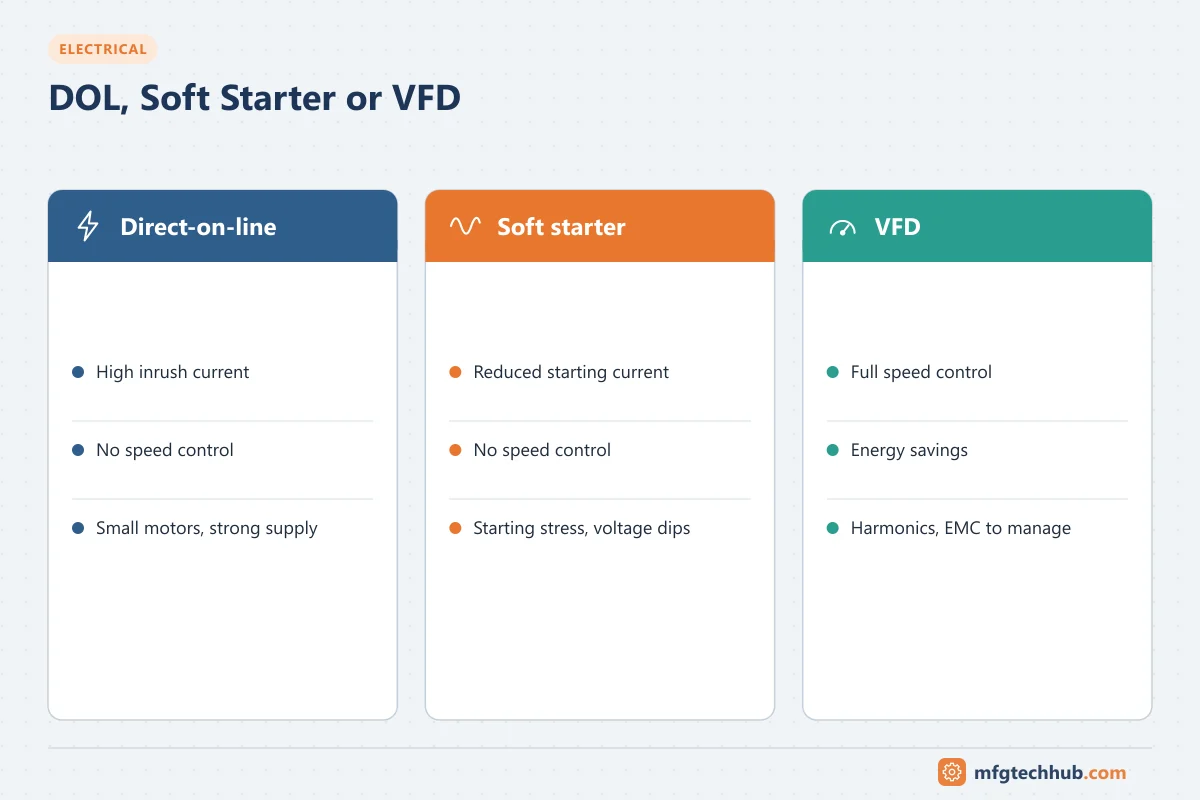
- Does the process need variable speed? If yes, use a VFD.
- Would variable speed save energy? Pumps and fans with varying demand usually benefit.
- Is the problem only starting stress or voltage dips? A soft starter is usually cheaper.
- Is the motor small and the supply strong? DOL may be acceptable.
- Consider lifecycle cost, not only purchase price.
Key takeaways
- Soft starters reduce starting current and mechanical shock but do not provide speed control.
- VFDs vary frequency to control speed and can save large amounts of energy on pumps and fans.
- VFD installations must address harmonics, motor insulation, bearing currents and EMC.
Related tutorials
Before you apply this in a plant: this article is for education. Always check the current edition of the relevant standards, the manufacturer's documentation for your exact product and version, and your site's procedures. Safety-related work needs qualified personnel. See our editorial policy.