
Types of Industrial Motors: AC, DC, Servo and Stepper Motors
On this page
Electric motors drive most of the equipment in a factory: pumps, fans, compressors, conveyors, mixers, machine tools and robots. Motors typically account for a large share of an industrial site’s electricity use, so choosing and controlling them well matters for both performance and energy cost. This article explains the main motor types, how they work, and where each is used.
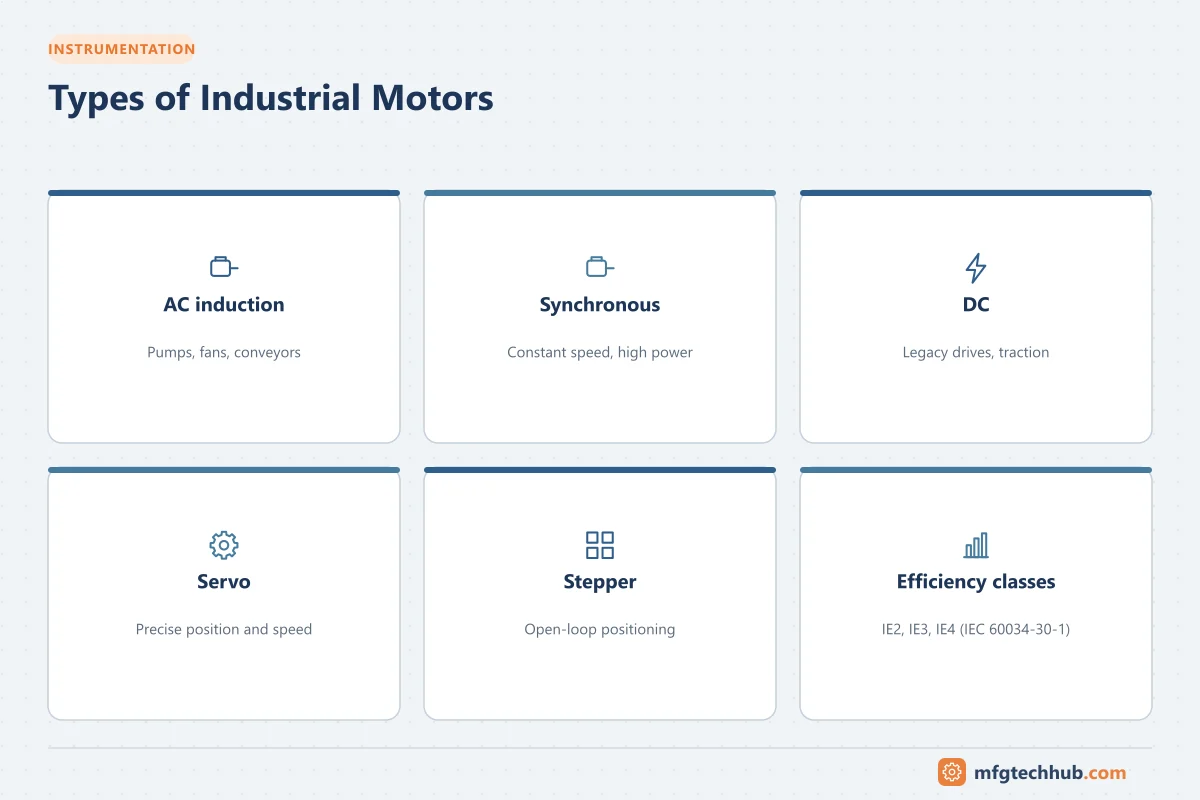
AC induction motors
The three-phase squirrel-cage induction motor is the workhorse of industry. It is simple, rugged, low-cost and needs little maintenance.
How it works
The stator windings create a rotating magnetic field. This field induces currents in the rotor bars, and the interaction produces torque. The rotor always turns slightly slower than the field; this difference is called slip.
Synchronous speed (rpm) = 120 × f ÷ pwhere f is the supply frequency in Hz and p is the number of poles.
| Poles | Synchronous speed at 50 Hz | at 60 Hz | Typical full-load speed at 50 Hz |
|---|---|---|---|
| 2 | 3,000 rpm | 3,600 rpm | about 2,900-2,960 rpm |
| 4 | 1,500 rpm | 1,800 rpm | about 1,440-1,480 rpm |
| 6 | 1,000 rpm | 1,200 rpm | about 960-985 rpm |
Starting
Direct-on-line (DOL) starting draws a high inrush current, often 6 to 8 times full-load current. Star-delta starters, soft starters or VFDs reduce this. See VFDs and Soft Starters.
Variants
- Wound-rotor (slip-ring) motors allow external rotor resistance for high starting torque; now largely replaced by VFDs.
- Single-phase induction motors power small loads, using capacitors or auxiliary windings to start.
Synchronous motors
A synchronous motor’s rotor turns at exactly synchronous speed, locked to the rotating field. The rotor field comes from DC excitation or permanent magnets.
- Large wound-field synchronous motors drive big compressors and mills, and can be over-excited to improve plant power factor.
- Permanent magnet synchronous motors (PMSM) offer very high efficiency and power density; they require a drive to run.
- Synchronous reluctance motors use a specially shaped rotor without magnets and, with a drive, achieve high efficiency.
DC motors
DC motors provide easy speed control and high starting torque. Types include separately excited, shunt, series and compound-wound motors. Their brushes and commutators need maintenance, so in most new applications they have been replaced by AC motors with VFDs. They remain in some older mills, cranes and traction systems.
Brushless DC (BLDC) motors use electronic commutation instead of brushes and are common in small fans, pumps and equipment.
Servo motors
A servo motor is part of a closed-loop motion system: motor, feedback device (encoder or resolver) and servo drive. It precisely controls position, speed and torque. Most industrial servos are permanent magnet AC motors.
Uses include robots, CNC machines, packaging machines, pick-and-place systems and anywhere precise, dynamic motion is required.
Stepper motors
A stepper motor moves in fixed angular steps (commonly 1.8° or 200 steps per revolution) when its windings are energized in sequence. It can position accurately without feedback (open-loop), which makes it simple and low-cost.
Limitations: torque falls at higher speeds, and if overloaded it can lose steps without the controller knowing. Closed-loop steppers with encoders address this. Uses include small indexing tables, 3D printers, valve actuators and laboratory equipment.
Comparison table
| Motor | Speed control | Efficiency | Maintenance | Typical uses |
|---|---|---|---|---|
| Induction (squirrel cage) | Fixed, or variable with VFD | Good to very good (IE2-IE4) | Very low | Pumps, fans, compressors, conveyors |
| Permanent magnet synchronous | With drive | Very high (IE4-IE5) | Low | High-efficiency pumps and fans, servo systems |
| Wound-field synchronous | Constant speed; VFD for large drives | Very high | Moderate | Large compressors, mills |
| DC (brushed) | Simple and precise | Moderate | High (brushes) | Legacy drives, cranes |
| Servo | Precise position, speed and torque | High | Low | Robots, CNC, packaging |
| Stepper | Open-loop positioning | Lower | Low | Small positioning tasks |
Motor efficiency classes
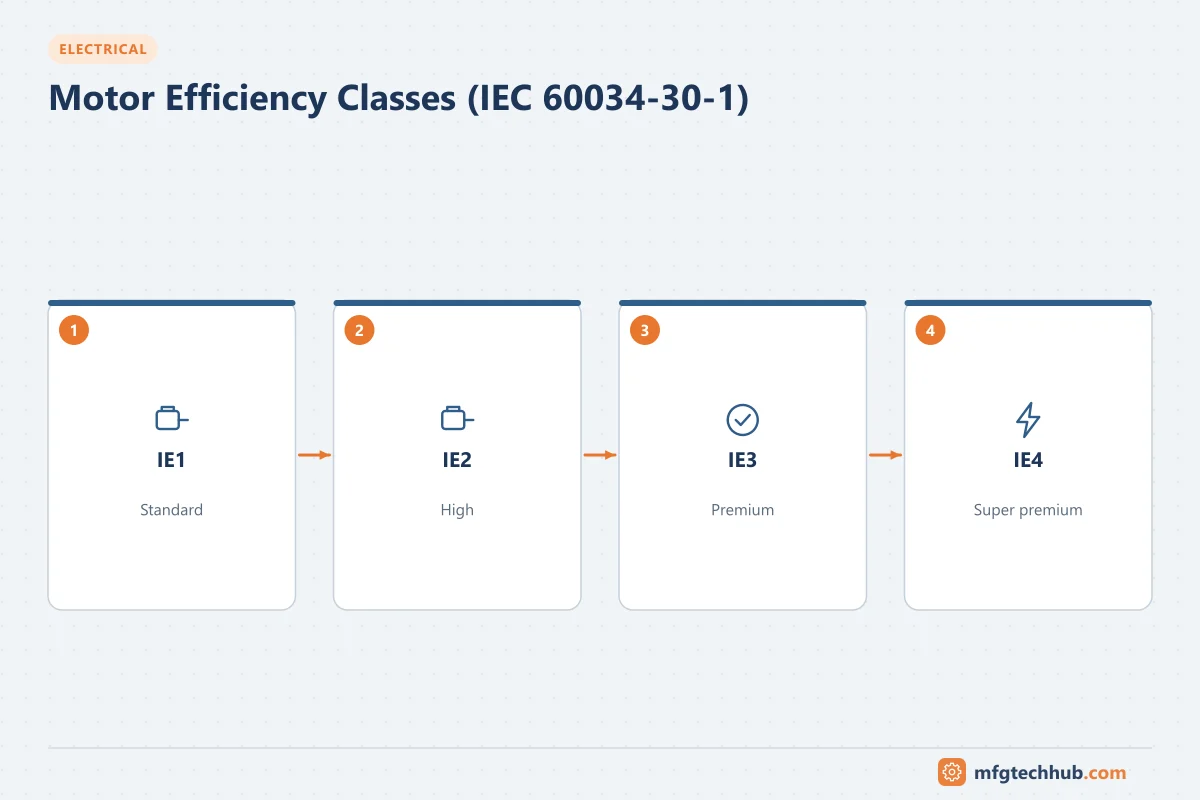
IEC 60034-30-1 defines efficiency classes for line-operated motors:
- IE1: standard efficiency
- IE2: high efficiency
- IE3: premium efficiency
- IE4: super premium efficiency
IE5 (ultra premium) is defined in IEC TS 60034-30-2 for variable-speed motors. Many countries set minimum efficiency requirements (often IE3) for new motors. In North America, NEMA Premium efficiency is broadly comparable to IE3.
Because a motor’s lifetime energy cost usually far exceeds its purchase price, choosing a more efficient motor often pays back quickly for machines that run many hours per year.
Reading a motor nameplate
A nameplate typically shows: rated power (kW or hp), voltage and connection (star/delta), full-load current, frequency, rated speed, power factor, efficiency class, insulation class (for example F), service factor, enclosure protection (IP rating), duty type (for example S1 continuous) and frame size.
Choosing a motor
- Load type: constant torque (conveyors) or variable torque (centrifugal pumps and fans).
- Speed requirement: fixed or variable, and how precise.
- Starting duty: starting torque needed and number of starts per hour.
- Environment: IP rating, hazardous area certification (Ex), temperature and altitude.
- Efficiency: annual running hours and energy cost.
- Control: DOL, soft starter, VFD or servo drive.
For positioning applications with servo motors, see Servo Motion Control Explained.
Key takeaways
- The squirrel-cage induction motor dominates industry because it is simple, rugged and cheap.
- Synchronous and permanent magnet motors offer higher efficiency, usually with a drive.
- Servo motors provide precise closed-loop motion; steppers provide simple open-loop positioning.
- IE efficiency classes help compare motors; higher efficiency often pays back quickly.
Related tutorials
Before you apply this in a plant: this article is for education. Always check the current edition of the relevant standards, the manufacturer's documentation for your exact product and version, and your site's procedures. Safety-related work needs qualified personnel. See our editorial policy.