
IoT-Enabled Wireless Sensor Networks (WSN) for Industry
On this page
Running cable to a new measurement point can cost far more than the instrument itself, especially on large sites, rotating equipment or in hazardous areas. Wireless sensor networks (WSN) make it practical to add measurements where wiring is too expensive or impossible: tank temperatures, pump vibration, steam trap health, corrosion, gas detection and remote pipeline data. They are a key enabler of the Industrial IoT.
What is a wireless sensor network?
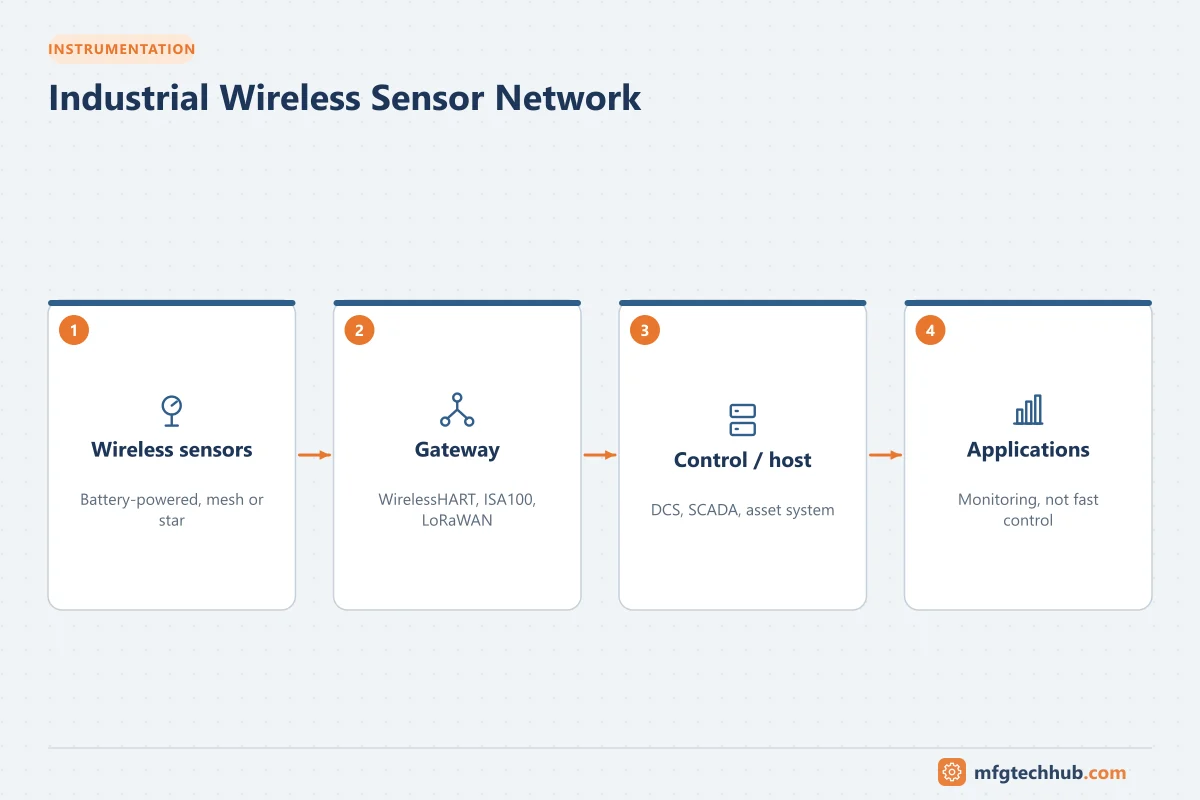
A WSN consists of battery-powered or energy-harvesting wireless field devices, one or more gateways that connect the wireless network to plant systems, and network management software that handles routing, security and diagnostics.
Wireless sensors ~~ (mesh or star network) ~~ Gateway ── Ethernet/Modbus/OPC UA ── DCS / SCADA / historian / cloudIndustrial wireless technologies
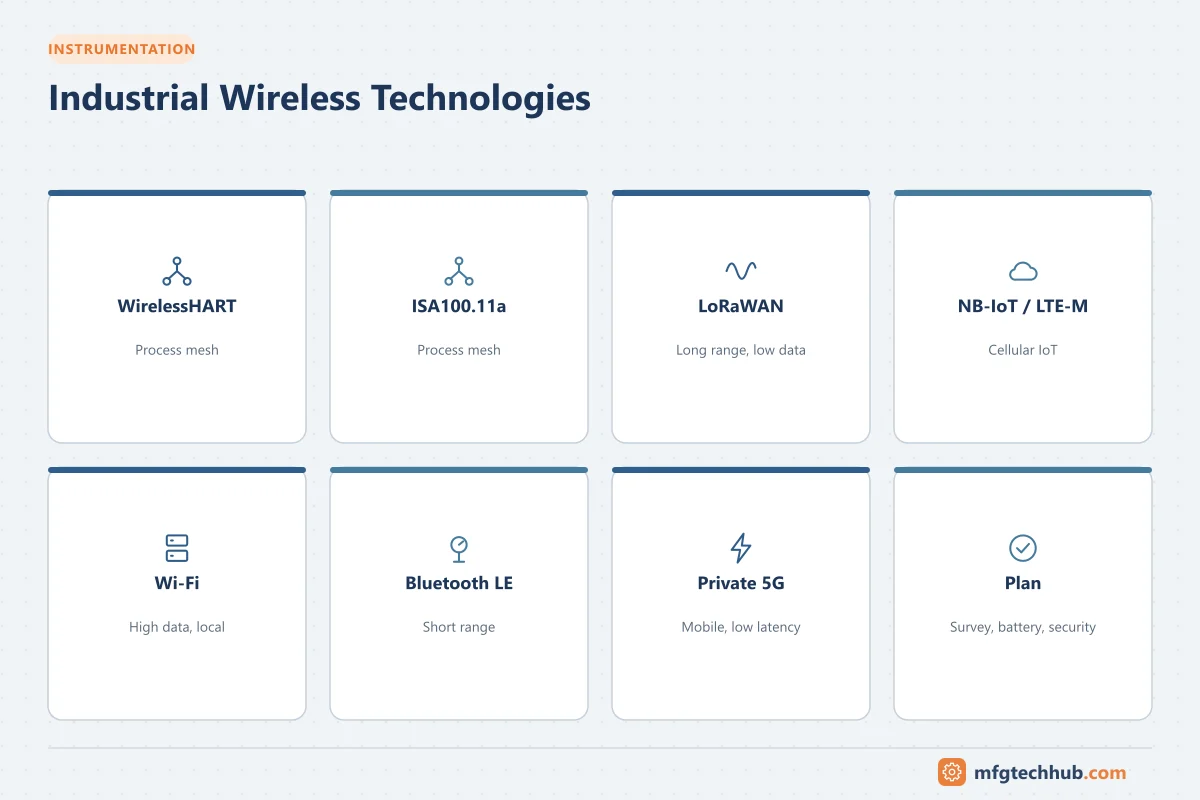
| Technology | Standard | Topology | Typical range | Strengths | Typical uses |
|---|---|---|---|---|---|
| WirelessHART | IEC 62591 (IEEE 802.15.4, 2.4 GHz) | Self-organizing mesh | About 100-200 m per hop, more with mesh | Mature process instrumentation ecosystem; uses HART commands | Process monitoring in plants |
| ISA100.11a | IEC 62734 (IEEE 802.15.4, 2.4 GHz) | Mesh or star | Similar to WirelessHART | Flexible, supports multiple protocols | Process monitoring |
| LoRaWAN | LoRa Alliance | Star | Several kilometres | Very long range, very low power | Remote and wide-area monitoring, utilities, agriculture |
| NB-IoT / LTE-M | 3GPP cellular | Star (via mobile network) | Wide area | Uses mobile network infrastructure | Remote assets, meters |
| Wi-Fi | IEEE 802.11 | Star | Tens of metres | High bandwidth | Cameras, tablets, higher-data devices |
| Bluetooth Low Energy | Bluetooth SIG | Point-to-point, mesh | Short | Low power, smartphone access | Device configuration, local sensors |
| Private 5G | 3GPP | Star | Site-wide | High bandwidth, low latency, mobility | Advanced applications; see 5G and Edge Computing |
Mesh vs star
- Mesh networks route data through neighboring devices, so a blocked path can be bypassed automatically. This improves reliability in plants full of steel structures.
- Star networks connect each device directly to a gateway; simpler, with long range for technologies such as LoRaWAN.
Battery life and update rate
Battery life depends mainly on how often a device transmits. Typical industrial devices update every few seconds to several minutes and can run for several years on a battery. Faster updates shorten battery life. Some devices use energy harvesting from vibration, heat or light.
Choose the slowest update rate that meets the application’s needs.
Good and poor applications for wireless
Good applications:
- Monitoring and trending (temperatures, pressures, levels)
- Condition monitoring (vibration, temperature, acoustic steam trap and valve leak monitoring)
- Environmental and safety monitoring (gas detection, safety showers)
- Temporary measurements and trials
- Remote or rotating equipment where cables are impractical
Poor applications:
- Fast closed-loop control
- Safety instrumented functions that require guaranteed response times (unless specifically designed and certified for it)
- Applications needing continuous, very high-frequency data (though some vibration sensors send summary values and occasional waveforms)
Planning an industrial wireless network
- Define the purpose and data requirements: update rates, latency and criticality.
- Conduct a site survey: identify obstacles, interference sources and gateway locations.
- Design for redundancy: in mesh networks, give each device several neighbors; consider redundant gateways.
- Plan the gateway connection to control systems (Modbus TCP, OPC UA, HART-IP, MQTT).
- Coordinate the spectrum with IT: 2.4 GHz is shared with Wi-Fi and Bluetooth.
- Plan battery replacement as part of maintenance.
Security
Industrial wireless standards include strong security features, such as AES-128 encryption, device authentication, join keys and message integrity checks. Good practice also includes:
- Managing join keys and credentials securely
- Placing gateways in the correct network zone, behind firewalls, as described in ISA-99 / IEC 62443
- Monitoring networks for unauthorized devices
- Keeping gateway firmware updated
Benefits
- Lower installation cost, especially for retrofits
- Faster deployment of new measurements
- Access to data from moving, remote or hazardous locations
- Easier condition monitoring programs, reducing manual rounds
Key takeaways
- Wireless sensor networks add measurements where wiring is costly or impractical.
- WirelessHART and ISA100.11a are designed for process plants; LoRaWAN and cellular IoT cover wide areas.
- Wireless is best for monitoring and condition data, not fast control or safety functions.
- Site surveys, redundancy, battery planning and security are essential.
Related tutorials
Before you apply this in a plant: this article is for education. Always check the current edition of the relevant standards, the manufacturer's documentation for your exact product and version, and your site's procedures. Safety-related work needs qualified personnel. See our editorial policy.