
Measurement, Control and Automation: How They Work Together in a Plant
On this page
Every automated plant rests on three layers that depend on each other. Measurement tells us what the process is doing. Control compares that with what we want and acts to correct it. Automation coordinates many loops, sequences and interlocks so the plant runs with little manual intervention. Automation cannot be better than the control beneath it, and control cannot be better than the measurement beneath that.
The main process variables
| Variable | Typical instruments | Detail page |
|---|---|---|
| Temperature | Thermocouples, RTDs, infrared sensors | Thermocouples, RTDs |
| Pressure | Pressure transmitters, gauges | Pressure Transmitters |
| Flow | Magnetic, Coriolis, vortex, DP, ultrasonic meters | Flowmeter Selection |
| Level | Radar, guided wave radar, DP, floats | Level Measurement Selection |
| Composition | pH, conductivity, oxygen, gas analysers | Analyser-specific pages |
| Electrical | Voltage, current, power, energy | Power Meters |
| Mechanical | Force, torque, vibration, position | Force and Vibration Sensors |
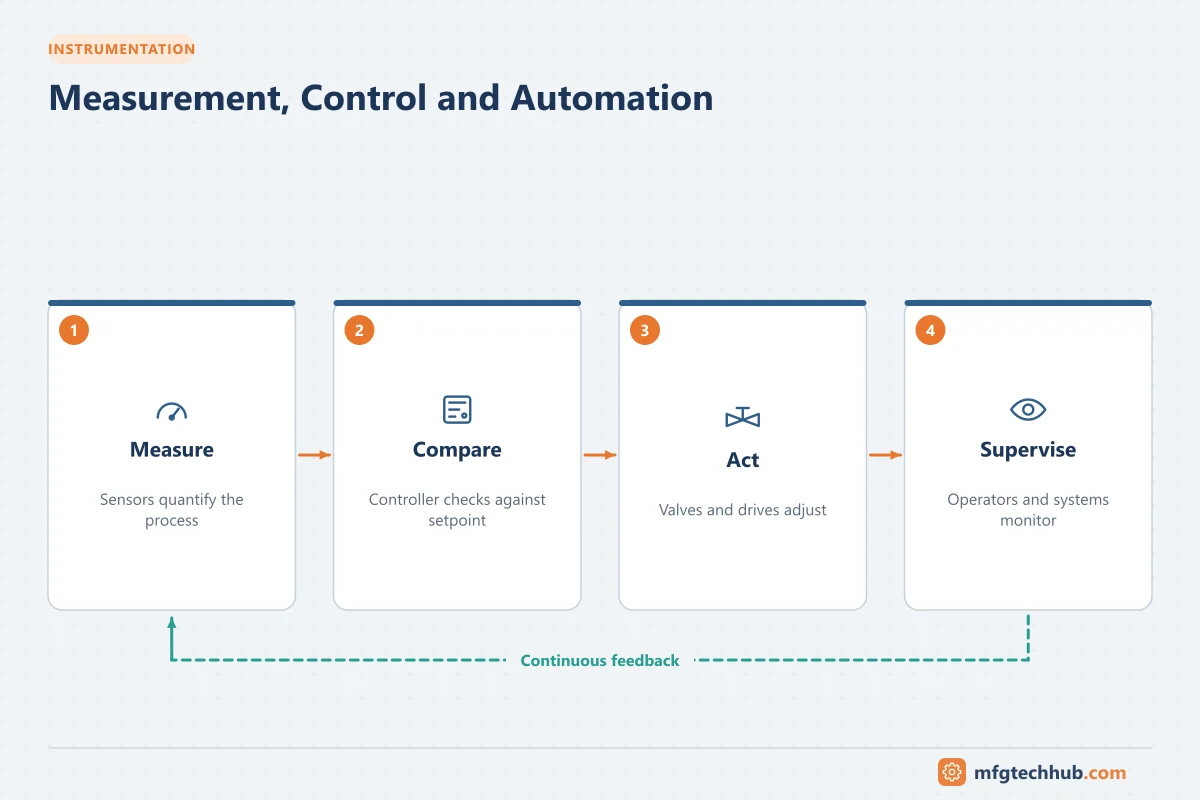
The control loop: measure, compare, act
A closed-loop controller continuously compares the measured process variable (PV) with the setpoint (SP) and adjusts its output to a final control element. See Open-Loop vs Closed-Loop Control and PID Control.
Worked example: tank level (illustrative)
| Step | Component | What happens |
|---|---|---|
| Measure | Level transmitter LT-100 | Reads 62 % and sends 4–20 mA (13.9 mA) |
| Compare | Controller LIC-100 in a PLC or DCS | Setpoint is 50 %; error is 12 % |
| Act | Outlet control valve LV-100 | Controller opens the outlet valve further |
| Supervise | HMI and alarms | Operator sees the trend; a high-level alarm is set at 85 % |
| Protect | Independent high-high switch | Stops the inlet pump if the level reaches the trip point |
Each layer has its own role: the loop keeps the level at setpoint, alarms tell the operator when something is wrong, and an independent protective layer prevents overfilling even if the loop fails. See Functional Safety.
Why measurement quality limits everything above it
- A controller acts on the measurement it receives. If the transmitter reads 2 % low, the process runs 2 % high, however well the loop is tuned.
- Noise in the measurement becomes movement of the valve.
- A slow measurement (for example a thermowell with long response time) limits how tightly the loop can be tuned.
- A frozen measurement can drive the loop to an extreme while looking normal on the screen.
See Accuracy, Precision and Repeatability and Common Instrument Failures.
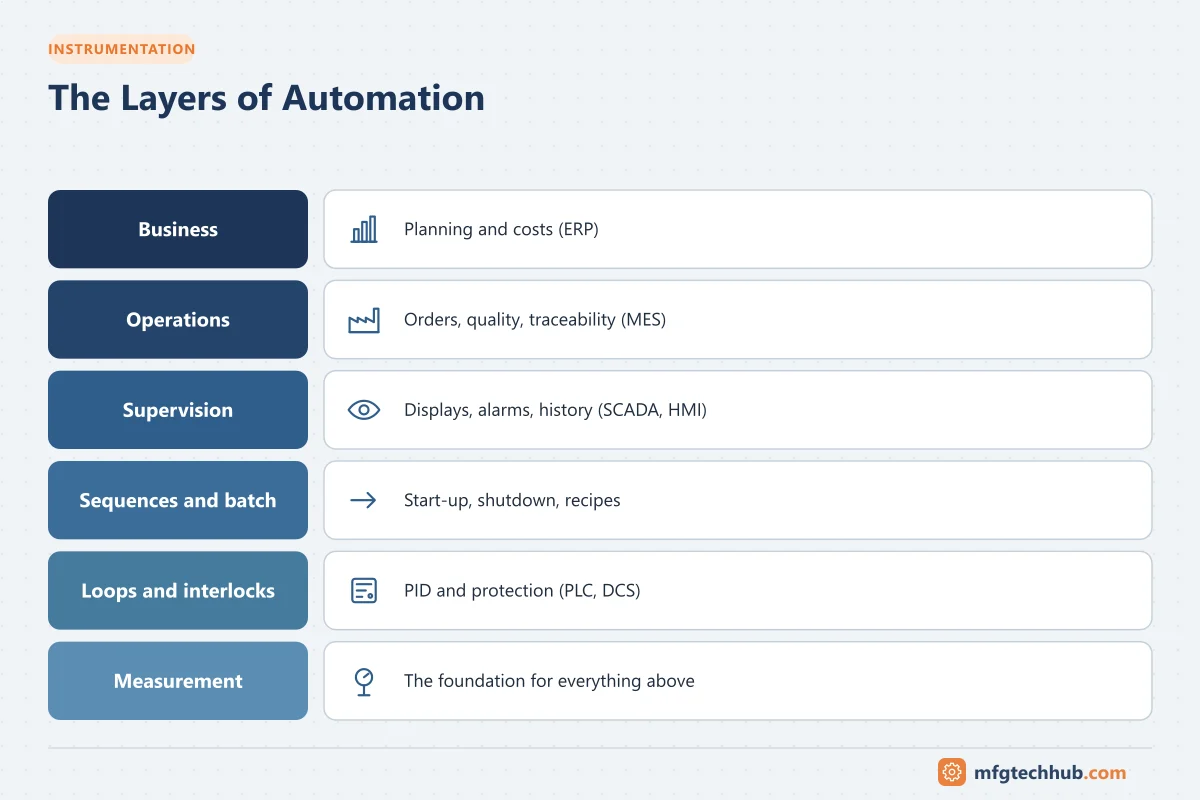
The layers of automation
| Layer | What it does | Systems |
|---|---|---|
| Loops and interlocks | Keep variables at setpoints, protect equipment | PLC, DCS controllers |
| Sequences and batch | Start-up, shutdown, recipes | PLC, DCS, batch systems |
| Supervision | Displays, alarms, history | SCADA, HMI, historians |
| Operations | Orders, quality, traceability, performance | MES |
| Business | Planning, costs, supply chain | ERP |
See What Is a PLC?, What Is a DCS?, What Is SCADA? and What Is MES?.
When measurement goes wrong
| Symptom | Typical measurement cause | First check |
|---|---|---|
| Loop oscillates after a change | Noisy or slow measurement, wrong range | Trend the PV; check damping and range |
| Product off-specification although PV is at setpoint | Calibration drift, wrong installation | Compare with a reference measurement |
| Value flat while process changes | Blocked impulse line, frozen sensor, stuck float | Local indication; process conditions |
| Alarm floods | Chattering signal near alarm limit | Deadband, filtering, sensor condition |
See Instrument Troubleshooting.
Frequently asked questions
Why is measurement important in industry?
Because every control action, alarm, quality record and business report is based on measurements. Errors in measurement become errors in product quality, energy use, safety and data.
What is the difference between control and automation?
Control keeps individual variables at their setpoints. Automation coordinates many loops, sequences, interlocks and systems so that the plant or machine runs with minimal manual intervention.
What is a final control element?
The device that changes the process in response to the controller output, such as a control valve, a variable-speed drive or a heater.
Key takeaways
- Measurement, control and automation build on each other.
- A loop measures, compares with the setpoint and acts through a final control element.
- Measurement accuracy, noise and speed limit how well any loop can perform.
- Protective functions must be independent of the control loop.
Related tutorials
Before you apply this in a plant: this article is for education. Always check the current edition of the relevant standards, the manufacturer's documentation for your exact product and version, and your site's procedures. Safety-related work needs qualified personnel. See our editorial policy.