
What Is MES? Manufacturing Execution Systems Explained with an Order Walk-Through
On this page
A manufacturing execution system (MES) manages and records what happens on the shop floor while products are being made: which order runs on which line, which materials and lots are used, what the operators did, which checks were performed, what the machines produced and why they stopped. It sits between business planning (ERP) and automation (PLCs, SCADA, DCS), turning plans into executed, documented production.
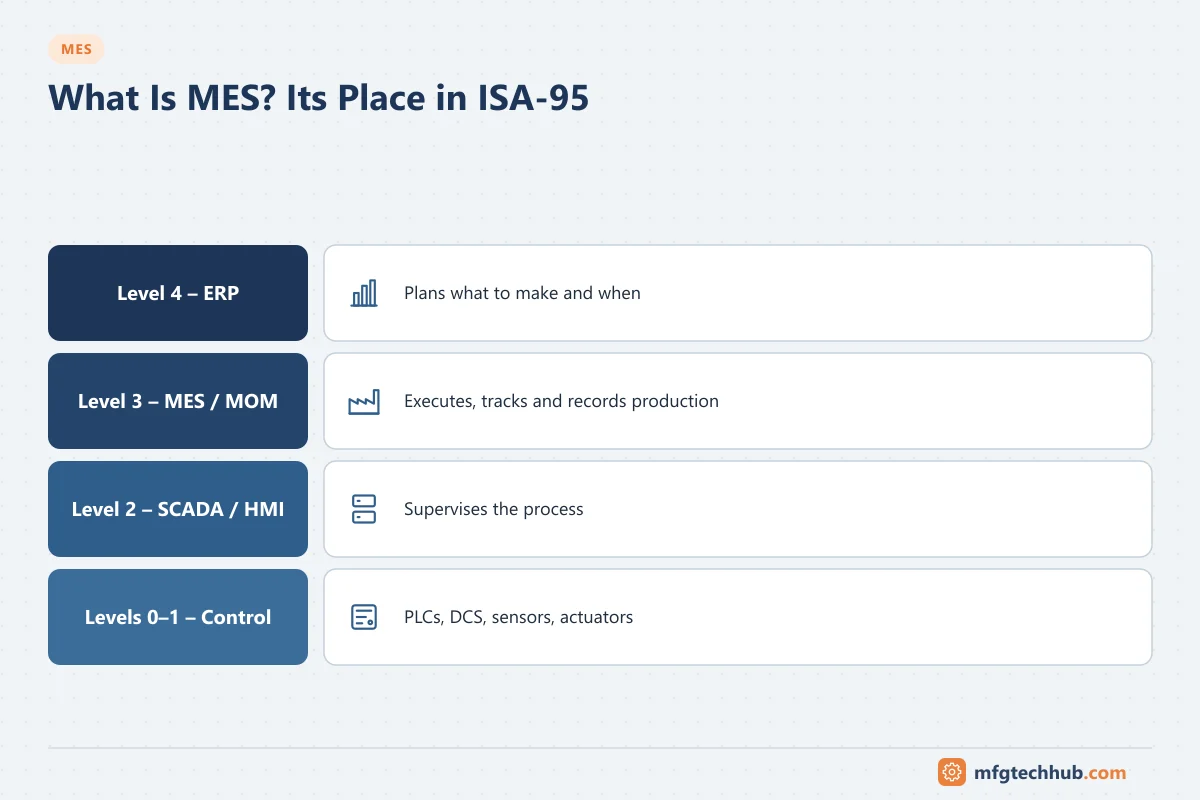
Where MES sits: ISA-95 level 3
The ISA-95 standard (IEC 62264) describes manufacturing in levels:
| Level | Systems | Time frame | Typical questions |
|---|---|---|---|
| 4: Business planning | ERP | Days to months | What do we make, when, with what materials, at what cost? |
| 3: Manufacturing operations | MES / MOM | Shifts, hours, minutes | Which order runs now, with which lot, by whom, and was it done right? |
| 2: Supervisory control | SCADA, HMI, DCS operator stations | Minutes to seconds | What is the process doing now? |
| 1: Control | PLCs, DCS controllers | Seconds to milliseconds | Control the machine or loop |
| 0: Process | Sensors, actuators, machines | Real time | The physical process |
See ISA-95 and MES Architecture.
Core functions
| Function | What it does | Detail page |
|---|---|---|
| Order management and dispatching | Receives orders from ERP, releases them to lines, tracks status | Scheduling and Planning |
| Material and WIP tracking | Lots, serial numbers, consumption, genealogy | Inventory and Material Management |
| Quality | In-process checks, SPC, non-conformances, holds | Quality Management |
| Process execution | Recipes, parameters, electronic work instructions, batch records | Process Management |
| Data collection | Counts, states, downtime, process values from machines and operators | Data Collection |
| Performance | OEE, downtime, scrap and loss analysis | Reporting and KPIs |
| Labour | Who worked, qualifications, time on orders | Labour Management |
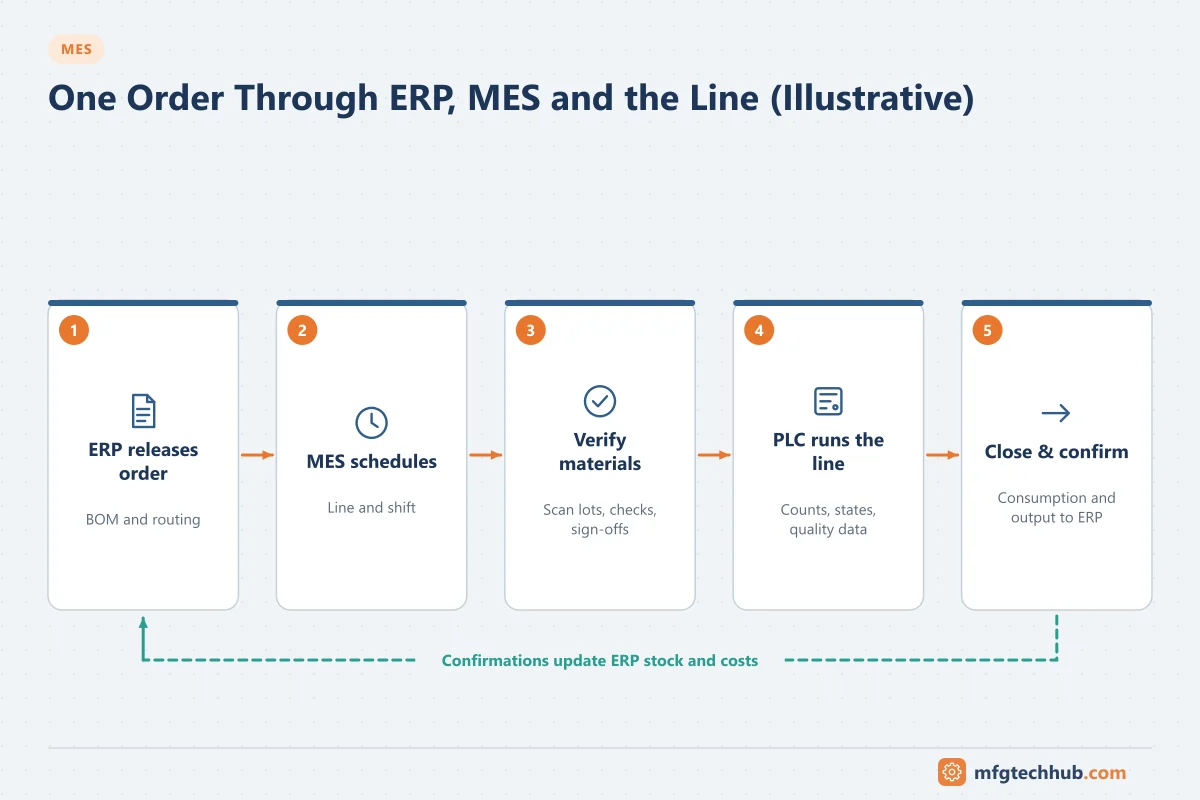
Following one order (illustrative)
A packaging plant makes 20,000 bottles of product A:
- ERP creates a production order with bill of materials and routing, and releases it to the plant.
- MES receives the order, the scheduler places it on line 2 for the morning shift.
- Materials are staged; at the line, the operator scans the bottle and label lots. MES checks they are the right materials, released and not expired.
- MES shows the line-clearance checklist and work instructions; the operator signs electronically.
- The PLC runs the filler; MES collects good and reject counts and machine states, and asks the operator for downtime reasons.
- Quality checks (fill weight, label position) are entered or captured automatically at the defined frequency; an out-of-limit result triggers a hold.
- At the end, MES reconciles materials, closes the order and sends confirmations (quantities, consumption, scrap) back to ERP.
- The record is available for traceability: which lots went into which pallets, who worked, what checks passed.
See ERP, SCADA and PLC Integration.
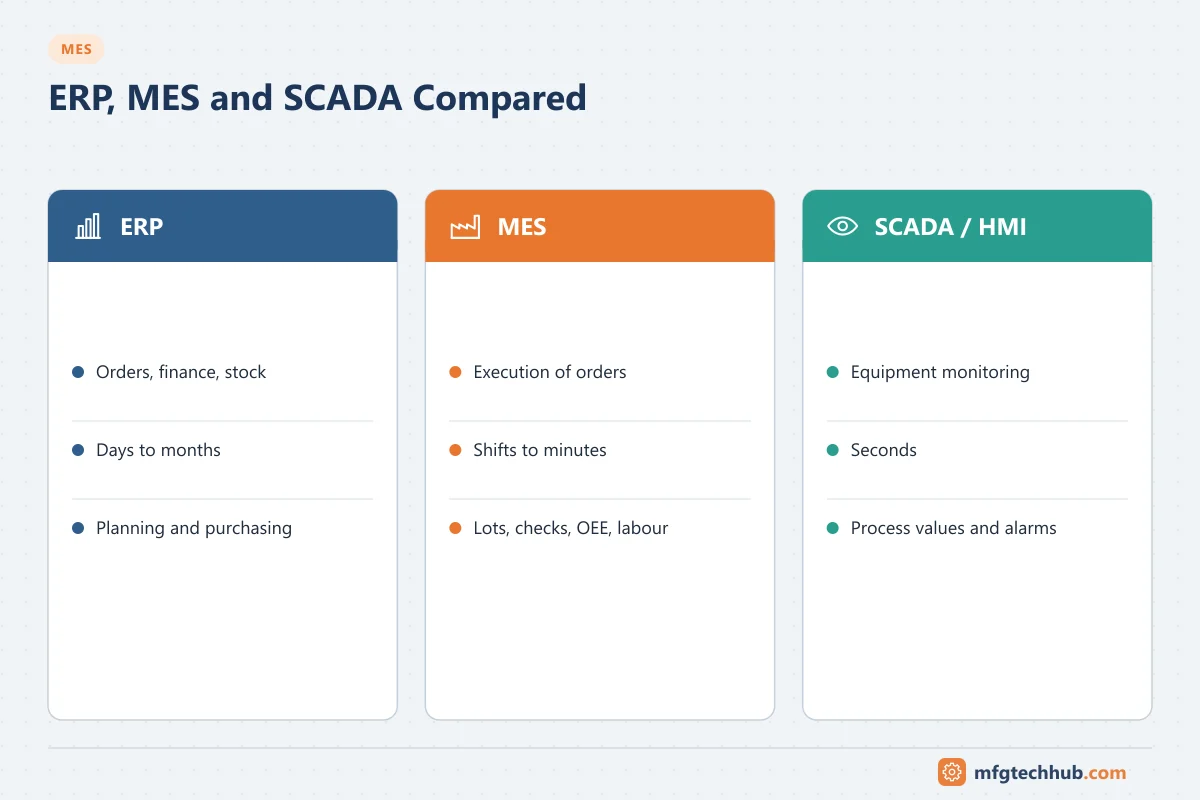
MES compared with ERP and SCADA
| ERP | MES | SCADA / HMI | |
|---|---|---|---|
| Focus | Business: orders, finance, purchasing, stock | Execution of production orders on the shop floor | Real-time monitoring and control of equipment |
| Time frame | Days to months | Shifts to minutes | Seconds |
| Typical data | Orders, BOMs, costs, stock | Lots, genealogy, checks, OEE, labour | Process values, alarms, states |
| Users | Planning, finance, purchasing | Operators, supervisors, quality, production management | Operators, engineers |
MES and MOM
Manufacturing operations management (MOM) is the broader ISA-95 term covering production, quality, inventory and maintenance operations at level 3. Many vendors now describe their products as MOM platforms. In everyday use, “MES” usually means the production execution core and “MOM” the wider suite.
Who uses an MES
| Role | Uses MES for |
|---|---|
| Operators | Work instructions, material scanning, checks, downtime reasons |
| Supervisors | Order status, line performance, shift handover |
| Quality | Checks, deviations, holds, batch record review, traceability |
| Planners | Order release and sequence, progress against schedule |
| Maintenance | Downtime data, equipment status |
| Management | OEE, yield, schedule adherence across lines and sites |
Does a plant need an MES?
Signs that an MES is worth evaluating: paper records that are slow to review or error-prone, traceability that takes days during a complaint or recall, disputed OEE and downtime figures, ERP stock that does not match reality, or regulatory requirements for electronic records. A smaller first step can be a focused application (for example downtime tracking or electronic batch records). See Why MES Matters and MES Planning, Business Case and Selection.
Frequently asked questions
What does MES stand for?
Manufacturing execution system: software that manages and records the execution of production orders on the shop floor, between ERP and automation.
What is the difference between MES and ERP?
ERP plans and accounts for the business (orders, materials, costs). MES executes and records production on the shop floor in real time: which lots were used, what was produced, which checks passed and why machines stopped.
Is MES the same as SCADA?
No. SCADA monitors and controls equipment in real time. MES works at the level of production orders, materials, quality and people, and uses data from SCADA and PLCs.
Key takeaways
- MES sits at ISA-95 level 3, between ERP and automation.
- It manages orders, materials, quality, process execution, data collection, performance and labour.
- It provides traceability and accurate confirmations back to ERP.
- MOM is the broader term for level 3 operations; MES is its production core.
Related tutorials
Before you apply this in a plant: this article is for education. Always check the current edition of the relevant standards, the manufacturer's documentation for your exact product and version, and your site's procedures. Safety-related work needs qualified personnel. See our editorial policy.