
MES Material Management: Staging, Point-of-Use Verification, Consumption, WIP and Genealogy
On this page
Effective Inventory and Material Management is one of the most critical components of a Manufacturing Execution System (MES). In modern industries where margins are tight and customer expectations are high, the ability to manage raw materials, track work-in-progress (WIP), and optimize finished goods handling can determine whether a business runs profitably or struggles with inefficiencies. By integrating inventory control into MES, manufacturers not only ensure that the right materials are available at the right time but also minimize waste, reduce production delays, and achieve better overall operational flow.
What is Inventory and Material Management in MES?
Inventory and Material Management within MES goes beyond basic stock keeping-it is a dynamic, real-time system that provides visibility and control over every stage of material flow. From the moment raw materials arrive at a factory to the point finished goods are shipped to customers, MES manages every transaction, transfer, and transformation of materials. This level of control is particularly vital in industries like pharmaceuticals, food and beverage, and electronics manufacturing, where compliance, safety, and precision are non-negotiable.
- Receiving Raw Materials: Ensures quality checks are performed, and materials are logged into the system immediately upon arrival.
- Staging Materials: Requests material for scheduled orders and confirms that the right lots arrive at the line (warehouse storage itself is managed by ERP or WMS).
- Material Usage: Tracks consumption on the shop floor to prevent overuse or waste.
- WIP Management: Monitors materials as they move between production stages, ensuring no bottlenecks or misplacements.
- Finished Goods Inventory: Keeps real-time updates of ready-to-ship items, improving order fulfillment accuracy.
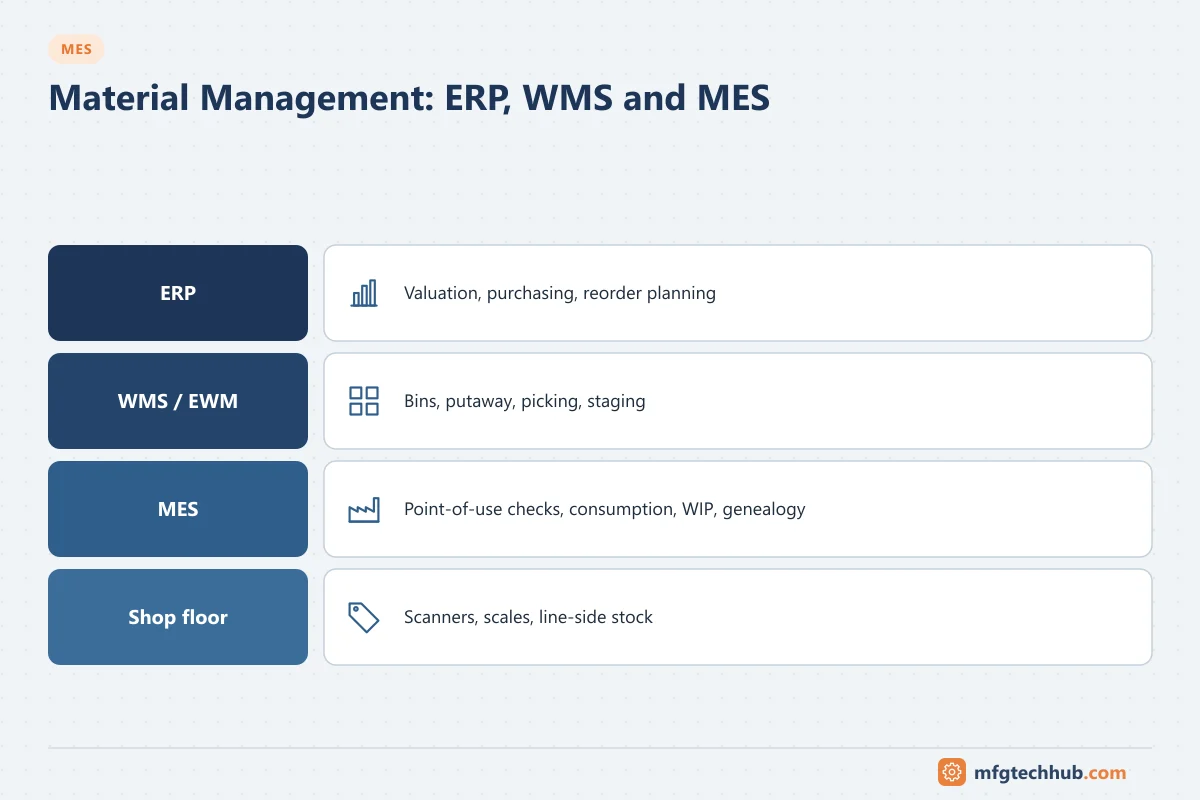
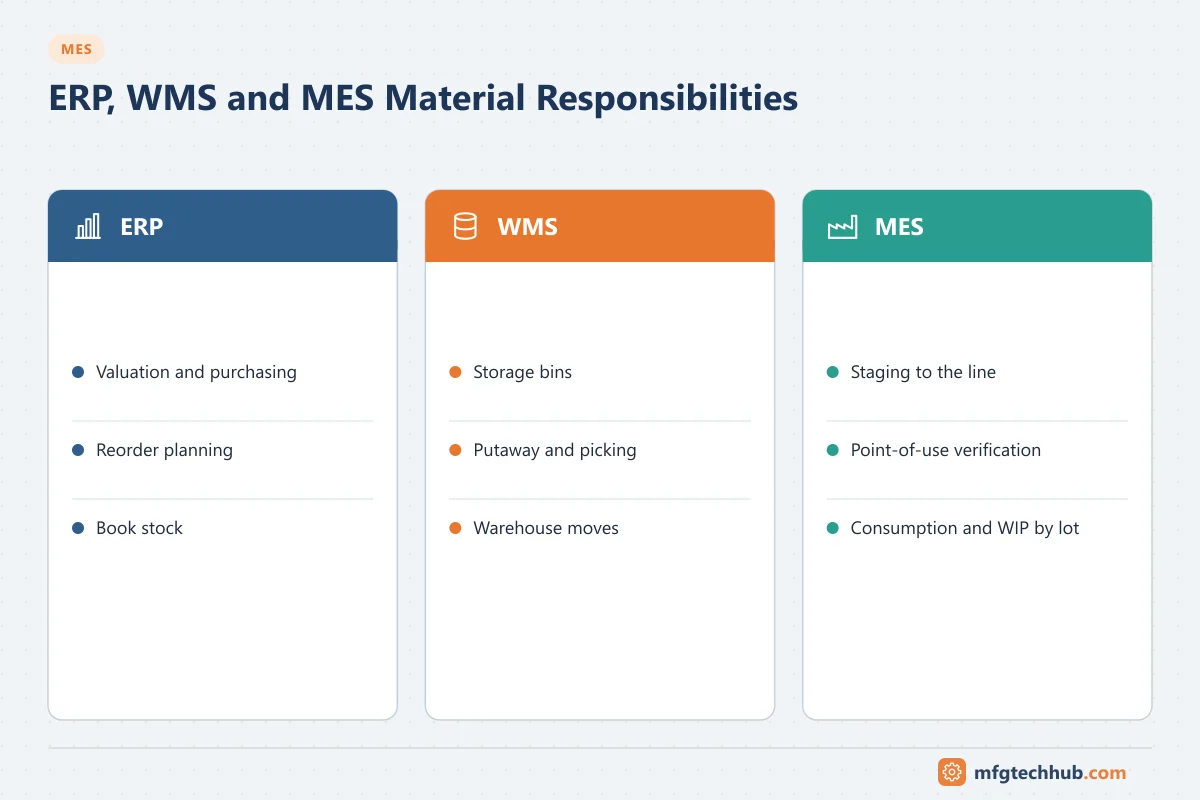
Who does what: ERP, WMS and MES
| Function | ERP | Warehouse management (WMS) | MES |
|---|---|---|---|
| Inventory valuation, purchasing, reorder planning | Yes | No | No |
| Warehouse storage bins, putaway, picking | Basic | Yes | No |
| Staging material to the line for an order | Requests / reservations | Picks and delivers | Requests, confirms receipt at the line |
| Point-of-use verification (right material, right lot) | No | No | Yes |
| Consumption and production at lot/serial level | Receives postings | No | Records and posts |
| Work in progress between operations | Order status only | No | Yes |
| Genealogy (which lots went into which product) | Limited | No | Yes |
Reorder alerts, procurement and warehouse optimisation are ERP and WMS jobs. The MES is the system that knows exactly which lot was used where, and when. See SAP EWM and MM for Production Supply for an ERP/WMS example.
Key Functions of Inventory and Material Management in MES
1. Real-Time Material Tracking
With MES, materials are no longer hidden in warehouses or waiting to be discovered during stock audits. Instead, they are constantly visible through technologies such as RFID tags, barcode scanning, and IoT-enabled sensors. Real-time material tracking allows managers to know exactly what is in stock, where it is located, and how it is being used.
This feature prevents sudden shortages, overstocking, or lost items. For instance, a food manufacturer can track batches of perishable ingredients, ensuring older stock is used first and preventing costly waste due to expiry.
2. Material Allocation
Material allocation ensures that the right materials are assigned to the right jobs at the right time. MES systems intelligently allocate materials based on availability, quality levels, and production priorities. This prevents critical components from being misused or allocated to low-priority tasks.
For example, in aerospace manufacturing, high-grade steel may be allocated only to specific engine components, while secondary parts receive standard materials. This smart allocation minimizes waste, improves production quality, and supports lean manufacturing practices.
3. Consumption Recording and Reconciliation
The MES records consumption as it happens: by scanning lots at the point of use, weighing at dispensing stations, or backflushing (automatic consumption based on the bill of materials when output is reported). Backflushing is simple, but it hides real scrap and overuse, so scan-based or weighed consumption is preferred for critical and expensive materials.
The MES then posts consumption and production to ERP, and inventory is reconciled regularly: MES consumption against ERP stock movements and physical counts. Persistent differences point to unrecorded scrap, wrong bills of materials or skipped scans.
4. Work-in-Progress (WIP) Tracking
WIP tracking gives managers visibility over partially finished goods moving across production lines. MES can show which batch is at which stage, whether there are delays, and how long each stage takes.
In pharmaceutical production, MES can track tablet batches from mixing to coating to packaging, helping identify bottlenecks and ensuring compliance with strict regulatory timelines.
5. Material Traceability
One of the most critical aspects of MES inventory management is traceability. MES records detailed material histories, including batch numbers, supplier origins, and inspection results. This not only ensures compliance with international quality standards but also enables quick action during recalls.
For example, a beverage company can instantly trace defective bottle batches back to the supplier and isolate only affected stock, avoiding large-scale recalls that could damage brand reputation.
6. Kanban and JIT (Just-in-Time) Support
MES integrates seamlessly with lean manufacturing methods such as Kanban and Just-in-Time (JIT). These methods ensure materials arrive exactly when needed, minimizing storage requirements and keeping production lines flowing smoothly.
In automotive manufacturing, for example, MES can ensure engine parts arrive at assembly stations exactly when required, reducing inventory piles while keeping production efficient.
7. Line-Side (Point-of-Use) Inventory
Materials staged at the line are often a blind spot between the warehouse and the order. The MES tracks line-side stock per lot, triggers replenishment requests (for example electronic kanban) and returns unused material to the warehouse at the end of an order, so ERP stock stays correct.
Troubleshooting material and inventory problems
| Symptom | Likely causes | Check |
|---|---|---|
| ERP stock differs from physical stock | Backflush with wrong BOM quantities, unrecorded scrap, returns not booked | Compare MES consumption, ERP postings and counts per material |
| Genealogy gaps | Scans skipped, containers mixed at the line, manual workarounds | Scan compliance by line; enforce validation at start |
| Wrong material used | No point-of-use verification; similar-looking materials | Mandatory scan against the order BOM |
| Expired or blocked lot consumed | Lot status not checked at the line | Lot status and expiry validation in MES |
| Line waiting for material | Staging lead times not planned; replenishment triggered too late | Staging requests tied to the schedule; kanban levels |
| Duplicate or missing ERP postings | Interface errors and retries | Interface error queue and message IDs |
Frequently asked questions
Does an MES manage inventory?
It manages material on the shop floor: staging, point-of-use verification, consumption, work in progress and genealogy at lot or serial level. Inventory valuation, purchasing and warehouse storage are handled by ERP and warehouse management systems.
What is backflushing?
Automatic posting of component consumption based on the bill of materials when finished output is reported. It reduces data entry but assumes standard quantities, so actual scrap and overuse are not captured unless recorded separately.
How does MES support traceability?
By recording which material lots or serial numbers were consumed in each operation and which lots or serials were produced, building a genealogy that can be searched forwards (where used) and backwards (where from).
Key takeaways
- ERP plans and values inventory, WMS manages warehouses, and MES controls material on the shop floor.
- Verify material at the point of use, record actual consumption, and reconcile with ERP regularly.
- Genealogy at lot or serial level is the MES’s unique contribution to traceability.
Related tutorials
Before you apply this in a plant: this article is for education. Always check the current edition of the relevant standards, the manufacturer's documentation for your exact product and version, and your site's procedures. Safety-related work needs qualified personnel. See our editorial policy.