
MES Benefits: Why Manufacturers Implement MES and How to Measure the Value
On this page
A Manufacturing Execution System (MES) manages and records what happens on the shop floor: which order is running, on which equipment, with which materials, by whom, and with what quality result. It sits between business systems such as ERP (which plan what to make) and control systems such as PLC, SCADA and DCS (which run the equipment). See What Is MES? for the basics.
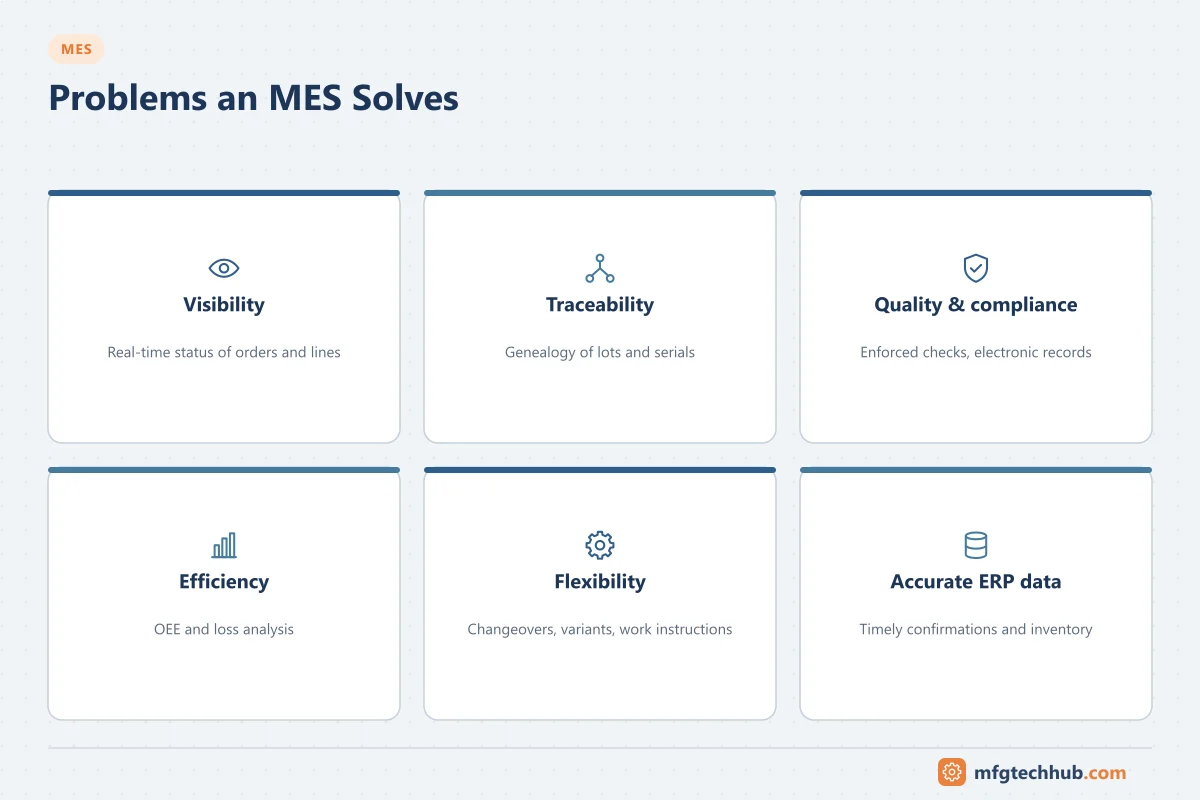
This article explains why manufacturers invest in MES, what each benefit means in practice, and, importantly, how to measure it so that a business case is based on evidence rather than vendor claims.
The problems MES solves
Plants without MES typically run on a mix of paper travellers, spreadsheets, whiteboards and manual ERP entries. The symptoms are familiar:
- Nobody knows the real status of an order until someone walks to the line.
- Downtime reasons are estimated at the end of the shift, so improvement efforts target the wrong problems.
- A customer complaint or recall requires days of searching paper records to find which batches used a suspect material.
- Quality checks happen, but results are not linked to the order, equipment and operator.
- ERP inventory is wrong because consumption and scrap are booked late or not at all.
- In regulated industries, batch record review is slow and error-prone.
Each benefit below addresses one or more of these problems.
1. Real-time visibility
MES collects production counts, machine states, order progress and material consumption as they happen, automatically from PLCs and machines where possible, and through operator screens where not.
- Supervisors see what is running, what is late and what is stopped without walking the floor.
- Planners can re-sequence work based on actual progress.
- Management gets consistent KPIs across lines and sites.
Measure it with: time from event to visibility (minutes instead of next day), percentage of production data captured automatically, schedule adherence.
2. Traceability and genealogy
MES records which material lots, components and equipment went into each batch or serial number, together with process data and quality results.
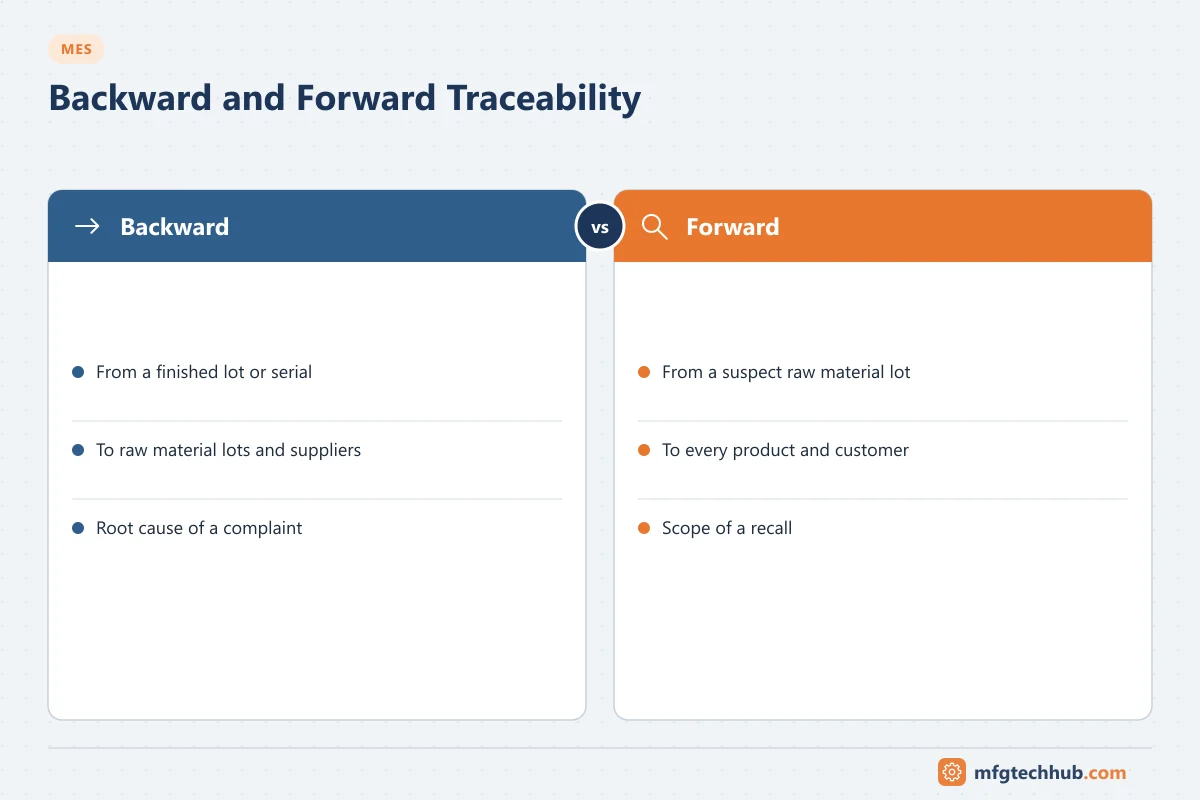
- Backward traceability: for a finished product, find all input lots, suppliers, equipment and operators.
- Forward traceability: for a suspect input lot, find every product that used it and where it was shipped.
- Recall scope can be narrowed from “everything made that month” to specific lots.
Measure it with: time to complete a trace (a mock recall exercise is a good baseline test), recall scope, audit findings.
3. Quality control and compliance
- In-process quality checks are enforced at the right step, with limits and automatic hold of non-conforming material.
- SPC (statistical process control) charts detect drift before products go out of specification.
- Electronic batch records (EBR) or electronic device history records (eDHR) replace paper in regulated industries, with audit trails and electronic signatures. See MES Quality Management.
- Review by exception: reviewers focus on deviations instead of checking every entry on paper.
Measure it with: first-pass yield, scrap and rework cost, number of deviations, batch record review and release time, audit observations.
4. Production efficiency
- Downtime tracking with reason codes (automatic from machine states, confirmed by operators) shows where capacity is lost.
- OEE (availability × performance × quality) becomes a reliable, comparable number. Try the OEE calculator.
- Electronic work instructions reduce errors and training time.
- Less paperwork and manual data entry frees supervisors and operators for productive work.
Measure it with: OEE and its three components, unplanned downtime hours, changeover time, labour hours spent on data entry.
5. Flexibility
- Recipe and specification management allows faster product changes with fewer errors.
- Dispatching adapts the sequence to material availability, machine status and priorities.
- MES supports high-mix, low-volume production where paper systems break down.
Measure it with: changeover time, schedule adherence, lead time, number of product variants handled per line.
6. Better decisions from data
The value of MES data grows when it is combined with context: order, product, equipment, shift and material. That makes it possible to answer questions such as:
- Which product-line combinations have the worst yield?
- Is a quality problem linked to a particular supplier lot or machine?
- Which downtime reasons cost the most capacity this quarter?
MES data is also a foundation for manufacturing data analytics and AI applications, because it provides the context that raw machine data lacks.
7. Accurate ERP data
By reporting consumption, production, scrap and labour to ERP at the right time, MES improves inventory accuracy and costing. See How MES Integrates with ERP, SCADA and PLC.
How to build a business case
Vendor case studies often quote large percentage improvements, but results depend heavily on the starting point and on how well the system is adopted. Build your own case:
- Baseline the current KPIs for 4–12 weeks (OEE, scrap, downtime, trace time, review time, inventory accuracy, paperwork hours).
- Identify the losses MES can realistically address, per line or area.
- Estimate improvement ranges conservatively (low/expected/high) and convert them into money: capacity gained, scrap avoided, labour hours saved, compliance risk reduced.
- Include full costs: licences or subscriptions, infrastructure, integration, validation (if regulated), training, internal project team and ongoing support.
- Start with a pilot on one line or area and measure against the baseline before scaling.
| Benefit area | Typical KPI | Where the data comes from |
|---|---|---|
| Visibility | Schedule adherence, WIP | MES order tracking |
| Efficiency | OEE, downtime hours by reason | Machine states + operator input |
| Quality | First-pass yield, scrap cost | Quality module, SPC |
| Compliance | Review/release time, deviations | EBR/eDHR |
| Traceability | Time to trace a lot | Genealogy records |
| ERP accuracy | Inventory accuracy, cost variances | ERP reconciliation |
When MES may not be the first step
MES is not always the right starting point:
- If machines are not connected at all, basic data collection and OEE monitoring may deliver value faster.
- If processes and master data (routings, bills of materials) are unstable, fix them first.
- If the organisation cannot support the system (IT/OT skills, process owners), plan that capability before a large rollout.
Challenges are covered in detail in MES Implementation Challenges.
Frequently asked questions
What is the main benefit of MES?
A reliable, real-time record of production that links orders, equipment, materials, people and quality. Visibility, traceability, compliance and efficiency improvements all come from that record.
Is MES only for large manufacturers?
No. Cloud and modular MES products have made MES more accessible to mid-sized plants. Smaller plants often start with specific modules such as OEE monitoring, electronic work instructions or traceability.
How is MES different from ERP?
ERP plans and manages the business (orders, inventory, finance) typically in days or shifts. MES executes and records production on the shop floor in minutes or seconds. See the ISA-95 model for how the two layers relate.
Key takeaways
- MES solves real shop-floor problems: poor visibility, slow traceability, paper quality records and inaccurate ERP data.
- Benefits include visibility, traceability, quality/compliance, efficiency, flexibility and better decisions.
- Measure each benefit with baseline KPIs and build the business case on your own data.
Related tutorials
Before you apply this in a plant: this article is for education. Always check the current edition of the relevant standards, the manufacturer's documentation for your exact product and version, and your site's procedures. Safety-related work needs qualified personnel. See our editorial policy.