
Industrial Energy Efficiency Solutions for Electrical Systems
On this page
Electricity is one of the largest controllable costs in most factories, and a significant share of it is wasted: motors running when nothing needs them, throttled pumps, leaking compressed air and oversized equipment. Energy efficiency projects cut costs and emissions at the same time, and many pay back within a few years or less. This article summarizes the most effective solutions for industrial electrical systems and how to prioritize them.
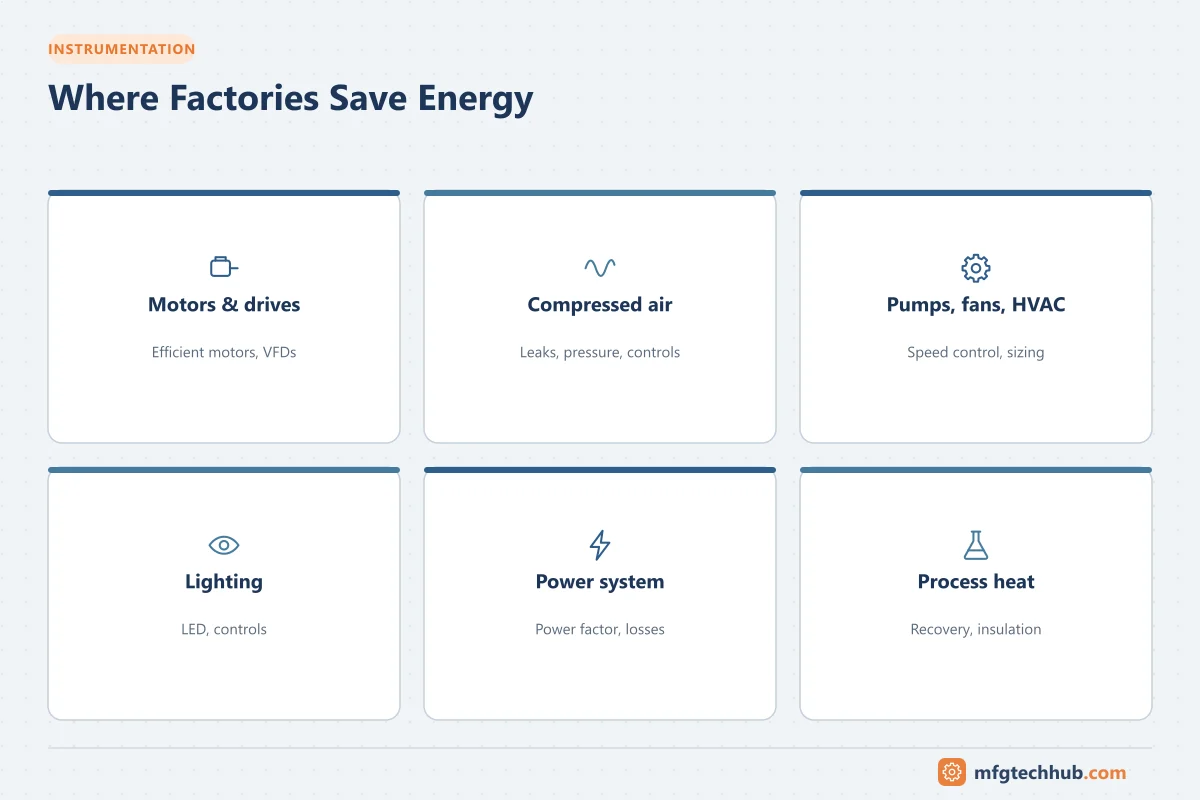
Where electricity goes in a typical factory
Motor-driven systems (pumps, fans, compressors, conveyors and process machines) usually consume the largest share of industrial electricity. Lighting, HVAC, process heating and electronics make up much of the rest. The exact breakdown varies by industry, which is why metering comes first.
1. Motors and drives
Use variable speed where demand varies
For centrifugal pumps and fans, power varies roughly with the cube of speed (the affinity laws). Replacing throttling valves, dampers or bypass control with VFD speed control often gives large savings. See VFDs and Soft Starters.
Choose efficient motors
Specify IE3 or higher efficiency motors for new installations and replacements, especially on motors that run many hours per year. See Types of Industrial Motors.
Right-size
Oversized motors run at low load, where efficiency and power factor are poor. Consider load when replacing motors.
Improve the driven system
Often the biggest gains are mechanical: efficient pumps selected for their duty point, trimmed impellers, efficient belts (or direct drive), and good alignment and lubrication.
2. Compressed air
Compressed air is one of the most expensive forms of energy in a plant, because most of the input electricity becomes heat.
| Measure | Why it helps |
|---|---|
| Find and fix leaks | Leaks can waste a large share of compressor output; ultrasonic leak detection finds them |
| Reduce system pressure | Lower pressure means less compressor energy; confirm end-use requirements |
| Improve compressor controls | Sequence multiple compressors; use a VSD compressor for trim load |
| Eliminate inappropriate uses | Replace open blowing, cleaning and cooling with blowers or other methods |
| Recover compressor heat | Use it for space heating or process water |
3. Pumps, fans and HVAC
- Match flow to demand with speed control and good controls
- Clean filters and coils; maintain belts
- Use free cooling and heat recovery in HVAC
- Optimize chiller plant sequencing and setpoints
4. Lighting
- Replace older lighting with LED fixtures
- Add occupancy and daylight controls
- Match lighting levels to tasks
5. Power system efficiency
- Power factor correction to reduce losses and penalties. See Power Factor Correction
- Harmonic mitigation to reduce transformer and cable heating. See Power Quality Analyzers
- Efficient transformers with low no-load losses, and de-energizing lightly used transformers where possible
- Voltage optimization within equipment tolerances
6. Controls and operations
- Automatic shutdown of equipment during breaks, weekends and idle periods
- Interlocks that stop auxiliaries (conveyors, fans, pumps) when the main process stops
- Better process control and tuning to reduce variability and rework
- Energy KPIs on operator dashboards
These measures often cost little and deliver quick results.
7. Process heating
Electric process heating (ovens, furnaces, dryers) benefits from better insulation, door seals, controls, heat recovery, and consideration of heat pumps where temperatures allow. See Sustainable Energy Solutions.
How to prioritize projects
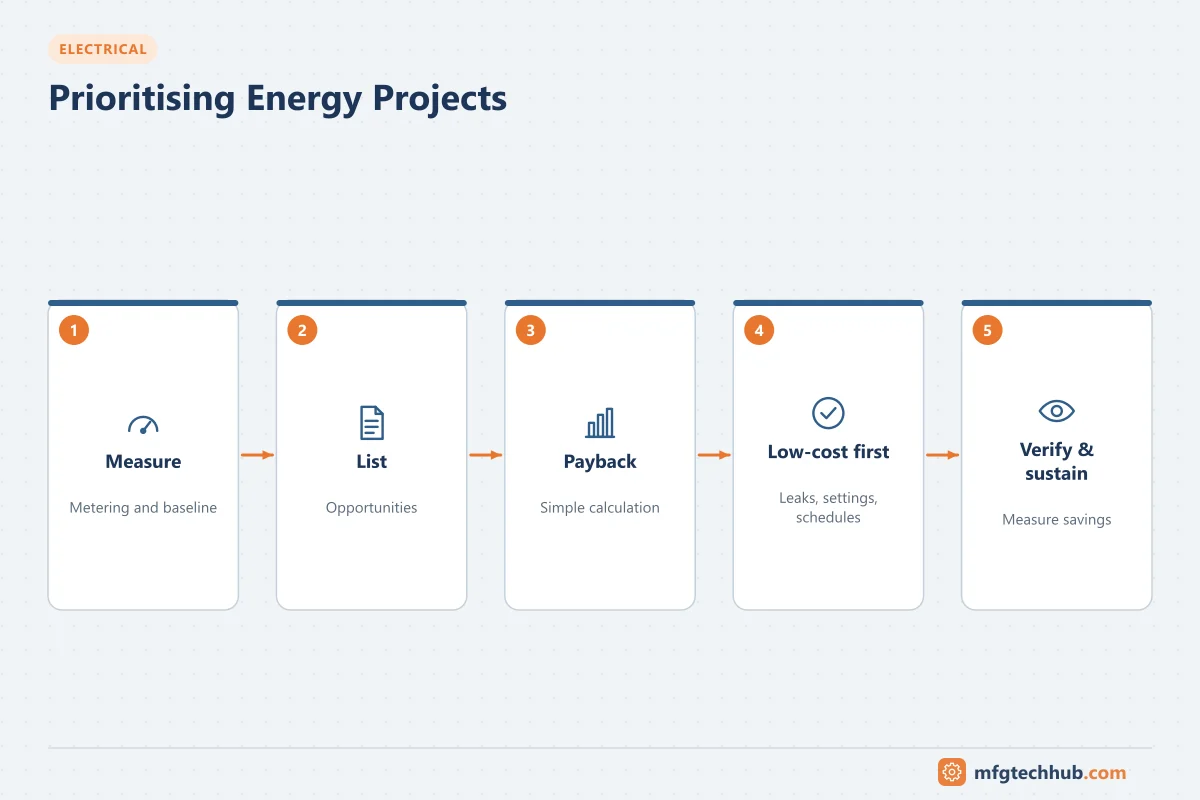
- Measure consumption by area and major load.
- List opportunities with estimated savings, cost and risk.
- Calculate simple payback (cost ÷ annual savings), and use lifecycle cost for larger projects.
- Start with no-cost and low-cost actions: shutdowns, leak repair, setpoints and controls.
- Group capital projects with good payback into investment plans.
- Verify savings using measurement, adjusted for production changes.
- Sustain the results with ownership, dashboards and regular reviews.
Example calculation (illustrative)
A 45 kW fan runs 6,000 hours per year with damper control at an average of about 70% of maximum airflow. With a VFD, fan power at 70% speed would ideally fall to about 0.7³ ≈ 34% of full power. Allowing for real system effects, the actual saving might be significantly less than this ideal, so engineers estimate savings from measured load profiles rather than the cube law alone. Even conservative estimates often show attractive payback for fans and pumps that run long hours at reduced flow.
Key takeaways
- Motor-driven systems are usually the largest efficiency opportunity; VFDs on variable-flow pumps and fans are often the best projects.
- Compressed air leaks and pressure are major sources of waste.
- Controls, shutdown practices and power system improvements add further savings.
- Measure, prioritize by payback, verify savings and sustain results.
Related tutorials
Before you apply this in a plant: this article is for education. Always check the current edition of the relevant standards, the manufacturer's documentation for your exact product and version, and your site's procedures. Safety-related work needs qualified personnel. See our editorial policy.