
Differential Pressure Flowmeters: Orifice Plates, Venturi Tubes, Nozzles, Cone Meters and Averaging Pitots
On this page
Differential pressure (DP) flowmeters are the oldest and still one of the most widely installed flow technologies. A primary element (orifice plate, Venturi tube, nozzle, cone or averaging pitot) creates a pressure difference that depends on flow; a DP transmitter measures it. The method is well standardised, works for liquids, gases and steam at almost any size, pressure and temperature, and needs no moving parts. Its weaknesses are limited rangeability, permanent pressure loss for some elements, and sensitivity to installation.
The principle
A restriction speeds up the fluid and lowers its pressure (Bernoulli). The flow rate is proportional to the square root of the differential pressure:
Q ∝ √ΔP
Worked example (illustrative)
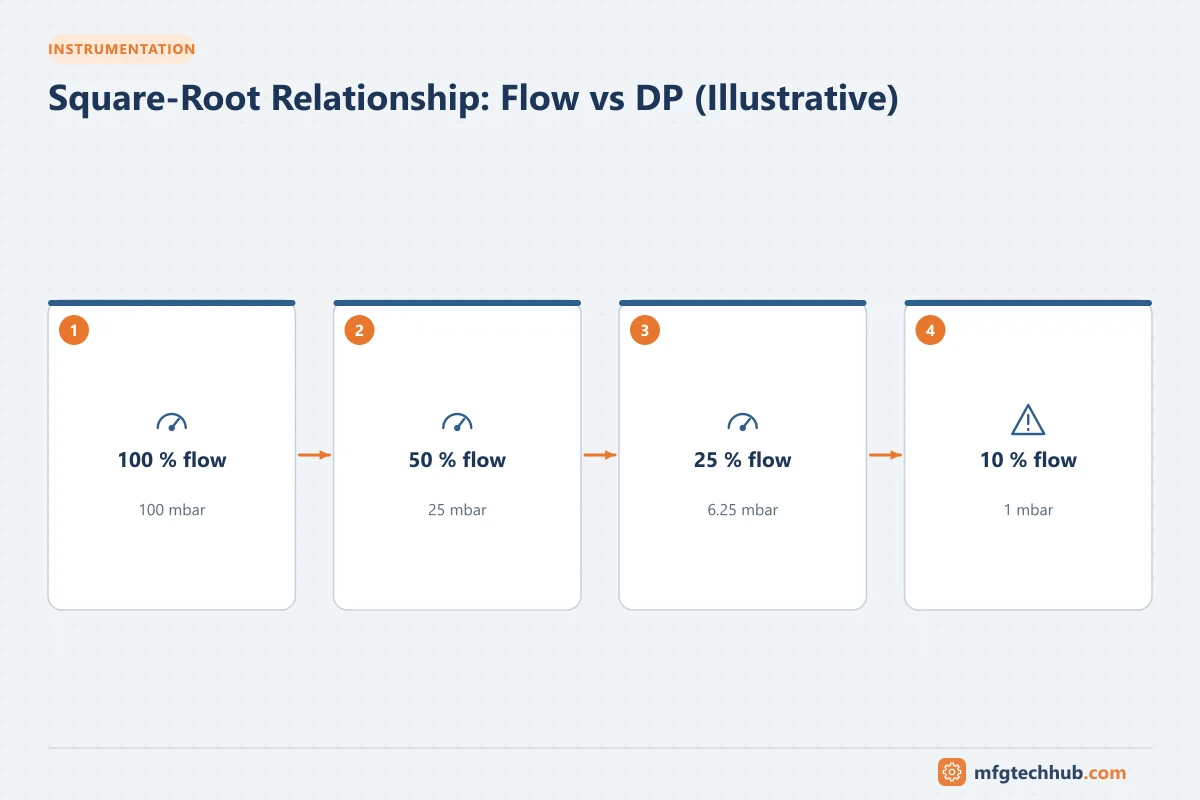
If an orifice produces 100 mbar at 100 % flow:
| Flow | ΔP |
|---|---|
| 100 % | 100 mbar |
| 50 % | 25 mbar |
| 25 % | 6.25 mbar |
| 10 % | 1 mbar |
At 10 % flow the transmitter sees only 1 % of its range, so small DP errors become large flow errors. This is why DP meters have limited rangeability with a single transmitter; stacked transmitters or other technologies are used where wide turndown is needed. The square-root extraction is done in the transmitter or in the control system, never both.
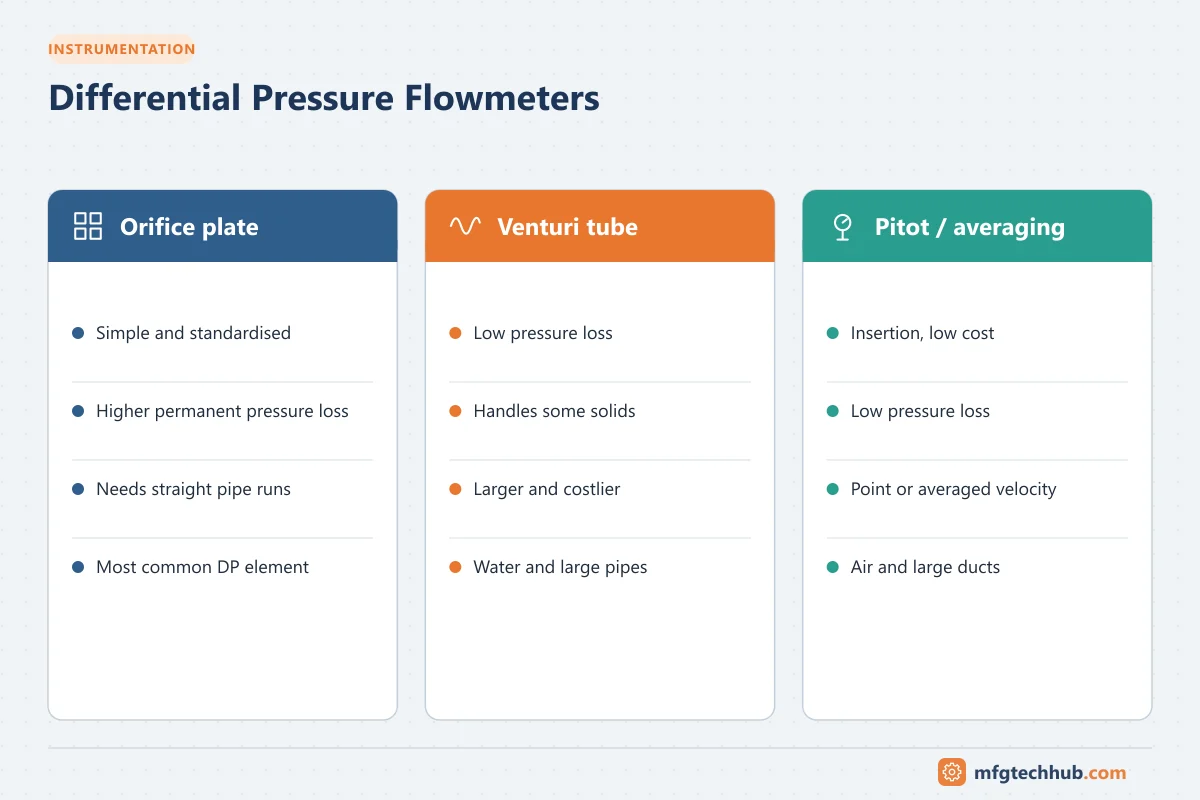
Primary elements compared
| Element | Pressure loss | Straight-run needs | Typical uses | Notes |
|---|---|---|---|---|
| Orifice plate | High | Significant | Clean liquids, gases, steam; very common | Cheap, easy to change; edge wear affects accuracy |
| Venturi tube | Low | Moderate | Large water pipes, where energy matters | Expensive, long; recovers most pressure |
| Flow nozzle | Medium | Moderate | High-velocity steam | Robust at high temperatures |
| Cone (V-cone type) | Medium | Short | Limited straight runs, dirty gases | Conditions the flow itself |
| Averaging pitot | Very low | Moderate | Large pipes and ducts, air, water | Easy insertion; lower accuracy |
| Wedge | Medium | Moderate | Slurries, viscous fluids | Suited to difficult media |
ISO 5167 specifies orifice plates, nozzles, Venturi tubes and cone meters, including dimensions, installation and uncertainty calculations. The beta ratio (bore diameter ÷ pipe diameter) is a key design parameter.
Installation
| Topic | Good practice |
|---|---|
| Straight runs | Provide the upstream and downstream lengths required by ISO 5167 for the fittings and beta ratio, or use a flow conditioner |
| Orientation of the plate | Sharp edge facing upstream; drain or vent holes as required |
| Tapping positions | Flange, corner or D and D/2 taps as designed |
| Liquid service | Transmitter below the taps so impulse lines stay full of liquid; slope lines to avoid gas pockets |
| Gas service | Transmitter above the taps so condensate drains back |
| Steam service | Condensate pots or equal liquid legs; transmitter below; fill impulse lines before commissioning |
| Manifold | Three- or five-valve manifold for isolation, equalising and zero checks |
See Pressure Transmitters for transmitter installation.
Gas and steam: density compensation
For gases and steam, flow depends on density, which changes with pressure and temperature. Multivariable transmitters or flow computers measure DP, static pressure and temperature to calculate compensated mass or standard volume flow. Without compensation, flow can be significantly wrong when conditions move away from design.
Troubleshooting
| Symptom | Likely cause | First check |
|---|---|---|
| Flow reads high at low flow, or noisy near zero | Low-flow cut-off not set, zero error | Zero with equalising valve open; low-flow cut-off |
| Reading consistently low | Worn or damaged orifice edge, plate installed backwards | Inspect the plate |
| Reading wrong after maintenance | High and low impulse lines swapped, manifold valve left open | Line connections, manifold positions |
| Drifting reading in liquid service | Gas trapped in impulse lines | Vent lines; check slope |
| Drifting reading in gas or steam service | Liquid in impulse lines, unequal legs | Drain; fill steam legs equally |
| Double square root | Extraction in both transmitter and DCS | Configuration of both |
| Error when conditions change | No density compensation | Compensation configuration |
Frequently asked questions
Why is flow proportional to the square root of differential pressure?
Because the differential pressure created by a restriction is proportional to the square of the velocity. Taking the square root converts the DP into a value proportional to flow.
What is the beta ratio of an orifice plate?
The ratio of the orifice bore diameter to the internal pipe diameter. It affects the differential pressure, pressure loss, accuracy and straight-run requirements.
When should a Venturi be used instead of an orifice plate?
When permanent pressure loss matters, such as in large water pipes or where pumping energy is expensive, or where the fluid carries some solids that would wear an orifice edge.
Key takeaways
- DP flowmeters measure flow through the square root of differential pressure.
- Orifices are cheap and common; Venturis save energy; cones and averaging pitots suit special cases.
- Installation (straight runs, impulse lines, transmitter position) decides accuracy.
- Compensate gas and steam flow for density; avoid double square-root extraction.
Related tutorials
Before you apply this in a plant: this article is for education. Always check the current edition of the relevant standards, the manufacturer's documentation for your exact product and version, and your site's procedures. Safety-related work needs qualified personnel. See our editorial policy.