
Manometers vs Piezoelectric Pressure Sensors: Static Reference vs Dynamic Measurement
On this page
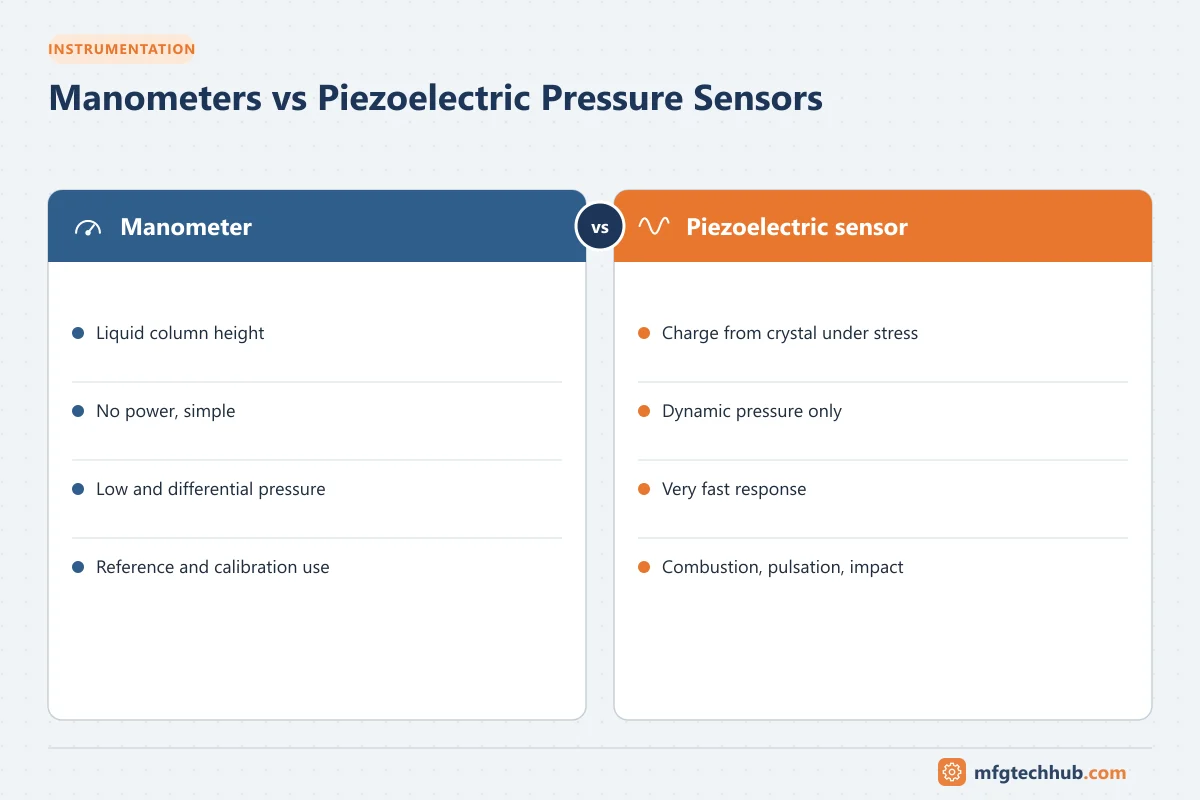
Manometers and piezoelectric sensors sit at opposite ends of pressure measurement. A liquid-column manometer is the simplest possible instrument: a tube of liquid whose height difference shows pressure, useful for low pressures and as a physical reference. A piezoelectric sensor is built for speed: it captures pressure changes in microseconds but cannot hold a steady reading. Knowing both helps choose the right tool, and avoid using either where it does not fit.
Liquid-column manometers
A manometer balances the pressure against a column of liquid. The pressure difference is:
ΔP = ρ × g × h
where ρ is the liquid density, g is gravitational acceleration and h is the height difference.
Worked example (illustrative)
Water (ρ ≈ 1,000 kg/m³) with a 150 mm height difference:
ΔP ≈ 1,000 × 9.81 × 0.150 ≈ 1,470 Pa ≈ 14.7 mbar
The same pressure with mercury (ρ ≈ 13,600 kg/m³) would give only about 11 mm difference, which is why dense liquids are used for higher pressures and water or light oils for low pressures.
Types
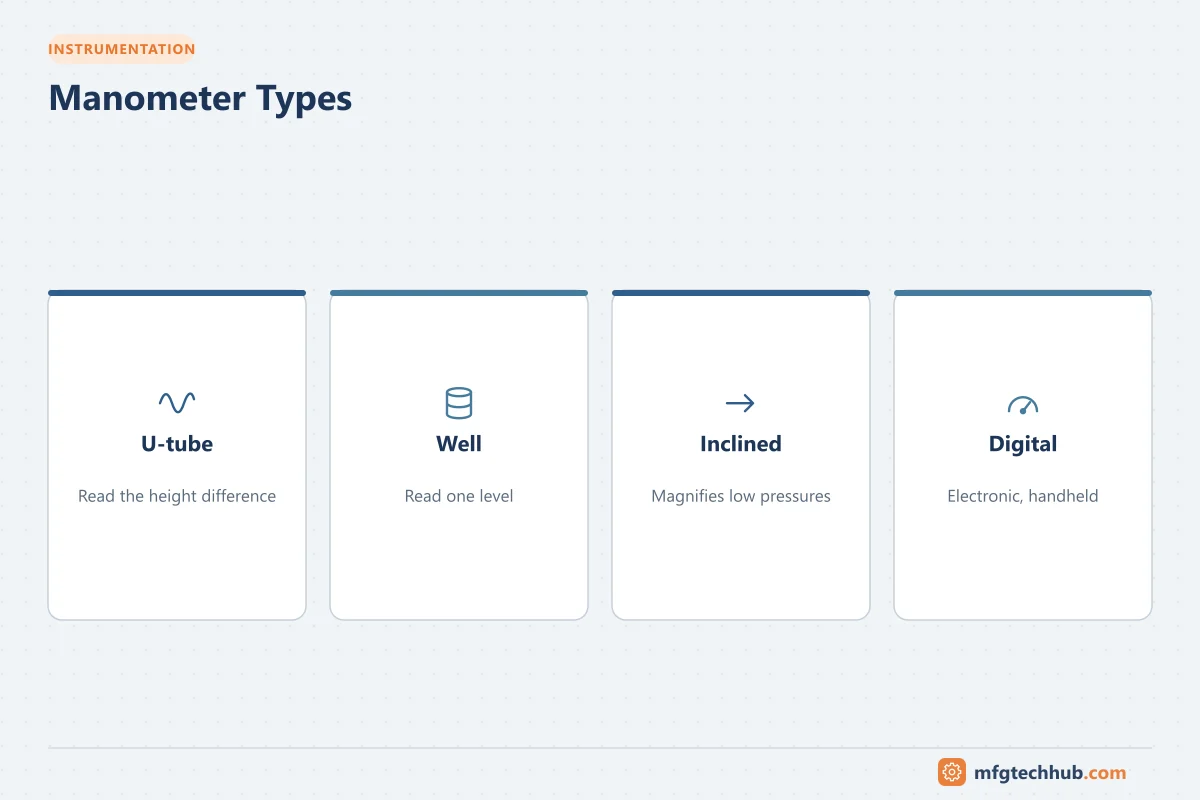
| Type | Features | Typical use |
|---|---|---|
| U-tube | Two limbs; read the height difference | Simple differential and gauge measurements |
| Well (reservoir) | One large reservoir, one tube; read one level | Easier reading, scale corrected for reservoir |
| Inclined | Tube at an angle magnifies the reading | Very low pressures, air flow and HVAC draft |
| Digital manometers | Electronic sensors, handheld | Field work; not a liquid column despite the name |
Where manometers are still useful
- Low differential pressures in air and gas: filter checks, duct pressures, draft, cleanroom pressure cascades.
- Physical reference without calibration drift of electronics, when the liquid density and temperature are known.
- Teaching the principle of hydrostatic pressure, which is also behind DP level measurement. See DP Level Measurement.
Limitations
- Readings depend on liquid density and temperature, and on local gravity for precise work.
- Meniscus reading and parallax errors.
- Slow response; not for fast changes.
- Liquid can be blown out by overpressure; mercury manometers are restricted in many places because of mercury’s toxicity.
Piezoelectric pressure sensors
A piezoelectric crystal (quartz or a ceramic) produces an electrical charge when stressed. A pressure change on the diaphragm produces a charge proportional to the change.
| Feature | Detail |
|---|---|
| Response | Very fast; high natural frequencies suit transients and pulsation |
| Measures | Dynamic pressure changes, not steady (static) pressure |
| Signal | Charge output needs a charge amplifier; IEPE sensors have built-in electronics powered by a constant current |
| Robustness | Rugged, wide temperature ranges for special types |
Because the charge leaks away over time, a piezoelectric sensor’s output decays for a constant pressure. It measures how pressure changes, not the absolute level. For static pressure, use piezoresistive or capacitive sensors. See Absolute, Gauge and Differential Pressure.
Typical applications
- Combustion pressure in engines and gas turbines
- Pulsation in pumps, compressors and pipelines
- Hydraulic and injection systems
- Blast, shock and explosion testing
- Machine tool and process monitoring where fast events matter
Side-by-side comparison
| Aspect | Liquid-column manometer | Piezoelectric sensor |
|---|---|---|
| Measures | Static pressure and differential | Dynamic pressure changes |
| Pressure range | Low (mbar to moderate) | Low to very high, depending on design |
| Response | Slow | Very fast |
| Output | Visual reading | Charge or voltage (IEPE) for DAQ |
| Power | None | Amplifier or IEPE supply |
| Calibration | Depends on liquid density, temperature, reading | Dynamic calibration; sensitivity in pC/bar or mV/bar |
| Typical use | Filters, ducts, draft, reference checks | Combustion, pulsation, shock |
For most process pressure measurements, neither is the first choice: a pressure transmitter is. See Pressure Transmitters.
Frequently asked questions
How does a manometer measure pressure?
By balancing the pressure against a column of liquid. The height difference h relates to the pressure difference by ΔP = ρgh.
Can a piezoelectric sensor measure static pressure?
No. Its charge leaks away for a constant pressure, so it measures pressure changes. Static pressure needs piezoresistive, capacitive or resonant sensors.
Why is an inclined manometer used?
Because inclining the tube spreads a small vertical height change over a longer scale, making very low pressures easier to read accurately.
Key takeaways
- Manometers measure low static and differential pressures with a liquid column: ΔP = ρgh.
- Piezoelectric sensors measure fast pressure changes and need charge amplifiers or IEPE electronics.
- Neither replaces a pressure transmitter for general process measurement.
- Choose by pressure level, speed of change and need for an electrical signal.
Related tutorials
Before you apply this in a plant: this article is for education. Always check the current edition of the relevant standards, the manufacturer's documentation for your exact product and version, and your site's procedures. Safety-related work needs qualified personnel. See our editorial policy.