
Industrial Circuit Breakers and Fuse Protection Explained
On this page
Every industrial circuit needs a device that disconnects it quickly when something goes wrong. Circuit breakers and fuses protect cables and equipment from overloads and short circuits, and help protect people from fire and electric shock. Choosing and coordinating them correctly keeps faults local, so one failed motor does not shut down an entire plant.
Overload vs short circuit
- Overload: current moderately above the rating for an extended time, such as an overloaded motor or too many loads on a circuit. It heats cables slowly.
- Short circuit: a very high current caused by a fault between conductors or to earth. It must be interrupted within milliseconds to limit damage.
Protective devices use two mechanisms: a thermal (time-delayed) element for overloads and a magnetic (instantaneous) element for short circuits. Electronic trip units do both with adjustable settings.
Types of circuit breakers
Miniature circuit breakers (MCBs)
Used for final circuits up to about 125 A: control circuits, lighting, sockets and small loads. Defined by IEC 60898-1 (household and similar) and IEC 60947-2 (industrial).
| Curve | Instantaneous trip range | Typical use |
|---|---|---|
| B | 3-5 × rated current | Resistive loads, long cables |
| C | 5-10 × rated current | General loads, small motors, lighting |
| D | 10-20 × rated current | High-inrush loads: transformers, motors, welding |
Moulded case circuit breakers (MCCBs)
Used for feeders and larger loads, typically from about 16 A to 1,600 A or more. They offer higher breaking capacities and adjustable thermal-magnetic or electronic trip units. Standard: IEC 60947-2.
Air circuit breakers (ACBs)
Used as main incomers and large feeders on low-voltage switchboards, often up to 6,300 A. Electronic trip units provide adjustable long-time, short-time, instantaneous and earth fault protection (often called LSIG), plus metering and communication. ACBs are usually withdrawable for maintenance.
Motor protection circuit breakers (MPCBs)
Combine short-circuit and adjustable overload protection for motors, typically up to around 100 A. See Motor Protection Relays.
Medium-voltage breakers
Vacuum and SF₆ breakers operated by separate protection relays protect medium-voltage networks. See Switchgear, Busbars and Panels.
Key breaker ratings
| Rating | Meaning |
|---|---|
| Rated current (In) | Current the breaker can carry continuously |
| Rated voltage | Maximum system voltage |
| Ultimate breaking capacity (Icu) | Maximum fault current the breaker can interrupt (it may not be reusable afterwards) |
| Service breaking capacity (Ics) | Fault current it can interrupt and remain fit for service, expressed as a percentage of Icu |
| Short-time withstand (Icw) | Current an ACB can carry for a short time (for example 1 s) to allow selectivity |
| Number of poles | 1P, 2P, 3P or 4P (4-pole switches the neutral) |
The breaking capacity must be at least the prospective short-circuit current at the point of installation. An undersized breaker can fail violently during a fault.
Fuses
Fuses contain a calibrated element that melts when current exceeds its rating. They are simple, reliable, very fast and have high breaking capacities (often 50-120 kA or more). Standard: IEC 60269.
| Fuse class | Meaning | Use |
|---|---|---|
| gG | Full-range, general purpose | Cable and general circuit protection |
| aM | Partial range (short circuit only) | Motor circuits, used with an overload relay |
| aR / gR / gS | Semiconductor (very fast) | Protecting drives, rectifiers and power electronics |
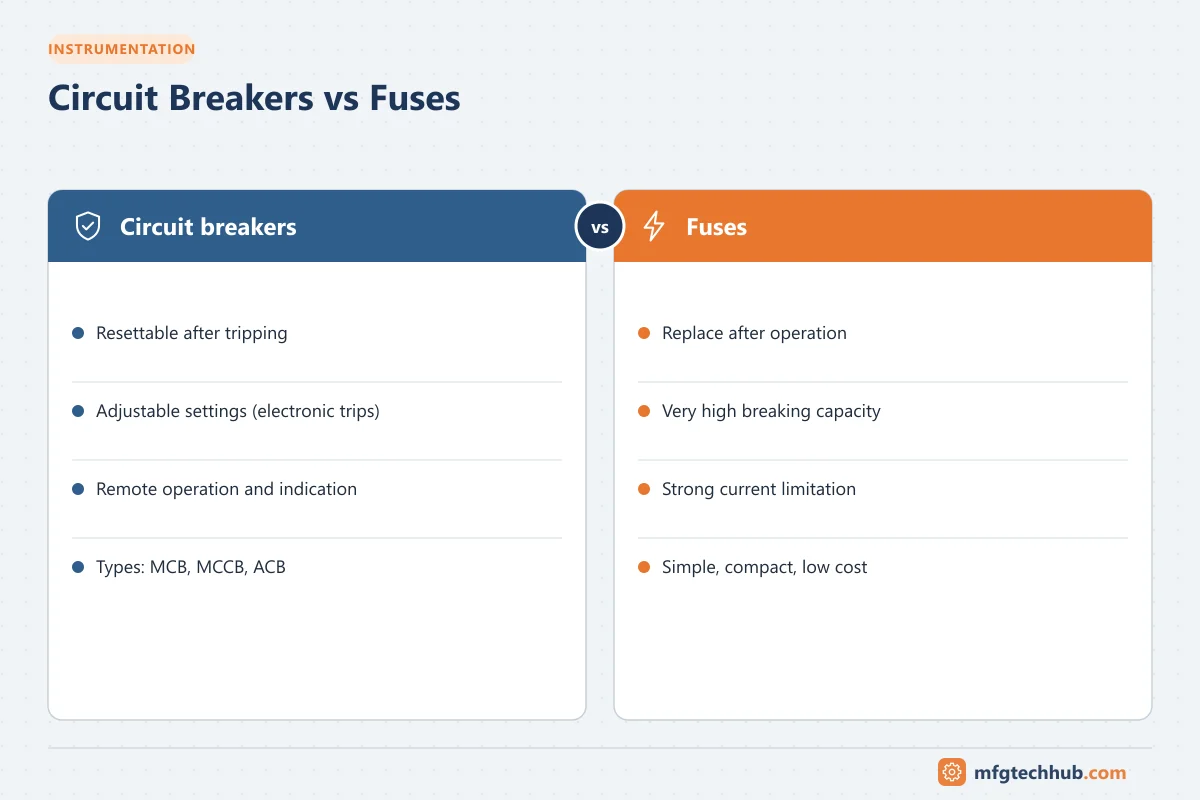
Breakers vs fuses
| Feature | Circuit breaker | Fuse |
|---|---|---|
| Reset after operation | Yes | Must be replaced |
| Adjustable settings | Often | No |
| Current limiting | Some designs | Excellent |
| Remote operation and signaling | Yes | Only with accessories |
| Cost | Higher | Lower |
| Risk of wrong replacement | Low | Someone may fit the wrong rating |
Selectivity (discrimination)
Selectivity means that only the protective device closest to a fault operates, leaving upstream supplies running. For example, a fault on a motor feeder should trip that feeder’s breaker, not the main incomer.
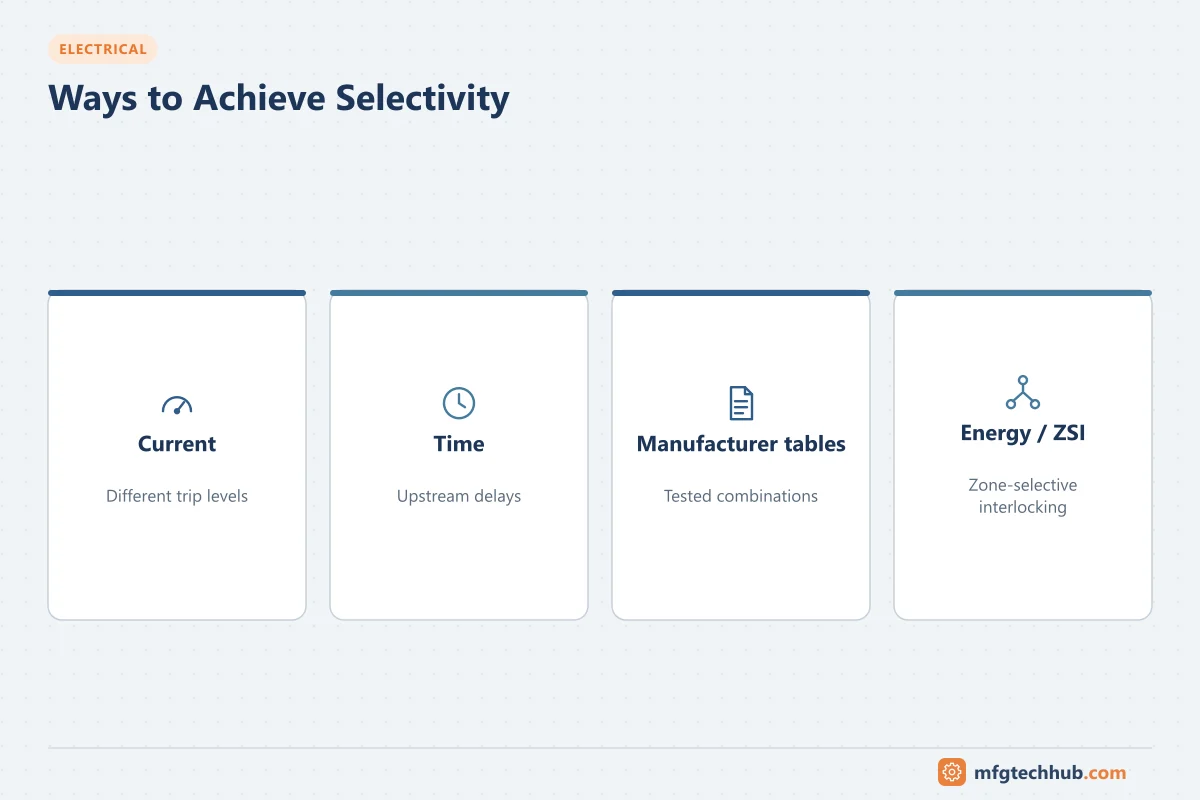
Selectivity is achieved by:
- Current selectivity: upstream devices have higher instantaneous settings
- Time selectivity: upstream devices have deliberate short-time delays
- Manufacturer’s selectivity tables for combinations of breakers and fuses
- Energy-based and zone-selective interlocking in advanced electronic trip units
Coordination studies using time-current curves are normally done with power system software.
Arc flash considerations
High fault currents can create arc flash events that seriously injure workers. Arc flash studies (commonly to IEEE 1584) calculate incident energy and define PPE and safe working distances (for example under NFPA 70E in North America). Faster clearing times, maintenance switches and remote racking reduce arc flash risk.
Selection checklist
- Load current and cable rating (the device must protect the cable)
- Prospective short-circuit current at the location
- Load type and inrush (curve selection)
- Selectivity with upstream and downstream devices
- Special requirements: motors, semiconductors, DC circuits, earth fault, remote control
Maintenance
- Exercise breakers periodically (open and close) so mechanisms do not stick
- Test electronic trip units with manufacturer test kits or secondary injection
- Check terminations with torque checks and infrared thermography
- Keep spare fuses of the correct type and rating, clearly labeled
- Investigate every trip; never simply reset repeatedly
Key takeaways
- Breakers and fuses protect against overloads and short circuits; breaking capacity must exceed the prospective fault current.
- MCB curves B, C and D suit different inrush characteristics.
- Fuse classes such as gG, aM and aR suit general, motor and semiconductor protection.
- Selectivity keeps faults local; arc flash studies protect workers.
Related tutorials
Before you apply this in a plant: this article is for education. Always check the current edition of the relevant standards, the manufacturer's documentation for your exact product and version, and your site's procedures. Safety-related work needs qualified personnel. See our editorial policy.