
AI and Machine Learning in Process Control
On this page
Process control has used mathematical models for decades, from PID tuning to model predictive control. Machine learning (ML) adds the ability to learn complex relationships directly from plant data. Applied carefully, AI can estimate hard-to-measure qualities, detect developing problems, keep control loops performing well and help optimize operations. Applied carelessly, it can undermine trust in the control system. This article focuses on practical, proven uses.
For a broader view of AI across manufacturing, see AI in Manufacturing.
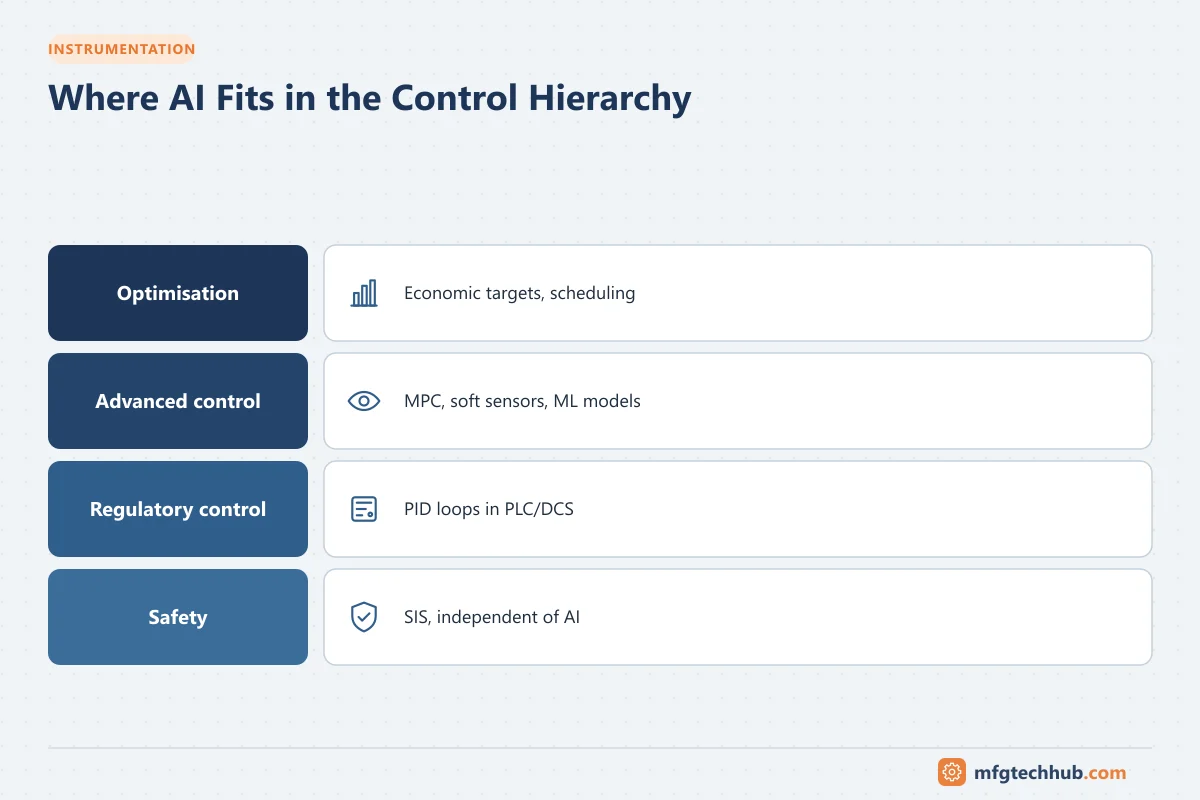
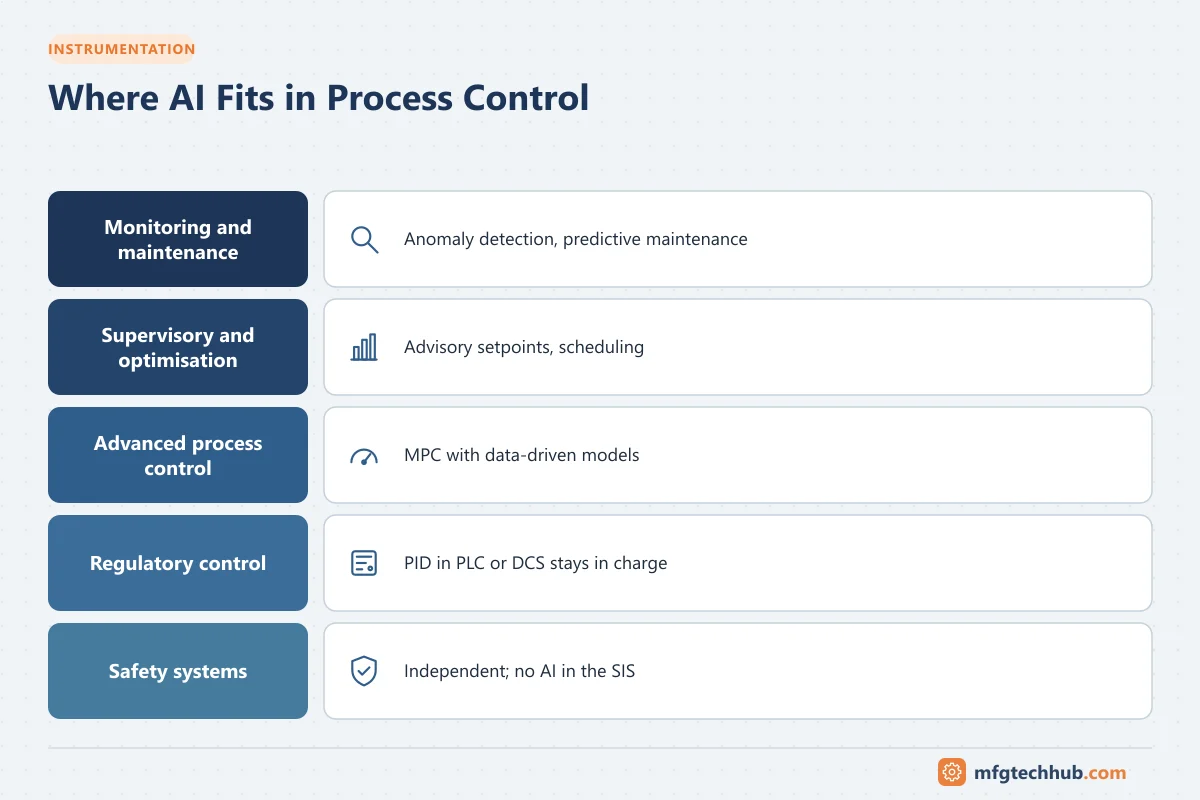
Where AI fits in the control hierarchy
| Layer | Role of AI and ML |
|---|---|
| Safety instrumented systems | No AI; deterministic, certified logic |
| Regulatory control (PID in PLC/DCS) | Normally unchanged; AI may suggest tuning |
| Advanced process control (APC/MPC) | Models may be improved with data-driven methods |
| Supervisory and optimization | Soft sensors, setpoint recommendations, optimization |
| Monitoring and maintenance | Anomaly detection, loop and instrument performance monitoring |
Keeping AI in the supervisory and advisory layers maintains the deterministic, validated behavior of the base control system.
Practical applications
1. Soft sensors (inferential measurements)
A soft sensor predicts a quality variable that is measured infrequently or slowly, such as a laboratory analysis, composition or viscosity, from process variables measured continuously (temperatures, pressures, flows).
- Enables tighter control of product quality between lab samples
- Provides backup if an online analyzer fails
- Common in refining, chemicals, polymers and food processing
Methods range from linear regression and partial least squares (PLS) to neural networks. Models must be validated and monitored, because process changes can make them inaccurate.
2. Anomaly detection
ML models learn normal multivariable behavior and flag unusual patterns early, for example a heat exchanger fouling, a compressor degrading or a valve starting to stick, often before individual alarm limits are reached. Techniques such as principal component analysis (PCA) have been used for multivariate statistical process monitoring for many years; newer methods include autoencoders and other neural networks.
3. Control loop performance monitoring
Plants often have hundreds or thousands of PID loops, and many perform poorly over time. Loop performance monitoring software analyzes loop data to find:
- Oscillating loops and their root causes (tuning, valve stiction, interaction)
- Loops frequently in manual mode
- Saturated outputs and sluggish response
- Instruments with noise or frozen signals
Pattern recognition and ML help diagnose causes such as valve stiction automatically. See Actuators and Control Valves.
4. AI-assisted tuning
Tools can identify process models from operating data and recommend PID settings, speeding up tuning for many loops. Engineers should still review and test recommendations. See PID Control Explained and the PID tuning calculator.
5. Advanced process control and optimization
Model predictive control (MPC) handles multivariable, constrained processes. Data-driven and hybrid models can speed up model building and maintenance. Reinforcement learning is an active research area for control and has seen selected industrial applications, but it requires careful safety constraints and validation.
6. Operator decision support
AI can help operators by predicting upcoming alarms, recommending responses to abnormal situations, and summarizing information. Generative AI assistants can search procedures and historical events, but must be restricted to approved sources and never replace validated procedures.
Data requirements
- Good historical data covering normal operation, different operating modes and relevant disturbances
- Accurate timestamps and alignment between process data and lab results (including sample delay)
- Data quality checks for frozen values, outliers and instrument failures
- Process knowledge to select meaningful input variables and interpret results
Safe deployment practices
- Start in advisory mode: show predictions and recommendations before allowing any automatic action.
- Keep the base control and safety systems independent.
- Set limits: any AI-driven setpoint changes must stay within engineered bounds, with rate limits.
- Provide fallback: if model inputs are out of range or the model fails, revert to normal control.
- Monitor model performance and retrain when process conditions change (model drift).
- Manage changes through the site’s management of change process.
- Involve operators early; trust is essential for adoption.
Frequently asked questions
Can machine learning replace PID controllers?
In practice, PID controllers remain the foundation of regulatory control because they are simple, robust and well understood. Machine learning is mostly applied above them, for monitoring, soft sensors, tuning support and optimization.
What is a soft sensor?
A soft sensor is a model that estimates a variable that is hard or slow to measure, such as a laboratory quality result, from other variables that are measured continuously. It allows closer control of product quality between laboratory samples.
How much data is needed to build a process model?
It depends on the process and the method. As a minimum, the data should cover the normal operating range, product grades and relevant disturbances, with accurate timestamps. Months of historical data are common for soft sensors; models must then be monitored and updated as the process changes.
Key takeaways
- AI is most valuable in soft sensors, anomaly detection, loop performance monitoring and supervisory optimization.
- Safety and regulatory control remain deterministic and independent.
- Good data, process knowledge and ongoing model monitoring are essential.
- Start in advisory mode and expand automation gradually with safeguards.
Related tutorials
Before you apply this in a plant: this article is for education. Always check the current edition of the relevant standards, the manufacturer's documentation for your exact product and version, and your site's procedures. Safety-related work needs qualified personnel. See our editorial policy.