
PLC Applications in Manufacturing: Machines, Production Lines, Line Integration and Data
On this page
In discrete manufacturing, almost every machine has a PLC: conveyors, packaging machines, assembly stations, robot cells, presses and palletisers. Each PLC controls its own machine, and together they must work as a line: passing products, starting and stopping in the right order, and reporting production data. This page covers what PLCs do in typical machines and how lines are integrated.
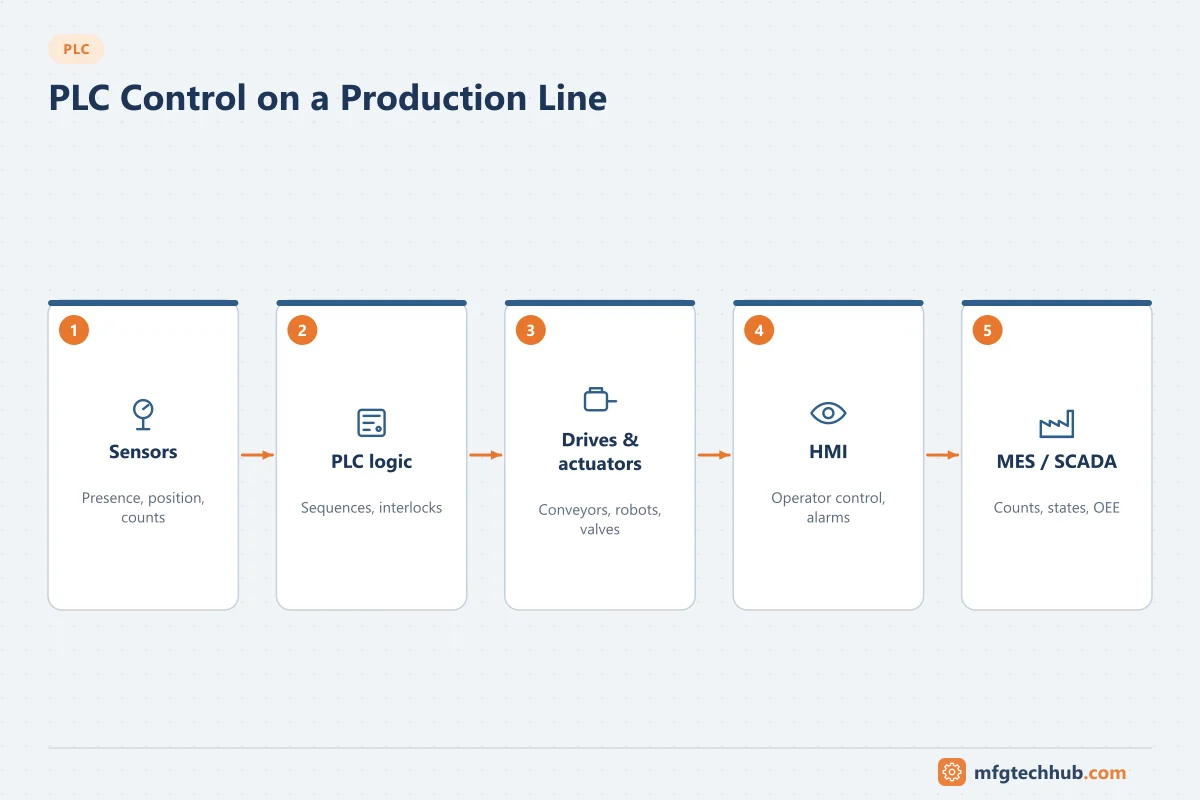
For worked examples of complete projects, see PLC Case Studies.
Typical machine applications
| Machine | What the PLC does | Typical devices |
|---|---|---|
| Conveyors and accumulation | Start/stop sequencing, zone control, jam detection, speed matching | Photo-eyes, VFDs, motor starters |
| Packaging machines (filling, capping, labelling, cartoning) | Machine cycle, registration, product tracking, reject handling, recipes | Servo drives, encoders, vision sensors |
| Assembly stations | Step sequences, part presence checks, tool control, error proofing | Pneumatic valves, proximity sensors, torque tools, RFID |
| Robot cells | Cell sequencing, robot handshake, part flow, safety zones | Robot controller interface, safety scanners, light curtains |
| Presses and forming | Stroke control, die protection, two-hand control, tonnage monitoring | Safety PLCs or safety relays, position sensors |
| Palletisers and wrappers | Layer patterns, stacking sequence, pallet handling | Servo or robot palletising, scanners |
| Machine tools | Auxiliary functions around the CNC (coolant, tool change, doors, chip conveyors) | CNC with integrated PLC |
| Test and inspection | Test sequences, pass/fail decisions, data logging | Measurement instruments, vision |
Motion-heavy machines use PLCs with integrated motion or dedicated motion controllers; see Servo and Motion Control.
Line control: machines working together
| Function | How it is done |
|---|---|
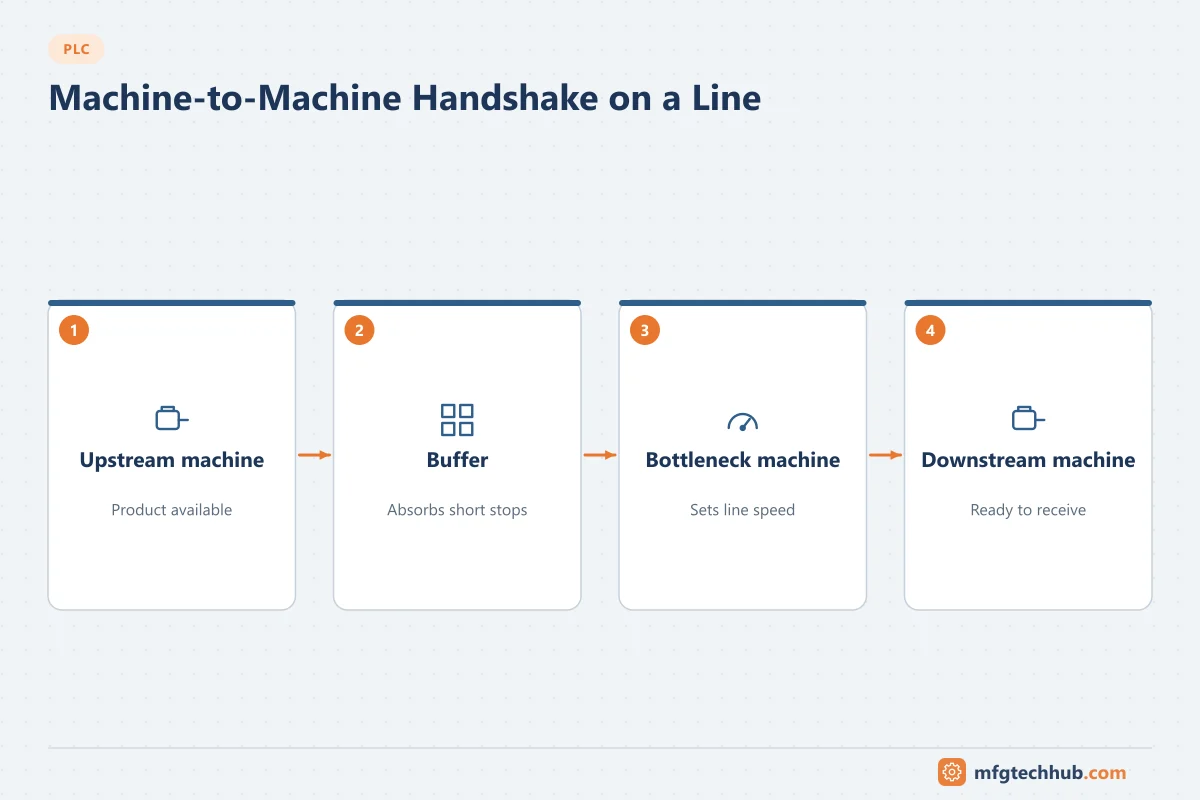
| Upstream/downstream signals | Each machine tells its neighbours “ready to receive”, “product available”, “running”, “faulted” |
| Accumulation | Buffers between machines absorb short stops; the line speed is set by the bottleneck machine |
| Line start and stop | Machines start from downstream to upstream and stop from upstream to downstream to avoid pile-ups |
| Speed control | Machines run faster when the buffer ahead is empty and slower when it fills |
| Changeover | Recipes sent to all machines; the line empties before the new product starts |
Signals between machines were traditionally hard-wired; today they are usually exchanged over PROFINET or EtherNet/IP, often using standard state models.
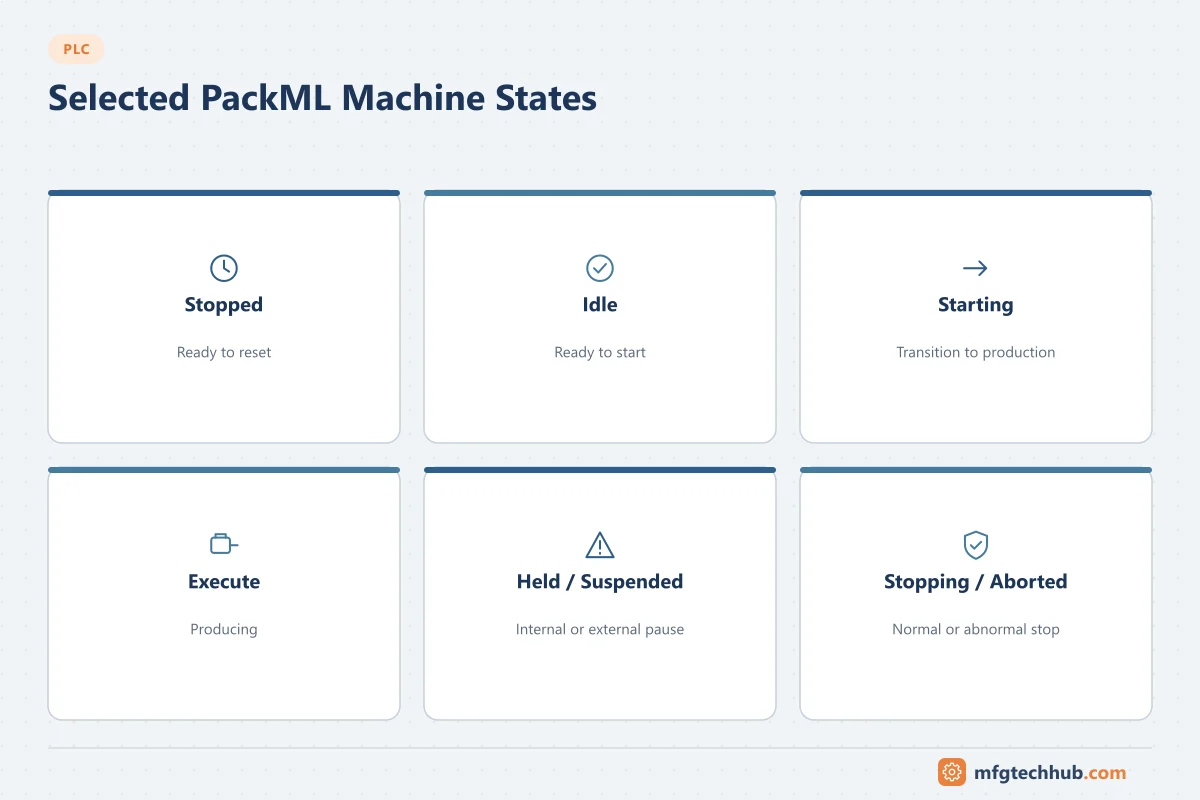
PackML machine states
PackML (ISA-TR88.00.02) defines standard machine states such as Idle, Starting, Execute, Held, Suspended, Stopped and Aborted, and standard tags for counts and faults. When all machines on a line follow it, line control, HMI and data collection work the same way regardless of the machine supplier. See PLC Industry Standards.
A typical line architecture
| Level | Components |
|---|---|
| Field | Sensors, valves, drives, robots, safety devices on each machine |
| Machine control | One PLC (often with safety) and HMI per machine |
| Line control | Line PLC or coordination logic; line HMI or SCADA |
| Plant systems | MES for orders, OEE and traceability; historian; maintenance systems |
Networks are segmented per machine or line, with firewalls towards the plant network. See OT Network Design Fundamentals.
Safety integration
Machine safety functions (emergency stop, guard doors, light curtains, safe speed for setup) are implemented with safety PLCs or safety relays and safety-rated drives, designed according to ISO 13849-1 or IEC 62061. On a line, safety zones and emergency stop areas must be defined so that stopping one machine does not create hazards at another. See Functional Safety.
Production data from PLCs
PLCs are the source of most production data:
| Data | Used for |
|---|---|
| Machine state and stop reasons | OEE availability and downtime analysis |
| Good and reject counts | OEE quality, yield |
| Cycle times and speeds | OEE performance |
| Serial numbers, batch codes, test results | Traceability and genealogy |
| Energy meters | Energy per unit |
Define state and stop-reason logic carefully in the PLC: OEE numbers are only as good as the signals behind them. Data is usually collected over OPC UA or MQTT into MES or a historian. See MES Data Collection and Integration and the OEE Calculator.
Common problems on production lines
| Problem | Typical cause | Remedy |
|---|---|---|
| Frequent micro-stops | Sensor misalignment, marginal timing, product variation | Stop-reason data, sensor maintenance, tuning of timers |
| Line runs below design speed | Bottleneck machine, poor accumulation control | Measure each machine’s speed and state; adjust buffers |
| Different behaviour per supplier machine | No common state model | PackML or a line-wide machine interface standard |
| OEE numbers disputed | Inconsistent state definitions | Agreed definitions implemented in the PLCs |
| Long changeovers | Manual adjustments, recipes not integrated | Recipe management and servo-driven format changes |
Frequently asked questions
What are PLCs used for in manufacturing?
Controlling machines such as conveyors, packaging machines, assembly stations, robot cells, presses and palletisers, coordinating them into production lines, handling safety functions with safety PLCs, and providing production data for OEE and traceability.
How do machines on a production line communicate?
Through handshake signals such as ready, product available, running and faulted, exchanged over industrial networks or hard-wired, often using a standard state model such as PackML.
Can PLC data be used for OEE?
Yes. PLCs provide machine states, stop reasons, counts and cycle times, which MES or OEE systems use to calculate availability, performance and quality.
Key takeaways
- Every machine on a line typically has its own PLC; line control coordinates them.
- Standard handshakes and state models such as PackML make multi-supplier lines manageable.
- Safety is designed per machine and per line with safety-rated systems.
- PLC signals are the basis of OEE and traceability; define them carefully.
Related tutorials
Before you apply this in a plant: this article is for education. Always check the current edition of the relevant standards, the manufacturer's documentation for your exact product and version, and your site's procedures. Safety-related work needs qualified personnel. See our editorial policy.