
PLC Applications in Process Control: Pumps, Dosing, PID, Batch, Utilities and When to Use a DCS
On this page
PLCs are best known for machine control, but a large share of process control also runs on PLCs: water and wastewater plants, pump stations, chemical dosing, boilers and compressors, packaged process skids and plant utilities. Modern PLCs handle analog signals, PID loops, sequences and batch logic well. The questions are how to engineer process control properly on a PLC and when the process has outgrown a PLC and needs a DCS.
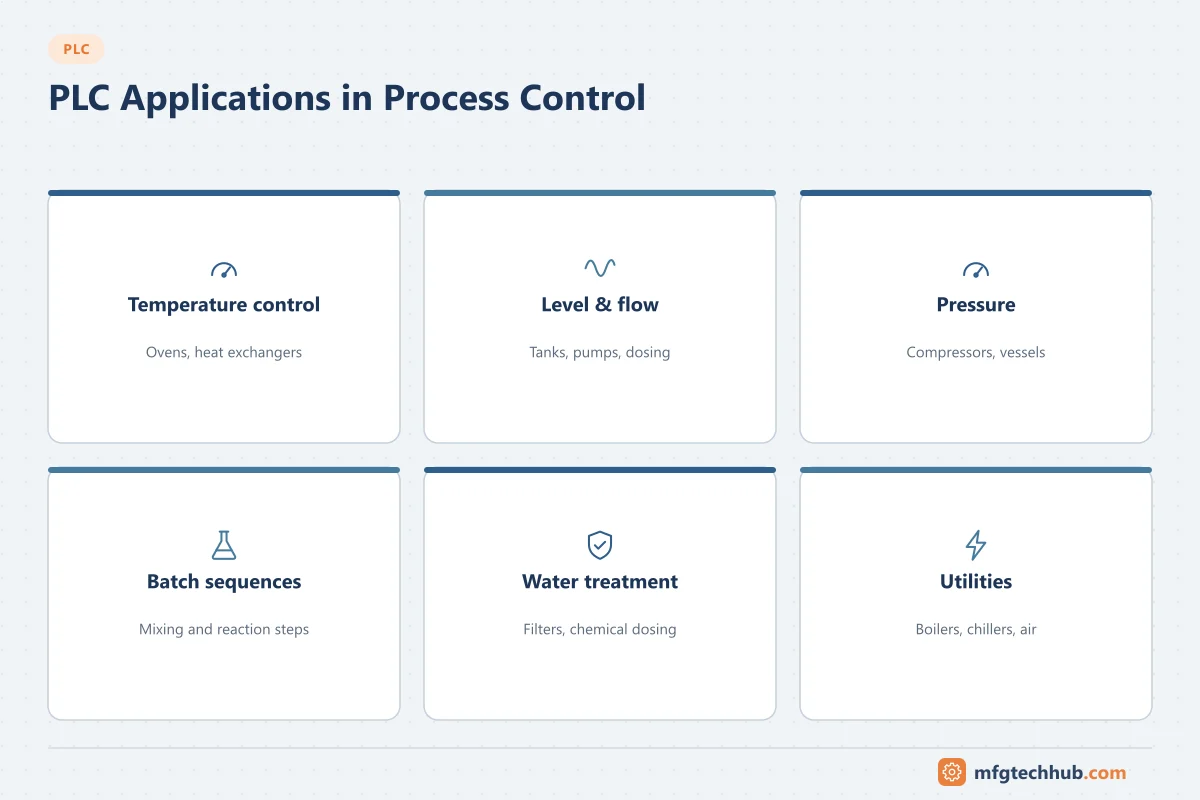
Typical process applications
| Application | What the PLC does | Key signals |
|---|---|---|
| Pump stations | Level control, duty/standby rotation, run-hour equalisation, dry-run protection | Level transmitters, pump status, flow |
| Chemical dosing | Flow-paced or residual-based dosing, pump speed control, low-tank alarms | Flow, analyser (for example chlorine, pH), dosing pump speed |
| Tank level and transfer | Fill/empty sequences, overfill protection interlocks | Level transmitters and switches, valve position |
| Temperature control | Heating or cooling via PID, cascade to valve or heater power | RTDs, thermocouples, control valves, thyristor units |
| Pressure control | Compressor and fan control, VFD speed via PID | Pressure transmitters, VFDs |
| Batch processes | Recipe-driven sequences: charge, heat, react, transfer, clean (CIP) | Weighing, flow totals, temperatures, valve feedback |
| Utilities | Boilers, chillers, compressed air, cooling towers | Pressures, temperatures, run states |
| Process skids | Complete packaged units (filtration, membrane, reverse osmosis, gas treatment) delivered with their own PLC | Skid instruments, interface to plant system |
PID control in a PLC
Modern PLCs provide PID function blocks (for example PID_Compact in Siemens S7-1200/1500 and PIDE in Rockwell Logix). Good practice:
- Run PID blocks in a periodic task at a fixed sample time suited to the loop. See How PLCs Work.
- Scale inputs and outputs consistently, and handle bad input quality (switch to manual or hold output).
- Configure modes (manual, automatic, cascade), bumpless transfer and output limits.
- Use anti-windup and set the correct control action (direct or reverse).
- Tune systematically and document the tuning. See PID Control and the PID Tuning Calculator.
For cascade, ratio, feedforward and override strategies, the concepts are the same as in a DCS; see DCS Control Strategies.
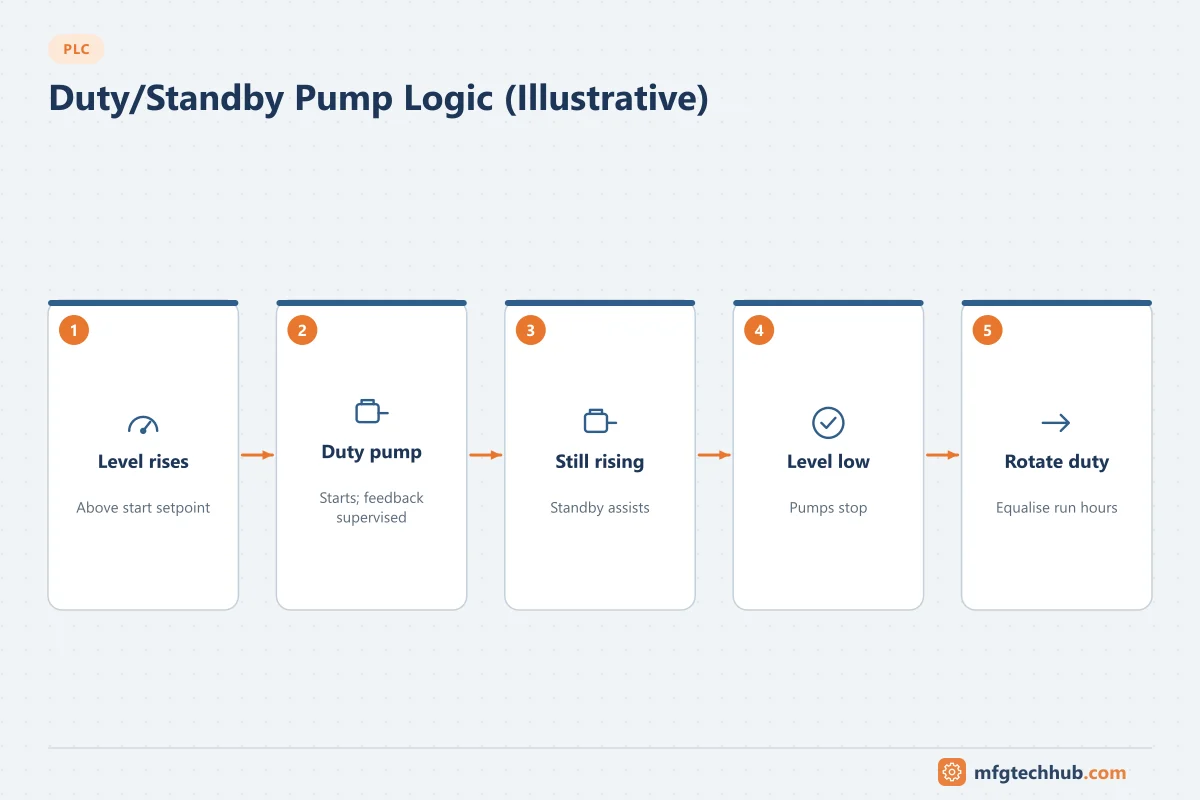
Example: duty/standby pump control (illustrative)
A sump with two pumps:
| Condition | Action |
|---|---|
| Level above start setpoint | Start duty pump |
| Level continues rising above second setpoint | Start standby pump as assist |
| Level below stop setpoint | Stop running pumps |
| Duty pump fault (no running feedback, overload) | Alarm; standby pump takes over as duty |
| Each start or at a set time | Rotate duty to equalise run hours |
| Level transmitter fails | Fall back to level switches; alarm |
| High-high level switch | Independent alarm (hard-wired where required) |
This pattern appears in water, wastewater, drainage and many utilities, and is a good example of process logic that PLCs handle well.
Process object libraries
In process work, every device and loop should behave the same way on the PLC and HMI. Vendors provide process libraries with standard blocks and faceplates for motors, valves, analog inputs and PID loops, for example Rockwell’s PlantPAx process objects and Siemens’ libraries for process applications, and many system integrators maintain their own. Using a library gives consistent alarms, modes, interlocks and faceplates, which is close to the “one database” advantage of a DCS.
Batch and sequences
Batch processes (food, specialty chemicals, pharmaceuticals, pilot plants) need recipe handling and step logic. PLCs can run batch sequences with SFC or state machines; for larger plants, a batch manager following ISA-88 manages recipes and records while the PLC runs the phases. See ISA-88 and PLC Programming Best Practices.
Availability and redundancy
- Redundant PLCs (hot standby CPU pairs) exist in several families for processes that must not stop.
- Redundant I/O and networks (for example ring topologies with MRP or DLR) protect against single failures.
- For less critical plants, a single CPU with good spares and backups is often enough; define this by risk.
Integration with SCADA and DCS
- Standalone PLC plants are supervised by SCADA or HMI software. See What Is SCADA?.
- Packaged skids with PLCs are integrated into a plant DCS through a defined interface: signals, alarms, commands and, increasingly, NAMUR MTP. See DCS System Integration.
- Safety instrumented functions use certified safety PLCs or a separate SIS. See Functional Safety.
PLC or DCS for a process?
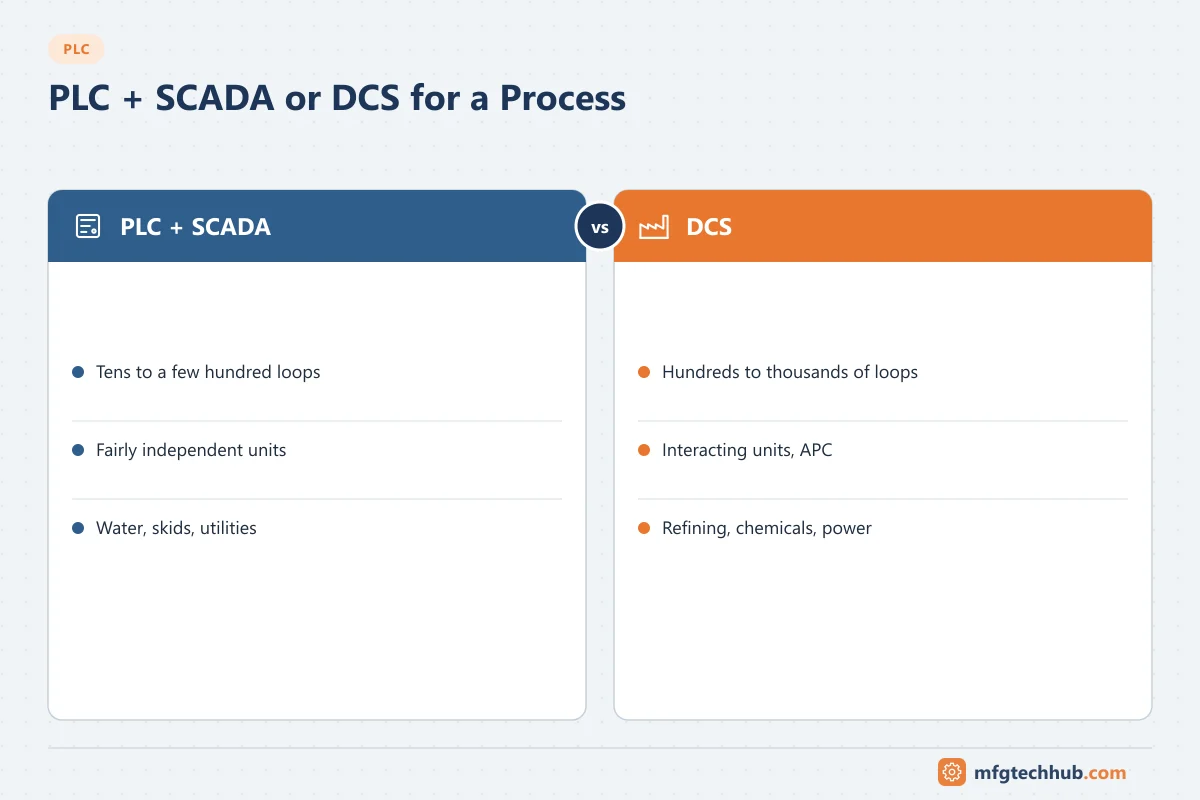
| Factor | Favours PLC + SCADA | Favours DCS |
|---|---|---|
| Size | Tens to a few hundred loops | Hundreds to thousands of loops |
| Process interaction | Units fairly independent | Highly interactive units, APC |
| Engineering model | Integrator-based, flexible | Integrated database and vendor lifecycle support |
| Operation | Local or small control rooms | Central control room for a whole plant |
| Typical examples | Water plants, skids, utilities, small chemical plants | Refineries, large chemical, power and pharmaceutical plants |
See DCS vs PLC and Why Process Plants Use a DCS.
Frequently asked questions
Can a PLC be used for process control?
Yes. PLCs are widely used for pump stations, dosing, utilities, skids, water treatment and batch processes. They provide analog I/O, PID blocks and sequence logic; process libraries make engineering consistent.
How is PID implemented in a PLC?
With a PID function block from the vendor library, executed in a periodic task at a fixed sample time, with scaled inputs, modes, output limits, anti-windup and documented tuning.
When should a DCS be used instead of a PLC?
When the plant has many interacting loops, needs a central control room with integrated engineering and high availability, or uses advanced process control and large-scale batch management.
Key takeaways
- PLCs control many processes: pumps, dosing, utilities, skids and batch plants.
- Run PID in periodic tasks with proper scaling, modes and tuning.
- Use process object libraries for consistent behaviour and faceplates.
- Choose PLC plus SCADA or a DCS by size, interaction and lifecycle needs.
Related tutorials
Before you apply this in a plant: this article is for education. Always check the current edition of the relevant standards, the manufacturer's documentation for your exact product and version, and your site's procedures. Safety-related work needs qualified personnel. See our editorial policy.