
Moving to SAP S/4HANA in Manufacturing: Migration Approaches, Shop-Floor Impact and Cutover Checklist
On this page
Many manufacturers are moving from SAP ECC to SAP S/4HANA. SAP’s published maintenance timeline is a major driver: mainstream maintenance for SAP ECC 6.0 (enhancement packages 6–8) ends at the end of 2027, with optional extended maintenance available to the end of 2030 under SAP’s terms. Check SAP’s current maintenance commitments for your contracts.
For manufacturing sites, the migration is not only an SAP project. Every interface to MES, LIMS, warehouse automation, label printing and shop-floor systems is affected, and a production plant cannot stop for weeks while issues are fixed. This guide focuses on those aspects.
Scope note: this article explains concepts and planning considerations. Technical migration steps, tools and prerequisites depend on your source release and target edition; follow SAP’s official documentation and your implementation partner’s methodology.
Migration approaches
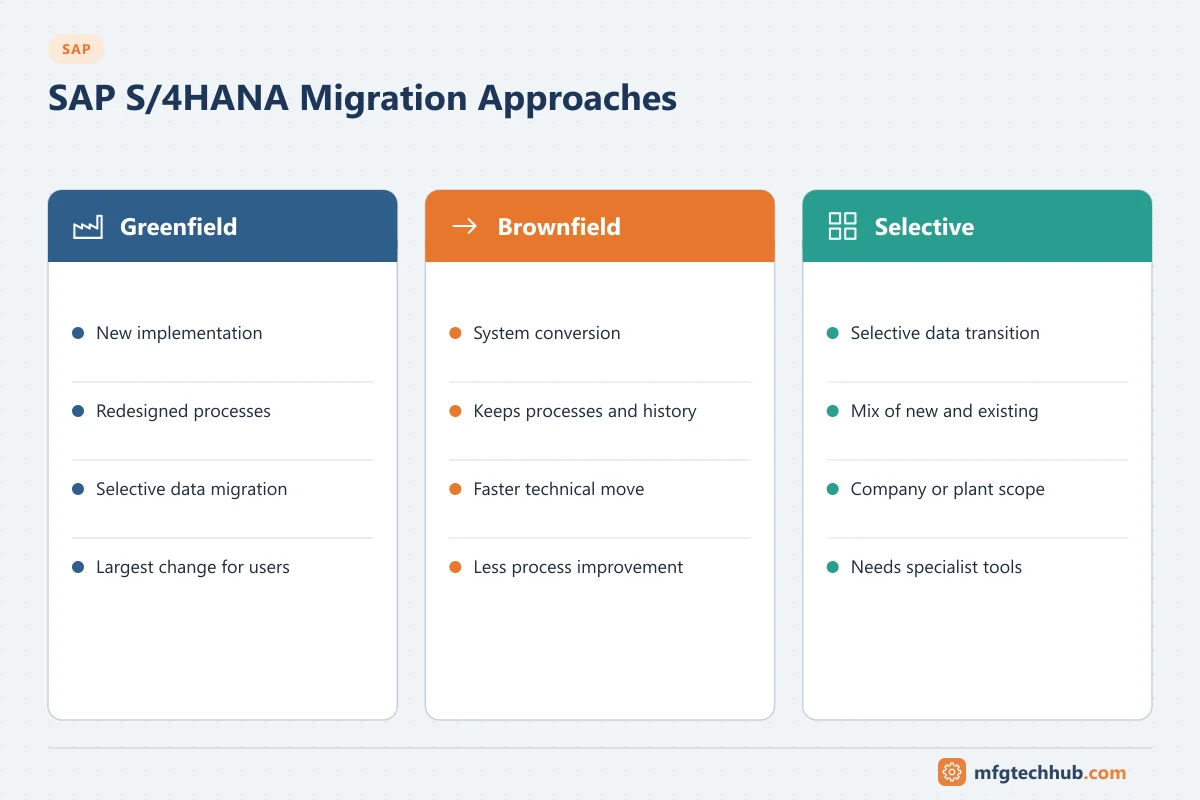
| Approach | Description | Suits | Consider |
|---|---|---|---|
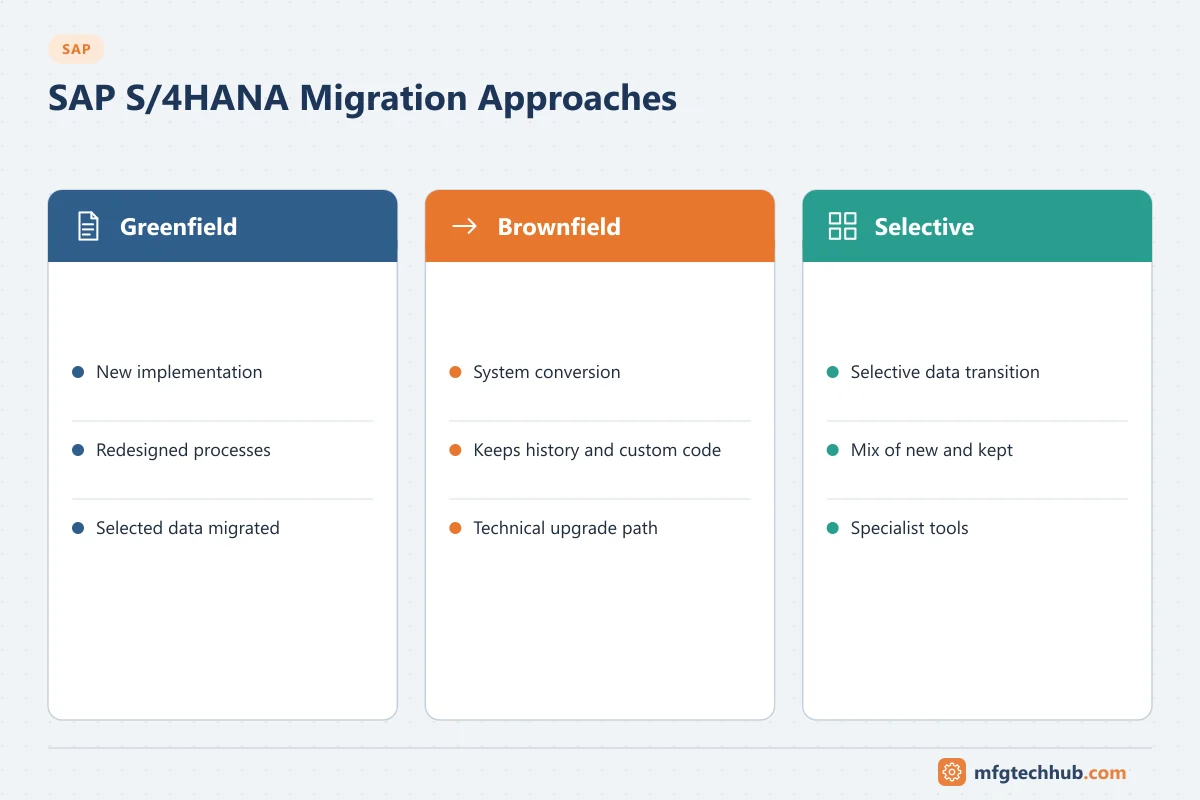
| New implementation (greenfield) | New S/4HANA system; processes redesigned; master and open transactional data migrated | Companies wanting to simplify and standardise processes | Largest process change; historical data usually stays in the old system or an archive |
| System conversion (brownfield) | Existing ECC system converted technically to S/4HANA, keeping configuration and history | Companies with processes that work well and much custom development | Custom code and data must be adapted; old complexity is carried over |
| Selective data transition | A combination: new or shell system with selected data and processes moved (for example by company code or plant) | Complex landscapes, consolidations, phased approaches | Needs specialised tools and expertise |
Many projects combine a technical conversion with later process optimisation, or roll out a greenfield template plant by plant.
Preparation activities
- Readiness and simplification checks: SAP provides tools (such as the SAP Readiness Check and simplification item checks) that show which functions, data and custom code are affected by the move to S/4HANA.
- Custom code analysis: identify and adapt custom programs, especially interfaces and shop-floor extensions.
- Business partner: customer and vendor master data are handled as business partners in S/4HANA, which requires preparation (customer/vendor integration) in conversion projects.
- Data quality: clean materials, BOMs, routings, recipes, work centres, batches and open orders before migration.
- Methodology: SAP Activate phases (discover, prepare, explore, realise, deploy, run) are commonly used for planning.
What changes for manufacturing
Changes depend on the release and chosen scope, but typical topics include:
- MRP Live as the planning run, and changed planning behaviour to test. See SAP PP Explained.
- Fiori apps for planners, production supervisors, quality and maintenance users, which changes training and authorisations.
- Simplifications in data models (for example material number length, business partner), which can affect interfaces.
- Warehouse management: a move to SAP EWM where the old warehouse solution is not continued. See SAP EWM for Production.
- Manufacturing execution: decisions on SAP ME/MII successors (for example SAP Digital Manufacturing) or third-party MES.
Impact on shop-floor interfaces
Create an interface inventory early. For each interface, record: source and target, message type or API, frequency, owner, criticality, current technology, and whether it changes.
| Interface | Typical risk during migration |
|---|---|
| Production/process orders to MES (for example LOIPRO) | Changed fields, lengths or custom enhancements |
| Confirmations and goods movements from MES | BAPI/API behaviour, authorisations, new mandatory fields |
| QM results from LIMS | Characteristic and lot handling, API changes |
| Label printing and handling units | Output management changes |
| Warehouse automation | New warehouse system or integration model |
| Maintenance data from condition monitoring | Changed APIs and asset structures |
| Reports and extractions to historians or analytics | Changed tables and data models |
See SAP–MES Integration.
Data migration
| Data | Typical approach |
|---|---|
| Master data (materials, BOMs, routings/recipes, work centres, equipment) | Migrated with validation; often cleansed and harmonised |
| Open orders (production, process, maintenance, purchase) | Migrated or closed before cutover and recreated |
| Stock and batches | Migrated at cutover with reconciliation of quantities and values |
| History | Converted (brownfield) or kept in the old system/archive (greenfield) |
SAP provides migration tools such as the SAP S/4HANA Migration Cockpit for new implementations. Plan several mock migrations with full reconciliation before the real cutover.
Testing
- Unit and integration tests of configured processes.
- End-to-end tests across SAP, MES, LIMS, warehouse and label systems: order release → execution → confirmation → goods movements → quality release → shipment.
- Performance tests for planning runs and high-volume interfaces.
- User acceptance tests with production, quality, maintenance and warehouse users.
- Regulated industries: validation of GxP-relevant functions and interfaces, with traceability to requirements.
Cutover checklist for a manufacturing site
- Production plan agreed around cutover (build-ahead stock, reduced production or shutdown window)
- Open orders strategy: finish, close or migrate; MES aligned with the same list
- Final stock counts and batch statuses frozen and reconciled
- Interfaces switched in the correct sequence, with queues drained before the switch
- MES, LIMS and warehouse systems tested against the new system in the final mock
- Label printers, scanners and output tested at every line
- Users trained and authorisations tested with real user IDs
- Go/no-go criteria defined, with a rollback decision point
- Contingency procedures for shipping and production if SAP is unavailable
- Hypercare team (SAP, MES, interfaces, IT/OT) on site or on call for the first production days
Hypercare
The first weeks after go-live need close monitoring:
- Interface error queues (IDocs, failed goods movements, middleware)
- Order release and confirmation backlogs
- Stock differences between SAP, MES and the warehouse
- Planning run results and exception messages
- User issues and training gaps
Define clear exit criteria for hypercare, for example stable error rates and reconciled inventories for several consecutive weeks.
Frequently asked questions
Is SAP ECC support really ending?
SAP’s published timelines state that mainstream maintenance for SAP ECC 6.0 (enhancement packages 6–8) ends at the end of 2027, with optional extended maintenance available until the end of 2030. Confirm the options that apply to your contract with SAP.
Should a manufacturer choose greenfield or brownfield?
It depends on how well current processes work, the amount of custom development, data history needs, and the appetite for change. Greenfield suits simplification and standardisation; brownfield suits preserving processes and history. Selective data transition offers combinations.
How does an S/4HANA migration affect MES?
Every SAP–MES interface must be analysed, adapted where needed and tested end to end. Cutover must coordinate open orders and stock between SAP and MES so production continues without duplicated or missing postings.
Key takeaways
- The move to S/4HANA is driven partly by SAP’s maintenance timeline; choose greenfield, brownfield or selective transition deliberately.
- Shop-floor interfaces are a major risk; build an interface inventory and test end to end.
- Clean data, run mock migrations, and plan cutover around production with clear go/no-go criteria and hypercare.
Related tutorials
Before you apply this in a plant: this article is for education. Always check the current edition of the relevant standards, the manufacturer's documentation for your exact product and version, and your site's procedures. Safety-related work needs qualified personnel. See our editorial policy.