
SAP for Manufacturing: How S/4HANA Modules Work Together from Planning to the Shop Floor
On this page
In most large manufacturers, SAP is the system of record for what is planned, bought, produced, stored, shipped and costed. Automation and MES engineers meet SAP at the integration boundary (production orders going down, confirmations coming up), yet many have never seen how the SAP side works. SAP consultants, in turn, often know little about what happens below MES.
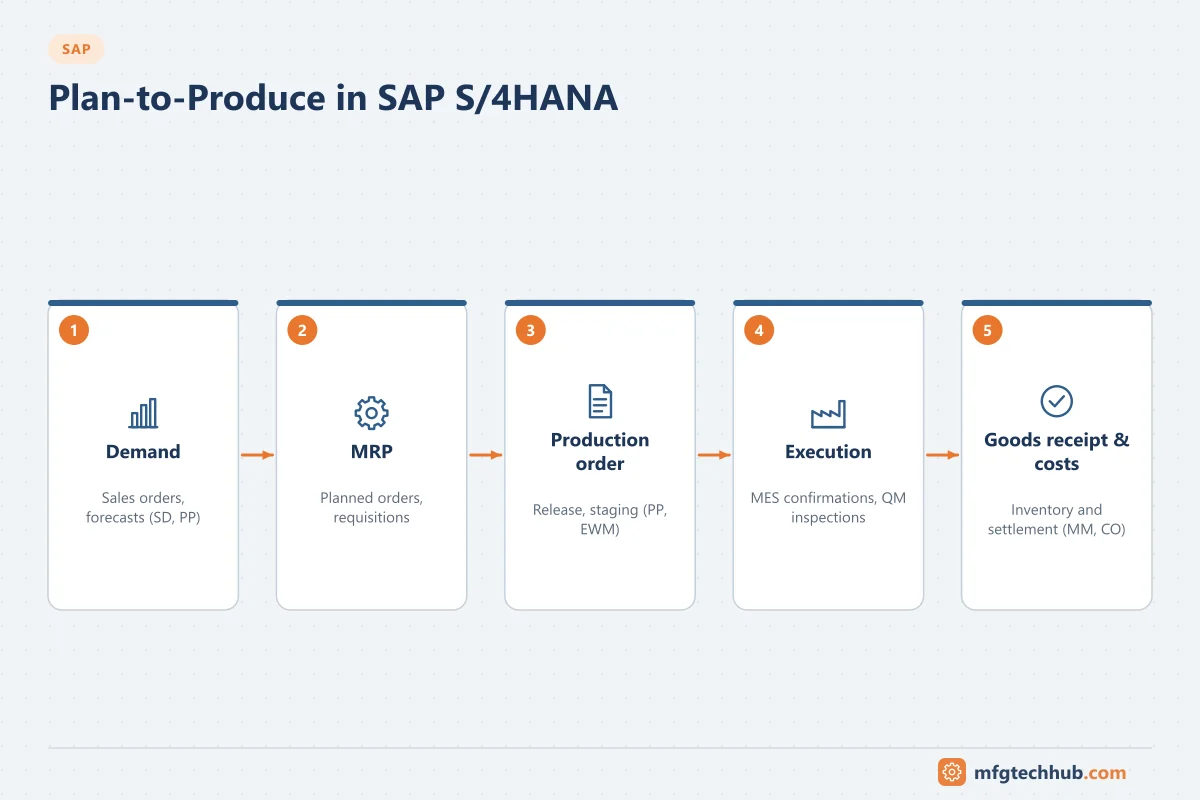
This article gives both groups a shared map. It describes SAP S/4HANA functionality for manufacturing at a conceptual level; specific transactions, apps and configuration depend on your release and scope and should be confirmed in the SAP Help Portal and your system.
Where SAP sits in the manufacturing stack
| Level (ISA-95) | Systems | Responsibility |
|---|---|---|
| Level 4 | SAP S/4HANA (ERP) | Demand, planning, purchasing, inventory valuation, orders, costs, finance |
| Level 3 | MES / MOM (for example SAP Digital Manufacturing or third-party MES), LIMS, WMS | Execution, genealogy, quality at the line, performance |
| Level 2 and below | SCADA, DCS, PLC, instruments | Real-time control and supervision |
See How a Factory Works for the whole stack.
The main SAP areas used in manufacturing
| Area | What it covers | Typical manufacturing objects |
|---|---|---|
| PP (Production Planning) | Discrete and repetitive manufacturing planning and execution | Material master, BOM, routing, work centre, MRP, production orders, confirmations. See SAP PP Explained |
| PP-PI (Production Planning for Process Industries) | Batch-oriented process manufacturing | Master recipes, resources, process orders, control recipes, PI sheets, process messages. See SAP PP-PI Explained |
| MM (Materials Management) | Purchasing and inventory management | Purchase orders, goods receipts and issues, stock, batches |
| QM (Quality Management) | Quality planning, inspection and notifications | Inspection plans, inspection lots, results recording, usage decisions, quality notifications. See SAP QM |
| PM / EAM (Plant Maintenance / Enterprise Asset Management) | Maintenance of equipment | Functional locations, equipment, notifications, maintenance orders, maintenance plans. See SAP PM |
| EWM (Extended Warehouse Management) | Warehouse processes, including production supply | Warehouse tasks, staging for production, putaway of finished goods. See SAP EWM for Production |
| SD (Sales and Distribution) | Sales orders, delivery, billing | Demand that drives make-to-order production |
| FI/CO (Finance and Controlling) | Accounting and cost controlling | Product costing, order settlement, variances |
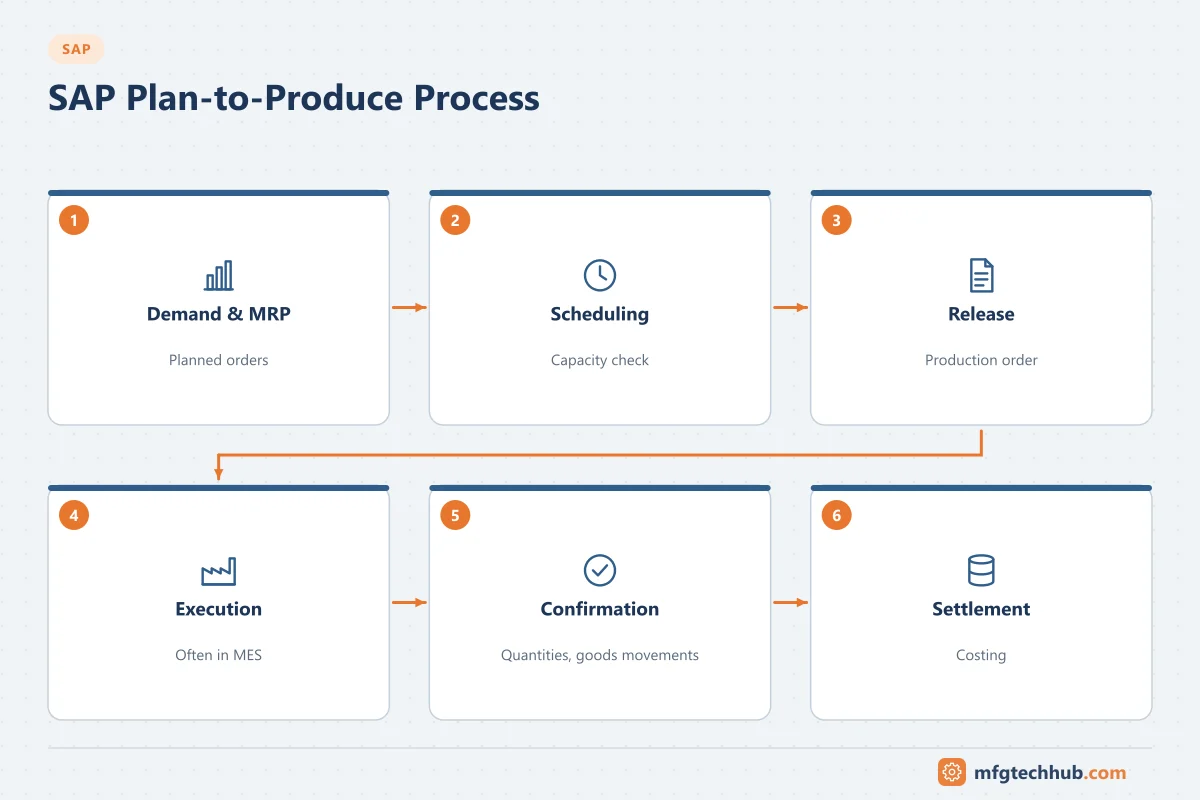
The plan-to-produce process
- Demand: sales orders and forecasts (planned independent requirements).
- Planning: MRP calculates net requirements from demand, stock and BOMs and creates planned orders or purchase requisitions. S/4HANA provides MRP Live for fast planning runs.
- Scheduling and capacity: planned orders are scheduled against work centres or resources.
- Order conversion and release: planned orders become production orders (PP) or process orders (PP-PI) and are released for execution.
- Execution: orders are sent to MES or executed with SAP shop-floor functions; materials are staged (EWM or MM).
- Confirmation: quantities, scrap, activity times and consumption are confirmed; goods issues and goods receipts post inventory movements.
- Quality: inspection lots for incoming, in-process and final inspection; usage decisions release or block stock.
- Costing and settlement: actual costs are collected on the order, variances calculated and settled.
Organisational structure in brief
| Object | Meaning |
|---|---|
| Company code | Legal entity for financial accounting |
| Plant | Production or distribution location; most manufacturing data is plant-specific |
| Storage location | Stock location within a plant |
| MRP controller, production scheduler | People or groups responsible for planning and execution |
| Work centre / resource | Where operations are performed (machines, lines, people); resources in PP-PI |
Master data that matters most to engineers
- Material master: every raw material, intermediate and finished product, with plant-specific planning, quality and storage views.
- Bill of materials (BOM) / recipe ingredients: what goes into a product.
- Routing / master recipe: the sequence of operations or phases, work centres/resources and standard values.
- Production version: combines a BOM and routing/recipe that are valid together.
- Batches and batch classification: essential for traceability in process industries.
MES integration depends on this data being correct: an order downloaded to MES is only as good as its BOM and routing.
SAP’s manufacturing execution offerings
- SAP Digital Manufacturing is SAP’s cloud-based manufacturing execution solution, covering execution, integration with automation, and performance insights.
- SAP Manufacturing Execution (SAP ME) and SAP Manufacturing Integration and Intelligence (SAP MII) are older on-premise products; version 15.5 is the final release. SAP partners citing SAP maintenance statements report end of mainstream maintenance at the end of 2027 (extended maintenance to 2030), and SAP positions SAP Digital Manufacturing as the successor. Confirm dates for your installed versions in SAP notes.
- SAP Plant Connectivity (PCo) and the newer Production Connector connect SAP to OPC UA servers, MQTT brokers, historians and other shop-floor sources. See Connecting SAP to the Shop Floor.
- Many companies use third-party MES products integrated with SAP. See MES Integration Guide and SAP–MES Integration.
How SAP connects to the plant
| Integration | Typical technology |
|---|---|
| Orders and master data to MES | IDocs (for example production order IDoc LOIPRO), APIs/OData, middleware such as SAP Integration Suite |
| Confirmations and goods movements from MES | BAPIs, IDocs or APIs |
| Quality results | QM interfaces, LIMS integration |
| Maintenance triggers | Counter readings or notifications from condition monitoring, historians or MES |
| Process data | Usually stays in historians and MES; SAP receives summarised or order-related data |
| Machines, SCADA and historians without an MES | A connectivity layer (SAP Plant Connectivity, Production Connector or third-party) with PLC handshakes. See Connecting SAP to the Shop Floor |
Design principle: SAP should receive business events (order started, quantity produced, material consumed, batch released), not raw sensor data every second.
Moving to SAP S/4HANA
If your site is still on SAP ECC, see Moving to SAP S/4HANA in Manufacturing for approaches, shop-floor impact and a cutover checklist.
Frequently asked questions
What is the difference between SAP PP and PP-PI?
PP is designed for discrete and repetitive manufacturing with routings and production orders. PP-PI is designed for process industries with master recipes, resources, process orders, control recipes and batch-oriented features. Both run in SAP S/4HANA.
Does SAP replace an MES?
SAP ERP plans and records production at the business level. Detailed execution (work instructions, machine integration, electronic batch records, real-time genealogy) is typically handled by an MES, which may be SAP Digital Manufacturing or a third-party product.
What should an automation engineer know about SAP?
Enough to understand orders, materials, batches, confirmations and goods movements, and which of these must flow between SAP, MES and automation, with what timing and error handling.
Key takeaways
- SAP S/4HANA is the business system of record; MES and automation execute production.
- PP, PP-PI, MM, QM, PM/EAM, EWM and FI/CO together cover plan-to-produce.
- Integration exchanges business events (orders, confirmations, consumption, quality) rather than raw process data.
Related tutorials
Before you apply this in a plant: this article is for education. Always check the current edition of the relevant standards, the manufacturer's documentation for your exact product and version, and your site's procedures. Safety-related work needs qualified personnel. See our editorial policy.