
How MES Works: ERP, SCADA, and PLC Integration
Why is Integration Important?
Manufacturing environments are complex, with multiple systems performing specific roles. Integration ensures that these systems work together cohesively, enabling:
- Data Synchronization: Real-time data sharing between shop floor and enterprise systems.
- Improved Decision-Making: Insights from MES inform decisions across all levels of operations.
- Operational Efficiency: Automation reduces manual intervention, ensuring faster and more accurate processes.
Beyond these points, integration also ensures traceability, a non-negotiable requirement in industries like pharmaceuticals, aerospace, and food processing. Without integration, quality audits and compliance checks can take weeks. With MES, all information is digital, searchable, and available instantly. Moreover, integration reduces duplication of work—no more entering the same data into multiple systems. It creates a single source of truth that management, engineers, and operators can rely on.
How MES Integrates with ERP, SCADA, and PLC
1. Integration with ERP Systems
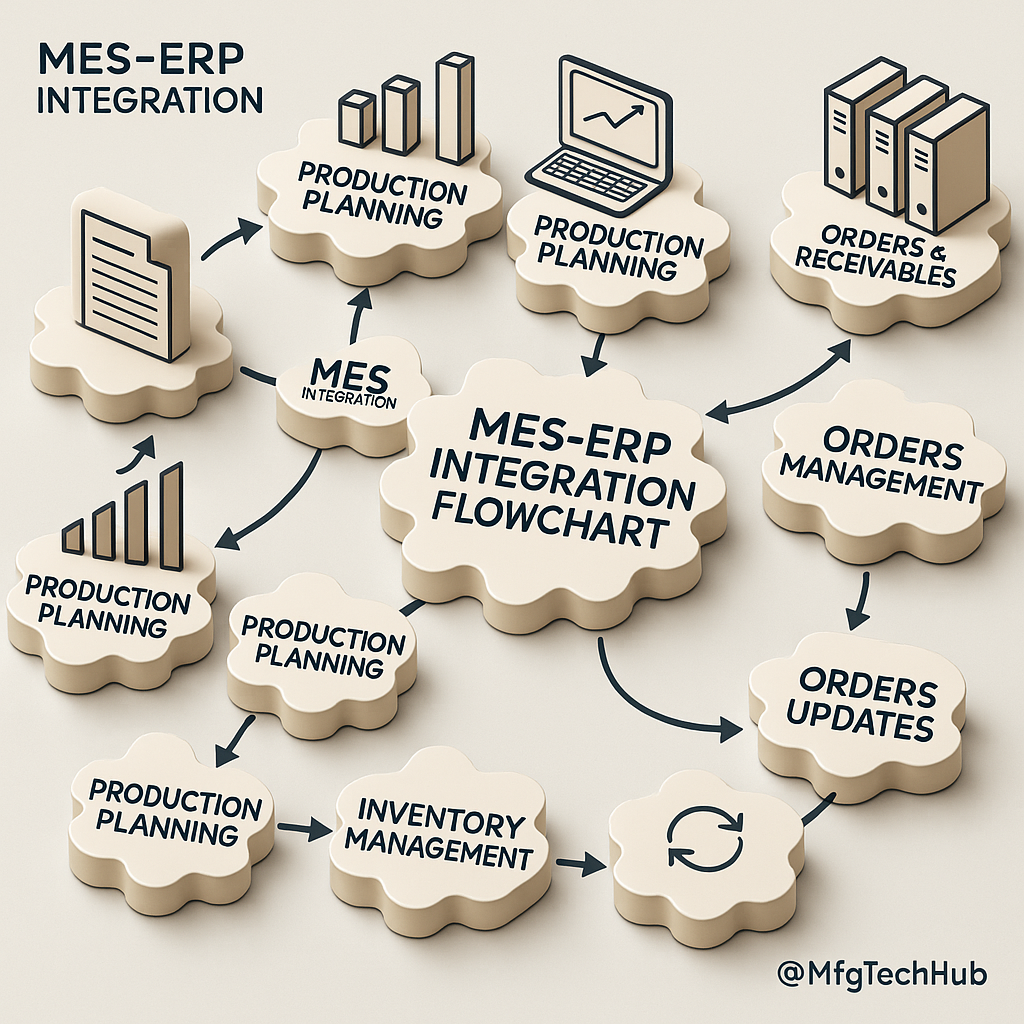
ERP systems handle enterprise-level operations such as inventory management, supply chain, finance, and order processing. MES bridges the gap between ERP and the shop floor by:
- Sharing Real-Time Data: MES sends live production data to ERP for inventory updates and order tracking.
- Receiving Planning Data: MES uses production schedules, recipes, and resource plans from ERP to manage shop floor activities.
Example Integration Flow:
- An order is created in ERP → MES receives the order details → MES tracks production → MES sends completion data back to ERP for inventory adjustments.
ERP focuses on business-level questions such as: “What do customers need?” and “How much inventory is available?” MES translates these requirements into actionable tasks: “What machine will produce this order?” or “Which operator is certified to run this process?” Without MES, ERP planning may remain theoretical. With integration, orders flow smoothly from boardroom planning to shop floor execution.
2. Integration with SCADA Systems

SCADA systems focus on monitoring and controlling shop floor equipment. MES integrates with SCADA to:
- Collect Real-Time Data: MES gathers process parameters like temperature, pressure, and speed from SCADA.
- Control Operations: MES uses SCADA to adjust equipment settings based on production requirements.
Example Integration Flow:
- SCADA collects machine data → MES processes this data to monitor KPIs → MES sends commands to SCADA for operational adjustments.
This integration ensures that production decisions are based on actual process conditions rather than estimates. For instance, if a furnace overheats, SCADA detects it instantly, and MES can pause the process or adjust schedules automatically. This reduces downtime and prevents defective products from moving down the line.
3. Integration with PLCs

PLCs are hardware controllers that automate machine-level operations. MES connects with PLCs to:
- Execute Commands: MES sends instructions to PLCs for machine operations.
- Monitor Performance: PLCs provide MES with data on machine status, cycle times, and alarms.
Example Integration Flow:
- MES sends production parameters to PLC → PLC controls machine functions → PLC sends operational data back to MES for monitoring.
The benefit here is precision and speed. PLCs execute instructions in milliseconds, while MES ensures those instructions align with overall production goals. This allows for “smart factories” where machines adjust automatically to demand fluctuations, without waiting for manual intervention.
Technologies Enabling MES Integration

- Communication Protocols:
- OPC-UA: Facilitates data exchange between MES, SCADA, and PLCs.
- MQTT: Lightweight protocol for IoT device integration.
- REST APIs: Enable MES-ERP communication for data sharing.
- Middleware:
- Software solutions that connect disparate systems and handle data transformation.
- Example: Integrating MES with legacy ERP systems using middleware.
- IoT and Edge Computing:
- IoT devices collect real-time data from machines.
- Edge computing processes data locally before sending it to MES for further analysis.
These technologies ensure integration is not limited to large corporations. Even mid-sized factories can adopt MES because open standards like OPC-UA and MQTT make it easier to connect new and old systems. Edge computing also helps balance performance and cost by filtering data locally before sending only what matters to central MES servers.
Benefits of MES Integration

- End-to-End Visibility:
- Provides a holistic view of operations from raw materials to finished products.
- Enhanced Productivity:
- Reduces manual data entry and errors.
- Ensures real-time updates for faster decision-making.
- Improved Quality Control:
- Combines machine data (SCADA/PLC) with ERP insights to monitor and maintain quality.
- Cost Savings:
- Optimizes resource utilization by synchronizing production schedules with shop floor operations.
- Regulatory Compliance:
- Ensures traceability by integrating data from all levels of manufacturing.
The biggest advantage of integration is decision-making speed. Instead of waiting for end-of-shift reports, managers and operators see KPIs in real-time dashboards. This agility allows them to react within minutes instead of hours or days, keeping production on track and costs under control.
Challenges in MES Integration
- System Compatibility:
- Older systems may not support modern integration protocols.
- Data Overload:
- Managing large volumes of real-time data requires robust infrastructure.
- High Implementation Costs:
- Integrating MES with ERP, SCADA, and PLC systems can be resource-intensive.
- Skill Gaps:
- Requires expertise in both IT and operational technologies.
While these challenges are significant, they are not insurmountable. Cloud-based MES solutions, open-source integration tools, and workforce training programs are helping even small manufacturers overcome barriers to entry. Many companies now adopt a phased integration approach, starting small and expanding gradually.
Real-Life Example: MES Integration in Automotive Manufacturing
In an automotive assembly plant:
- ERP Integration: MES receives orders from ERP and updates inventory after production.
- SCADA Integration: MES monitors welding robots via SCADA for real-time quality checks.
- PLC Integration: MES sends assembly line instructions to PLCs, ensuring precise operations.
Outcome: The integration streamlines production, reduces downtime, and ensures timely delivery of vehicles.
This example highlights how integration transforms production from a reactive system into a predictive one. Potential failures are spotted early, materials are used more efficiently, and production aligns seamlessly with customer demand. In industries with tight margins and strict delivery schedules, such integration is not just an advantage—it is a necessity.
Conclusion
MES integration with ERP, SCADA, and PLC is the backbone of the smart factory. It enables collaboration across organizational levels, ensures real-time visibility, and allows for rapid response to changing market or operational conditions. By adopting open standards and modern technologies, manufacturers can overcome challenges and unlock powerful benefits such as cost reduction, higher quality, and regulatory compliance.
As industries move toward Industry 4.0 and beyond, MES will evolve further—integrating with AI, machine learning, and digital twins. The factories of the future will not only produce efficiently but also learn and adapt continuously, with MES serving as the digital nervous system connecting strategy to execution.